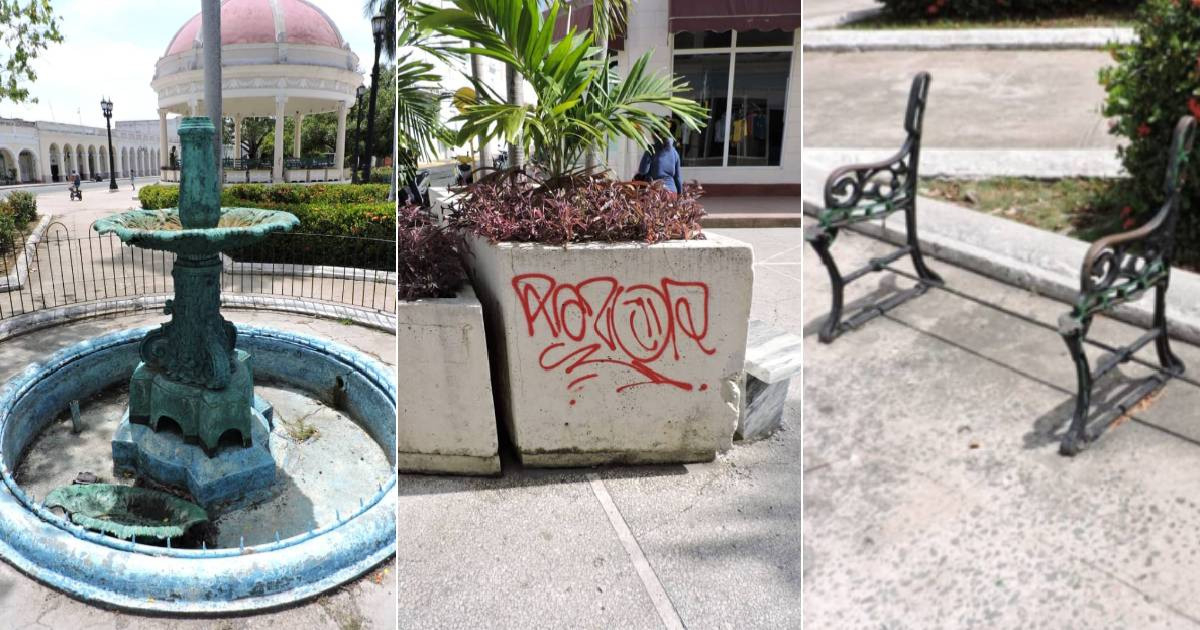
The official newspaper, 5 de Septiembre, has raised concerns about the escalating vandalism and mounting garbage in the public areas of Cienfuegos, as efforts are ongoing to portray the so-called Pearl of the South as an idyllic city.
An article published on Tuesday by the provincial Communist Party paper highlighted the decline of the central José Martí park, noting benches without slats, missing railings, and fountains "drowned in their own filth."
The monument dedicated to the Cuban National Hero is also depicted as "increasingly unprotected," according to the report.
The boulevard's planters are equally affected by neglect. The newspaper pointed out the presence of graffiti, ironically likening the perpetrators to the controversial British street artist Banksy but criticizing these acts as purposeless.
The issue extends to litter accumulation in the streets. 5 de Septiembre lamented a "'Sierra Escambray' of filth mounds everywhere," exacerbated by the lack of trash bins, many of which have been "severed from their bases or completely removed."
The article attributes some of the deterioration to a "selfish and repulsive minority" that acts against citizens' rights to enjoy a well-maintained city. The blame was placed not only on vandalism but also on the neglect of public spaces.
However, the critique also targeted the authorities, warning that without "strong action" to curb impunity and a more robust presence of those enforcing regulations, Cienfuegos might revert to its previous state of decay.
As a solution, the newspaper advocated for a public debate to update urban regulations and establish penalties for damaging public spaces. Suggested measures include fines equivalent to a minimum wage and mandatory community service.
This denunciation emerges as the official press promotes initiatives to showcase a revitalized city, highlighting rejuvenated spaces, new projects, and elements aimed at enhancing Cienfuegos's tourist appeal.
Founded in 1819 by French settlers as Fernandina de Jagua, and recognized as a UNESCO World Heritage Site since 2005, the city faces a dual threat: structural neglect by the State and active destruction by those who, as noted by the newspaper, turn public spaces into scenes of their own despair.
In June 2025, the same source reported garbage buildup on major arteries like Prado, San Fernando, and 5 de Septiembre Avenue, while the state-run Comunales company blamed collection failures on fuel shortages.
Last June, residents of the Tulipán neighborhood reported an improvised dump on 75th Street, across from buildings inhabited by children and the elderly. One resident described San Carlos Avenue as having only one passable lane: "the other half is garbage from the sidewalk to the middle of the street."
Additionally, a resident of Santa Clara Street, between 50th and 53rd Streets in Cienfuegos, complained on Facebook about the lack of trash collection for over a month in his block.
Vandalism is not exclusive to Cienfuegos. Recently, spray-painted graffiti defaced Camagüey's Ignacio Agramonte Park, a UNESCO Cultural Heritage Site, while in August, planks were ripped from the benches at Plaza de Marte in Santiago de Cuba, and the bust of Antonio Maceo was toppled in Las Tunas.
Understanding the Vandalism Crisis in Cienfuegos
What are the main issues caused by vandalism in Cienfuegos?
Vandalism in Cienfuegos has led to missing bench slats, vanished railings, graffiti, and clogged fountains with trash in public areas, contributing to the city's decay.
How is the garbage issue affecting Cienfuegos?
The accumulation of garbage in Cienfuegos is worsening due to a lack of trash bins and inadequate waste collection, creating unsightly and unhygienic conditions in public spaces.
What measures are being proposed to combat vandalism and neglect?
Proposed measures include updating urban regulations, imposing fines equivalent to a minimum wage, and requiring community service for those who damage public areas.