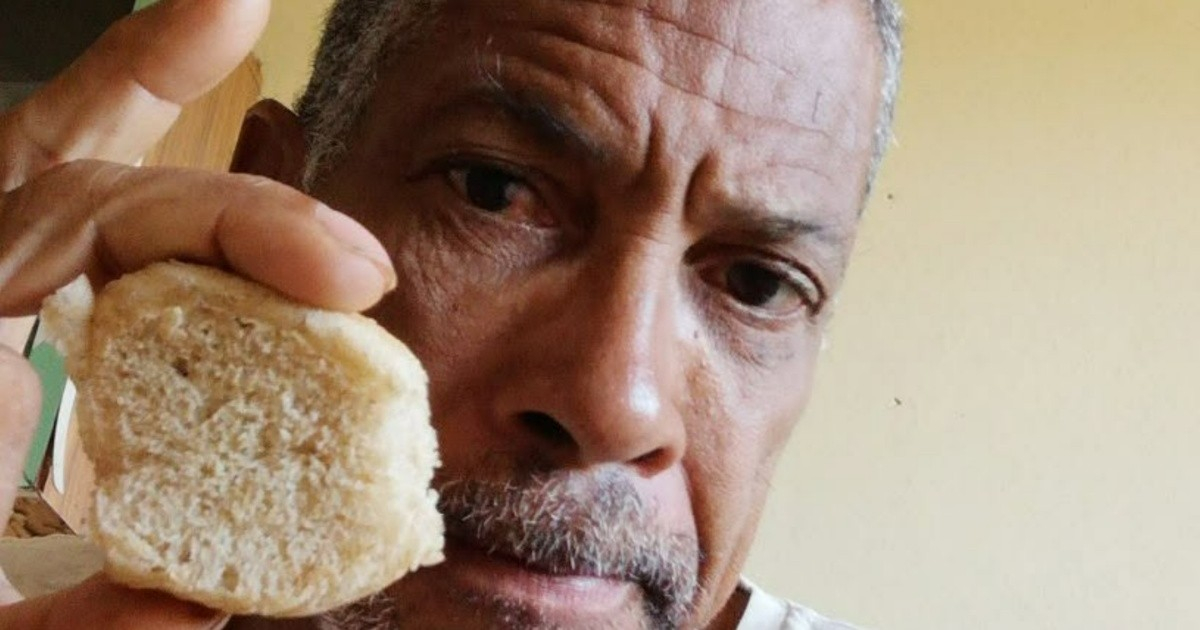
A Cuban citizen, Roberto D J Morales, took to Facebook to express his outrage over the poor quality of the rationed bread he received. In his post, he revealed a loaf split open to reveal its subpar condition, questioning if such a product is fit for human consumption.
"Do we really deserve this garbage they call bread? I won't hide my face, I have nothing to conceal. This is disgraceful," Morales wrote, appearing in a photo with a look of disapproval as he held the piece of bread up to his face.
Morales pointed out that each piece of bread doesn't even weigh 75 grams and that his salary doesn't allow him to buy bread from the informal market, where prices range from 450 to 2,200 pesos per loaf depending on the type. "If my salary allowed me to buy this every day, I think I'd only use it to feed animals: chickens, pigs, rabbits," he added.
Recurring Complaints About Rationed Bread
Throughout 2026, citizens from various provinces in Cuba have reported that rationed bread often arrives underweight, poorly baked, with acidity, mold, black spots, or a sour smell.
In June, decomposed bread was reported in Santiago de Cuba. By July, Guantánamo residents complained about bread with high acidity, lacking fat and salt, and developing dark spots shortly after being made. In August, new images of substandard bread from Santiago sparked fresh outrage on social media.
Structural Issues Behind the Crisis
Underlying this crisis are structural problems that the Cuban regime has failed to address. Cuba requires about 20,000 tons of wheat flour each month to supply rationed bread. However, as of June 2026, only one out of six contracted shipments for the year had arrived, highlighting the ongoing flour shortage. Power outages, fuel shortages, and the use of alternative flours like cassava, sweet potato, or corn further complicate the situation.
The official weight of rationed bread had already been reduced from 80 to 60 grams per loaf since September 2024 due to flour shortages. By 2026, some provinces saw portions drop to as low as 40 grams.
The Burden of Private Market Prices
The private market offers an alternative, but at prices beyond the reach of most Cubans. Since July 2026, the Cuban Bread Company in Havana has set prices at 110 Cuban pesos per 100 grams and 550 pesos per half kilo. In private bakeries, a bag of six loaves can cost the equivalent of an entire monthly minimum wage, which from July 2026 was set at 3,210 pesos.
In Santiago de Cuba, reports have surfaced of bread bags costing up to 700 pesos, while earlier this year, complaints arose about the rationed rolls being "almost the size of an egg," with accusations of theft during production.
Impact of Hoarding on Bread Availability
The situation is exacerbated by hoarding: this month, cases have been reported of resellers stockpiling rationed bread to sell it at inflated prices, depriving the most vulnerable of their only daily subsidized food.
Understanding Cuba's Bread Crisis
Why is there a shortage of flour in Cuba?
Cuba faces a flour shortage due to the failure to receive contracted shipments, power outages, and fuel shortages, which hinder production and distribution.
How do private market prices for bread compare to government rationed prices?
Private market prices are significantly higher, with a bag of six loaves often costing the equivalent of a full monthly minimum wage, unlike the government rationed bread which is subsidized but of poor quality.
What is the impact of bread hoarding in Cuba?
Hoarding leads to inflated prices in the black market and restricts access for those who rely on the subsidized bread as a primary food source.