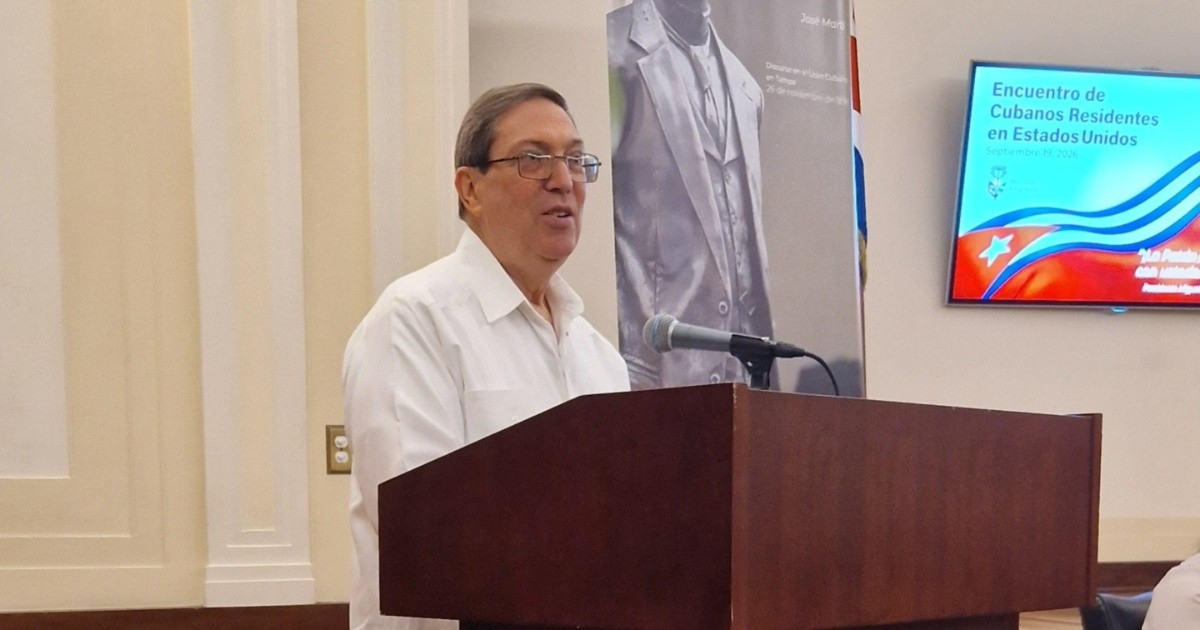
During an event in New York coinciding with the United Nations General Assembly, Cuban Foreign Minister Bruno Rodríguez Parrilla emphasized on Saturday that the Cuban regime is making significant efforts to integrate Cuban expatriates. This statement was made at the National Meeting of Cuban Residents in the United States.
Rodríguez shared his remarks on the social media platform X, noting that the gathering took place during the High-Level Segment of the 81st session of the UN General Assembly.
"I highlighted the crucial work our country is doing to foster better relations and integration of compatriots who reside, or spend extended periods, outside Cuba, as well as their descendants," the Foreign Minister stated.
The speech mixed a welcoming tone towards the diaspora with the regime's usual narrative concerning U.S. sanctions.
Rodríguez criticized the embargo, calling it a "collective punishment" against the Cuban people and deemed it an unjustifiable "cruel crime."
He also condemned what he described as "the reinforcement of U.S. aggression against Cuba" and its "ruthless impact" on Cuban families, omitting any acknowledgment of the government's role in the island's ongoing crisis.
The regime's outreach to the diaspora is backed by legal measures: Cuba announced new migration laws—Law 171 on Migration, Law 172 on Citizenship, and Law 173 on Foreigners—in May 2026, which will take effect in November.
Among the notable changes is the removal of the 24-month limit abroad that results in the loss of Cuban residency, now replaced by "effective migratory residency" based on family, work, economic, or property ties.
The human rights organization Cubalex criticized these regulations for perpetuating a discretionary control system over Cubans' mobility instead of providing genuine rights to the diaspora.
Rodríguez's visit to New York has been packed with diplomatic engagements. On Thursday, he met with the Chinese Foreign Minister in what was described as a "fruitful" meeting. On Friday, he criticized a Harvard report on Cuba, dismissing it as "pseudoscientific" and an attempt to "confuse and manipulate."
The report, released in early September, directly blames the Cuban government for the island's crisis and suggests a new constitutional assembly, amnesty for political prisoners, and a social market economy.
In bilateral matters, Rodríguez admitted earlier this month that talks between Cuba and the United States are "stalled" with no progress, contrasting with the conciliatory tone he adopted towards the diaspora on Saturday.
Cuba plans to bring the issue of the embargo to the UN General Assembly once again on October 27 and 28, 2026, marking another chapter in the regime's diplomatic efforts at the multilateral organization.
Understanding Cuba's Diplomatic Stance and Migration Laws
What are the new Cuban migration laws?
The new migration laws include Law 171 on Migration, Law 172 on Citizenship, and Law 173 on Foreigners. A significant change is the removal of the 24-month limit abroad for maintaining Cuban residency, replaced by criteria like family or economic ties.
How has Cuba responded to U.S. sanctions?
Cuba has condemned U.S. sanctions, describing them as a "collective punishment" and a "cruel crime" against its people, while highlighting their adverse effects on Cuban families.
What was the focus of Bruno Rodríguez's speech in New York?
His speech focused on Cuba's efforts to integrate its diaspora and criticized U.S. sanctions. It also highlighted the regime's diplomatic initiatives and new migration laws.