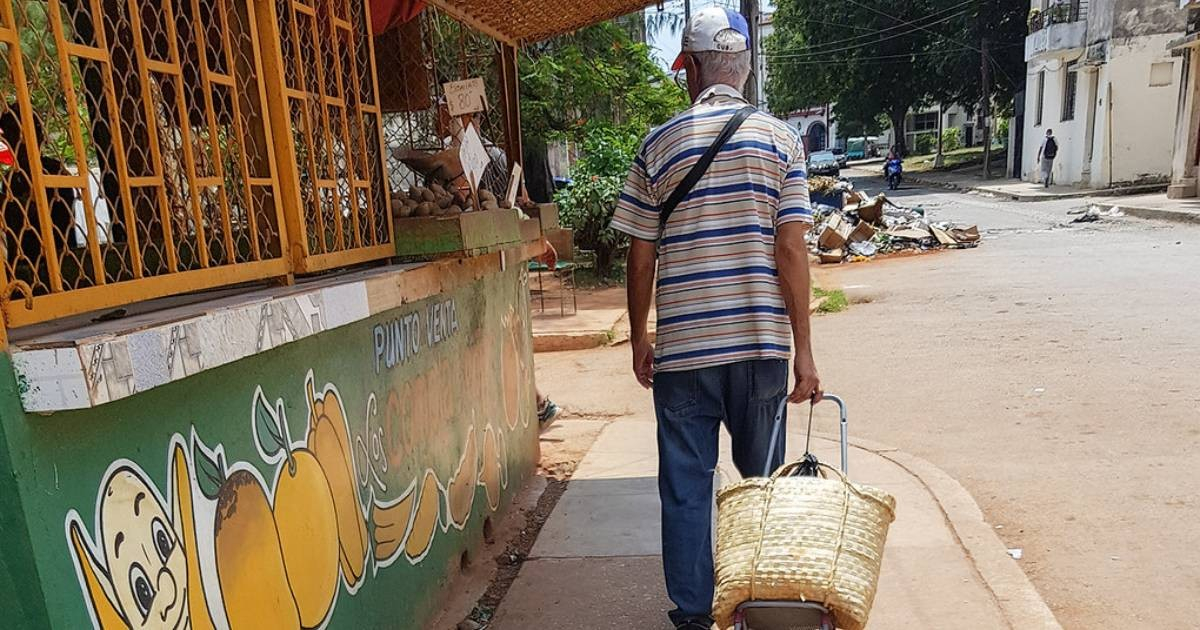
A simple remark overheard from a loved one inspired Arnoldo Fernández, a writer, journalist, and historian based in Contramaestre, Santiago de Cuba, to craft one of the most poignant portraits of hunger in Cuba. His Facebook post, titled "Cuba: The Country Where Hunger Learned to Speak of Food," has resonated deeply with Cubans both on the island and abroad this week.
The genesis lies in a phrase uttered by someone Fernández holds dear: "Cubans live to eat. We don't eat to live."
From this, Fernández unfolds an intimate essay that transcends political commentary, presenting instead an emotional dissection of chronic scarcity.
The Daily Struggle for Food
"In Cuba, discussing food is not a casual conversation. It's a way of narrating the day. It's about what surfaced, what's missing, what was found, what was lost, and what can be concocted with the scant resources available," writes Fernández.
His reflection delves deeper, exploring how hunger infiltrates thoughts, dreams, and even the language of an entire nation.
"Our lives are consumed with thoughts of what we will eat next. Although it may seem like a domestic habit, it is one of the most insidious ways hunger penetrates a society," the author observes.
Imaginary Feasts and Stark Realities
Fernández illustrates how Cubans have become adept at imagining flavors they've never tasted, celebrating what would be a mundane meal elsewhere as a feast.
"There are flavors we know exist, much like some countries—aware of their presence, yet unfamiliar," he writes with a painful precision.
The narrative also captures the experience of Cubans who emigrate, only to be bewildered by abundance—not just in markets, but in the sheer discovery of things that were once confined to their imagination.
For Fernández, this collective preoccupation with food does not denote a gluttonous people, but rather one that has endured prolonged hunger.
"Hunger doesn't always wear the face of someone who hasn't eaten. Sometimes it's the face of someone who eats but cannot choose, who fills their plate but worries about tomorrow," he notes.
Alarming Statistics and Emotional Toll
His conclusion is as simple as it is devastating: "Talking about food every day doesn't necessarily mean a love for it. Sometimes it signifies a profound lack."
Fernández's reflection is not an isolated perception. Data confirms that Cuba's food crisis is the worst in decades. The "In Cuba There's Hunger 2025" survey, conducted by the Food Monitor Program and Cuido60 with responses from over 2,500 households across 16 provinces, revealed that 33.9% reported at least one family member went to bed hungry in the past 30 days, a nine-point increase from 2024.
A staggering 79.4% of families allocated 80% or more of their income solely to food, with 40.6% spending everything they earned just on sustenance.
National production has plummeted between 2018 and 2023: pork by 95%, rice by 87%, beans by 70%, and milk by 58%, while Cuba imports around 80% of its food at an annual cost of approximately $2.4 billion.
The repercussions extend beyond hunger. A study published in Social Science & Medicine found that 55.4% of surveyed Cuban adults suffered from extremely severe depression, 66% from severe anxiety, and 65.8% from extreme stress.
Testimonies gathered in August depict the daily ordeal of "solving" food as a "constant psychological torture" and an "unrelenting physical and emotional drain."
According to a March survey this year, 80% of Cubans believe the current crisis is worse than the "Special Period" of the 1990s.
Fernández concludes his piece by rephrasing the initial thought: "Perhaps we don't live to eat. Perhaps we have spent too long living around hunger. And when hunger becomes a habit, it ends up occupying everything: conversations, memories, dreams, worries, visits, celebrations. Even the language itself."
Understanding Cuba's Food Crisis
What sparked Arnoldo Fernández's reflection on hunger in Cuba?
A remark from a loved one that "Cubans live to eat" inspired Arnoldo Fernández to write a poignant essay about the pervasive hunger in Cuba.
How severe is the current food crisis in Cuba?
According to recent surveys, Cuba is facing its worst food crisis in decades, with significant declines in domestic production and a high percentage of income spent on food.
How does the food scarcity impact Cuban society beyond hunger?
The food scarcity in Cuba is linked to severe depression, anxiety, and stress among adults, indicating a deep emotional and psychological impact on society.