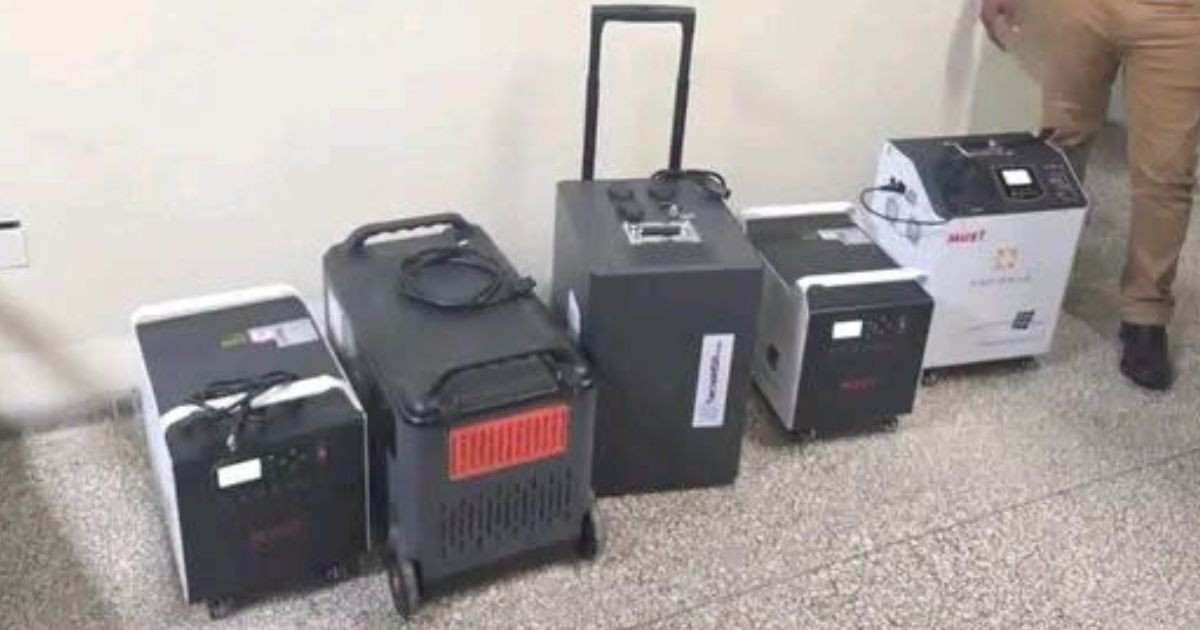
In a significant move, several private enterprises in Villa Clara have donated backup electrical systems to local hospitals. This initiative aims to bolster the operation of anesthesia machines, ensuring the welfare of critically ill patients amidst potential generator failures due to prolonged operation hours.
Official journalist Henry Omar Pérez shared on Facebook this Friday that the delivery followed a call to action by the Communist Party of Cuba (PCC) and the provincial government, coordinated by the UNURE.
As Pérez explained, these private enterprises provided EcoFlow devices to "support the anesthesia machines for critically ill patients in the intensive care units of provincial hospitals."
Pérez noted that while fuel for the generators is currently secured, a pressing concern remains: "Their technical condition could deteriorate due to excessive operational hours."
This acknowledgment highlights that the private sector's contributions are more than mere symbolic gestures; they offer essential security for medical equipment should the generators, crucial for maintaining services during blackouts, fail.
Community Reactions and Official Discourse
The journalist portrayed the donation, with the typical official romanticism, as a demonstration of the "sensitivity" of these private enterprises, publicly expressing gratitude for their assistance. However, the ensuing online discussion offered a different perspective.
One user remarked that donating such equipment was "the least they could do."
Pérez promptly defended the private businesses: "Who told you they are obligated to give anything? They do it out of goodwill, and you respond with a venomous comment," he retorted, adopting a confrontational tone akin to the regime's usual rhetoric on social media rather than engaging in a respectful exchange.
He further challenged: "The important thing is to know what your attitude would be if you had the money and capability. Would you contribute? My question is, what do you contribute, what do you do?"
The Role of Private Enterprises in the Healthcare System
This defense underscores a critical point: private enterprises are not required to provide resources to the state-run healthcare system.
It is these private businesses that are allocating their funds to strengthen vital hospital equipment, which relies on an electricity infrastructure severely strained by the ongoing energy crisis.
Moreover, this situation brings to light a stark reality: the Cuban state cannot independently secure the necessary backup power to protect essential equipment in its hospitals.
The reality, as evidenced in practice, confirms this truth.
Earlier in February, the Ministry of Public Health itself announced a contingency plan in response to energy challenges, which included reducing elective surgical activities and prioritizing urgent and emergency operations.
Months later, official sources admitted that over 100,000 surgical procedures were delayed in Cuba, a statistic that drew sharp criticism after state media attributed these delays to the impact of U.S. sanctions.
Electrical issues have also directly affected critical areas. In April, a blackout in the Intensive and Intermediate Care Units at the Saturnino Lora Provincial Hospital in Santiago de Cuba forced the evacuation of 12 patients, as confirmed by the hospital's management.
Questions about Villa Clara Hospital Support
Why are private enterprises donating to Villa Clara hospitals?
Private enterprises are donating backup electrical systems to support the operation of anesthesia machines in hospitals. This is crucial to maintain patient care during potential generator failures due to prolonged use.
What challenges do hospitals in Cuba face regarding power supply?
Cuban hospitals face significant challenges with power supply due to an overstrained electrical infrastructure and an ongoing energy crisis, leading to potential generator failures and the need for backup solutions.
How has the Cuban government responded to the energy crisis in healthcare?
The Cuban government announced a contingency plan to address energy challenges, prioritizing urgent and emergency surgeries while reducing elective surgical activities.