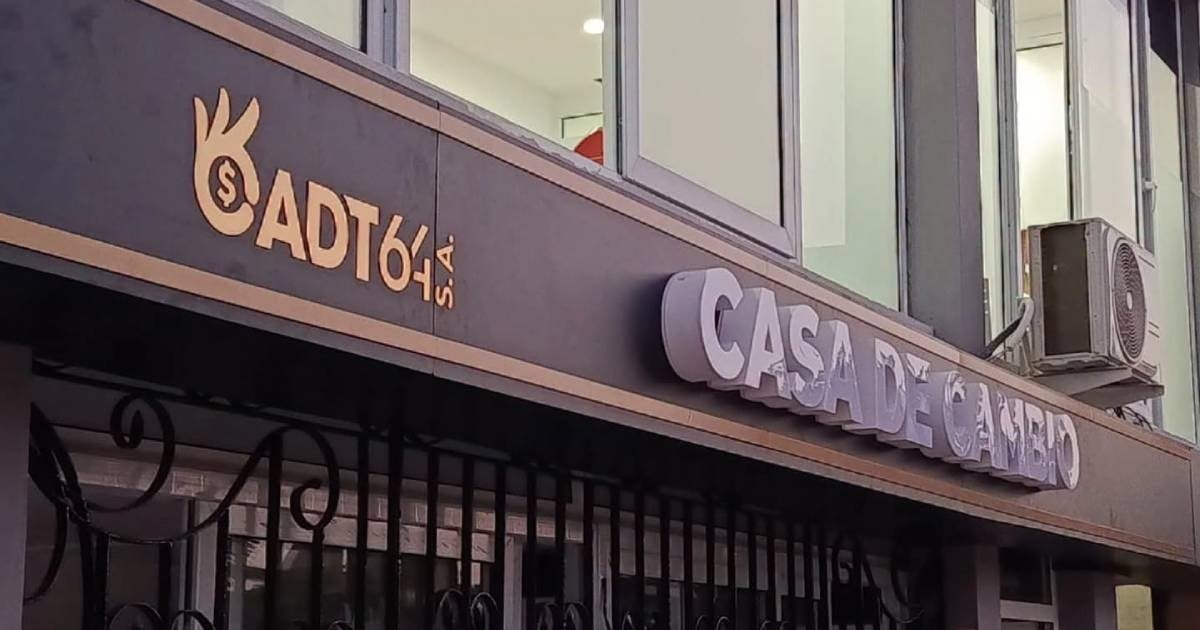
The launch of Cuba's first private currency exchange has drawn scrutiny from economist Pedro Monreal, who points out that its initial rates are revealing a significant trend: formal markets are emerging with pricing that is much closer to the informal market rather than to the Segment III official rate.
In a detailed analysis shared on Facebook, Monreal delved into the operations of ADT 64 in Santa Clara, critiquing the inaugural rates and the lack of detailed public information about the procedure the Central Bank of Cuba (BCC) used to issue licenses for such exchanges.
The initial pricing offered a stark comparison: on Tuesday, ADT 64's screen listed the dollar at 710 CUP for buying and 730 CUP for selling, paralleling the informal market's approximately 700 CUP, while the official Segment III rate hovered around 655 CUP per dollar.
However, a caveat is necessary: visitors to the establishment observed that while ADT 64 was indeed purchasing foreign currency, it had not yet started selling it, despite a displayed selling rate of 730 CUP.
Private Operators and Market Dynamics
Monreal asserts that the initial behavior of the exchange challenges the assumption that introducing private operators into the formal market would automatically lead to a cheaper dollar.
"The new venture isn't about making dollars cheaper; rather, it's set to price them at a level that maintains currency availability," he stated.
This places the BCC in a precarious position: if these private exchanges continue to align with informal market prices, the Segment III rate might have to adjust upward.
Conversely, if the Central Bank sticks to a managed rate that ignores the data from its own pilot, the initiative could lose the value the authorities have ascribed to it.
Challenges in Establishing a National Reference Rate
According to Monreal, the role of ADT 64 extends beyond mere currency transactions; the BCC confirmed that the exchange's operations are being leveraged as data points to support the official Segment III rate.
Ian Pedro Carbonell Karell, who oversees the BCC's payment system, clarified that the data stem from "real, settled, and confirmed exchange operations," not from speculative offers seen on social media.
Monreal differentiates between an operational test and one that can provide statistically significant data to set a national rate. A single exchange, or even a small number, might suffice to test operational aspects like cash handling or security but would be inadequate for setting a national benchmark.
He proposed that a minimum of 10 exchanges across at least five provinces, including Havana, might be necessary for a meaningful sample. A more robust model could require 20 to 25 exchanges located in the capital, various interior cities, airports, and tourist areas.
Openness and Regulation Concerns
Monreal also criticized the transparency of the model, describing it as a "pilot with opaque access." He noted that despite at least one operator being licensed, no specific public regulations explain how others might obtain similar licenses.
Though Cuba has general financial system and currency market regulations, such as Decree-Law 362 of 2018 and BCC resolutions 127 and 128 of 2025, there is no specific provision detailing criteria for private exchanges, including minimum capital, eligibility, or reporting obligations.
This lack of publicly known rules currently renders the authorization process a discretionary power of the BCC, rather than a transparent procedure accessible to all interested parties.
Monreal concludes that it's too early to ascertain the true objective of this experiment—whether it's merely to test operational functionality or to establish a significant statistical reference influencing the official rate.
"Until that becomes clear, the uncertainty remains: Is this a test of the business's viability, or an attempt to gauge the system with an insufficient number of data points?" he questioned.
The project's rollout has been shadowed by a lack of information. When it was officially announced that the first private exchange was operational in Santa Clara, authorities initially withheld its name, ownership details, location, operating hours, currencies handled, commissions, and transaction limits.
Eventually, it was disclosed that ADT 64 began operations on September 14, and its early public rates even surpassed those in the informal market at the time.
FAQs on Cuba's New Private Exchange
What is the significance of ADT 64 in Cuba's currency market?
ADT 64 is the first private currency exchange in Cuba, marking a shift towards formal market operations. Its initial rates closer to the informal market highlight potential implications for the official Segment III rate.
Why is Pedro Monreal critical of the new exchange?
Pedro Monreal criticizes the exchange for its lack of transparency and for setting rates near those of the informal market, challenging expectations that private operators would lower the dollar's cost.
How might the private exchange affect Cuba's official rate?
If private exchanges like ADT 64 continue to align with informal market rates, it may pressure the official Segment III rate to adjust, potentially affecting its stability.