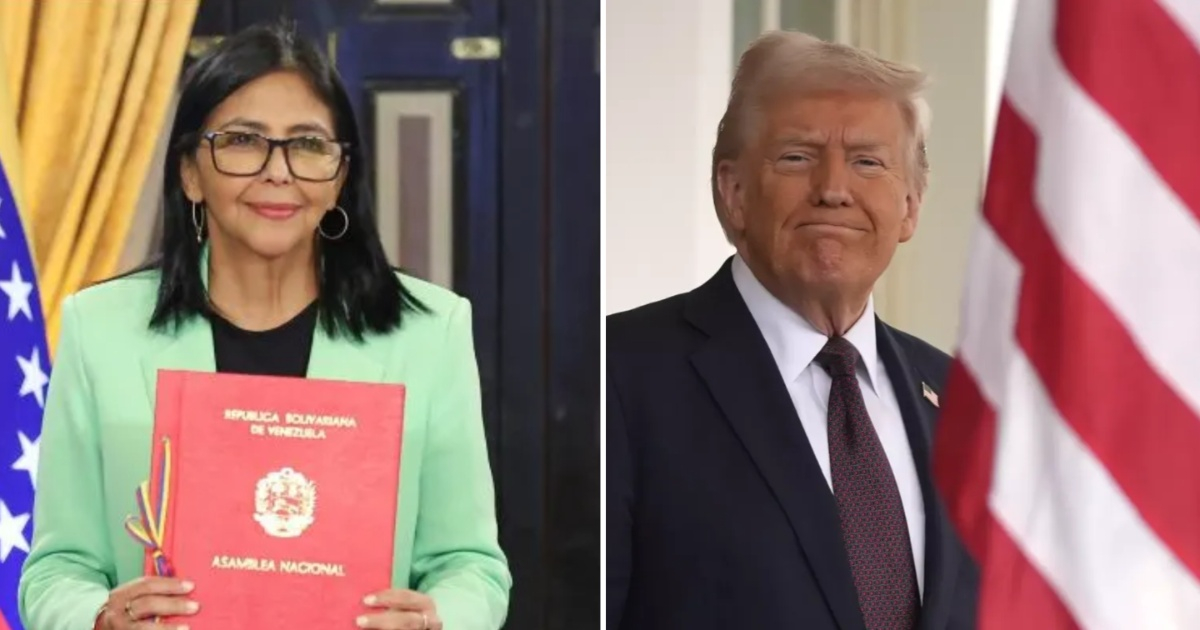
This Friday, the White House confirmed that President Donald Trump is scheduled to meet with Venezuela's interim president, Delcy Rodríguez, next week in New York. This meeting will take place alongside the United Nations General Assembly, as reported by the Associated Press.
U.S. Ambassador to the UN, Mike Waltz, made the announcement during a press call with journalists. Waltz clarified that the meeting will be a "pull-aside" format—a more casual and brief interaction compared to a formal bilateral meeting, lacking seated delegations, a specific agenda, or a joint press appearance.
This marks the first in-person encounter between the two leaders. According to journalist David Alandete, it represents "the clearest signal yet of Washington's evolving relationship with the head of the Venezuelan regime following the capture of Nicolás Maduro."
Trump himself hinted at the potential meeting a few days before aboard Air Force One when he answered media queries with a noncommittal "maybe, maybe."
Diplomatic Thaw Between Washington and Caracas
The meeting follows a swift diplomatic thaw between Washington and Caracas, initiated on January 3, 2026, when U.S. forces captured Maduro in Caracas during "Operation Absolute Resolution" and brought him to the United States to face drug trafficking charges.
After this operation, Rodríguez, who was vice president, assumed the role of interim president, and the Trump administration acknowledged the new Venezuelan government. The two leaders had their first phone conversation on January 14, where Trump described Rodríguez as "a fantastic person," while she referred to the dialogue as "long, productive, and courteous."
Since then, normalization of relations has progressed rapidly. On April 1, the United States removed Rodríguez from the Office of Foreign Assets Control (OFAC) sanctions list, where she had been listed since September 2018.
Historic Oil Deal and Continued Criticism
By the end of August, Trump announced a historic oil agreement: the private firm North American Blue Energy Partners secured rights to 17 Venezuelan oil fields with over 65 billion barrels of proven reserves, with the U.S. Department of Defense holding a 35% stake in the company.
On September 16, Trump removed Venezuela from the list of countries failing to meet anti-drug commitments, adding another gesture of détente to the agenda for next week in New York.
However, not all reactions have been positive. Opposition leader María Corina Machado questioned the legitimacy of the oil deal, warning, "The wealth of our land does not belong to an illegitimate regime."
Upcoming Meetings with Global Leaders
During the high-level week of the General Assembly, which runs from September 22 to 26, Trump is also slated to meet with British Prime Minister Andy Burnham—their first meeting since Burnham took office in July—and Japanese Prime Minister Sanae Takaichi, as well as leaders from the Gulf Cooperation Council.
This encounter with Rodríguez will be the first between a U.S. president and a Venezuelan leader in over eleven years, since the brief exchange between Barack Obama and Nicolás Maduro at the 2015 Summit of the Americas in Panama.
FAQs on Trump and Delcy Rodríguez's Meeting
What is the significance of Trump's meeting with Delcy Rodríguez?
The meeting signifies a significant diplomatic shift and potential thaw in relations between the U.S. and Venezuela, especially after the capture of Nicolás Maduro and the recognition of Rodríguez's interim government by the Trump administration.
What are the implications of the oil deal announced by Trump?
The oil deal, involving significant U.S. interests and a private firm, could reshape the economic landscape of Venezuela and strengthen ties between the two nations. However, it also faces criticism regarding its legitimacy and implications for Venezuelan sovereignty.