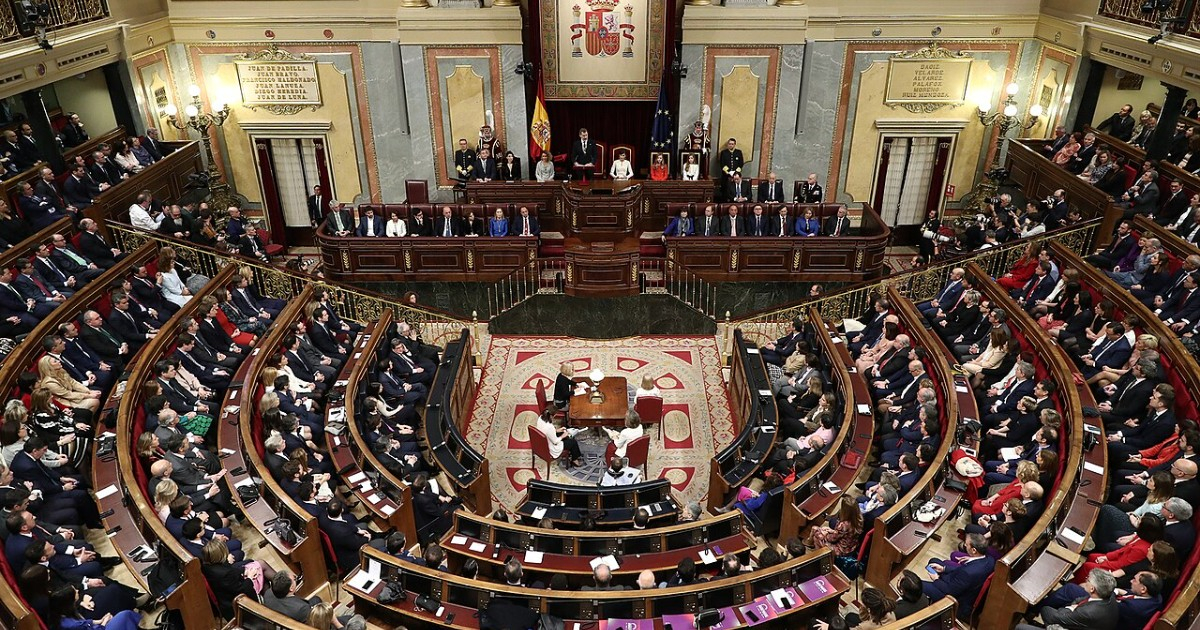
The Spanish Congress of Deputies has dismissed a proposal from the Sumar party that aimed to encourage the government to lead a European Union stance favorable to Cuba. This initiative sought to counteract U.S. economic measures and enhance cooperation with the island's regime in key sectors.
According to EFE, the non-binding proposal was rejected with 170 votes against, 163 in favor, and 13 abstentions.
The vote was conducted on the text that included an amendment from the Socialist Group.
Originally, Sumar's initiative urged the Spanish government to continue demanding the removal of the U.S.'s "economic, commercial, and financial blockade" against Cuba and to lead a EU opposition to these measures.
It further suggested bolstering collaboration with Cuba, especially in areas such as energy, food, and pharmaceuticals.
Debate and Opposition from Various Parties
During the debate, Sumar's Enrique Santiago held the U.S. policy responsible for worsening the Cuban people's condition and urged parliamentary groups to set aside "political and ideological considerations" in support of the proposal.
However, the text faced resistance from various parties for different reasons.
Junts' Isidre Gavin expressed opposition to sanctions but rejected the notion that the island's "poverty and misery" could be attributed mainly to former U.S. President Donald Trump. Gavin argued that the primary blame lies with a "leftist dictatorship," as reported by EFE.
Vox's Andrés Alberto Rodríguez criticized the initiative as a "political and moral absurdity," questioning the expectation that Spain's government would "shield the Cuban dictatorship" within the EU.
Criticism of the Proposal's Scope
People's Party's Belén Hoyo pointed out that the proposal did not mention the "dictatorship," "political prisoners," "censorship," "repression," or "persecution" in Cuba.
Alberto Catalán from the Union of the Navarrese People (UPN) called the initiative "self-serving and hypocritical."
PNV's spokesperson, Maribel Vaquero, shared her party's opposition to U.S. measures but deemed the proposal insufficient, arguing that any stance on Cuba must also denounce "regime repression."
Other Perspectives and European Context
PSOE's Rafaela Romero advocated for distinguishing between supporting the Cuban populace and backing Havana's authorities. Romero stressed that defending the Cuban people against U.S. measures "does not equate to defending the government" of Cuba and questioned using the population's suffering as leverage for political change.
In contrast, BNG's Néstor Rego supported backing Cuba as a means to protect national sovereignty, while Podemos' Javier Sánchez Serna demanded tangible solidarity, suggesting military aid and sending oil tankers to the island.
ERC and EH Bildu members also voiced criticism of Washington's stance. Republican Jordi Salvador urged "less talk and more action," whereas Jon Iñarritu questioned U.S. foreign policy towards adversarial nations.
The vote in the Spanish Congress follows several decisions and statements from European institutions regarding relations with Havana.
In May, the EU's High Representative for Foreign Affairs, Kaja Kallas, confirmed a review of the Political Dialogue and Cooperation Agreement between the EU and Cuba. Kallas acknowledged the agreement had "not yielded the expected results" and called for economic reforms and greater openness from Cuban authorities.
A month later, on June 18, the European Parliament approved a resolution advocating individual sanctions against Miguel Díaz-Canel and called for suspending the agreement with Cuba. The resolution passed with 283 votes in favor, 199 against, and 85 abstentions, also demanding actions against GAESA leaders and the release of political prisoners.
In July, during a UN General Assembly debate on the U.S. embargo, the EU reiterated its opposition to such sanctions but maintained that Cuba's crisis cannot be solely attributed to the embargo, urging political and economic reforms, as well as respect for human rights and the release of arbitrarily detained individuals.
Frequently Asked Questions about the Spanish Congress and Cuba
What was the proposal presented by the Sumar party?
The Sumar party proposed that the Spanish government lead a European Union stance favorable to Cuba, counteracting U.S. economic measures and enhancing cooperation with the Cuban regime in key areas.
How did the Spanish Congress vote on this proposal?
The proposal was rejected with 170 votes against, 163 in favor, and 13 abstentions.
What were the main criticisms of the proposal?
Critics argued the proposal failed to address issues like the Cuban dictatorship, political prisoners, censorship, and repression. Some viewed it as politically and morally absurd.