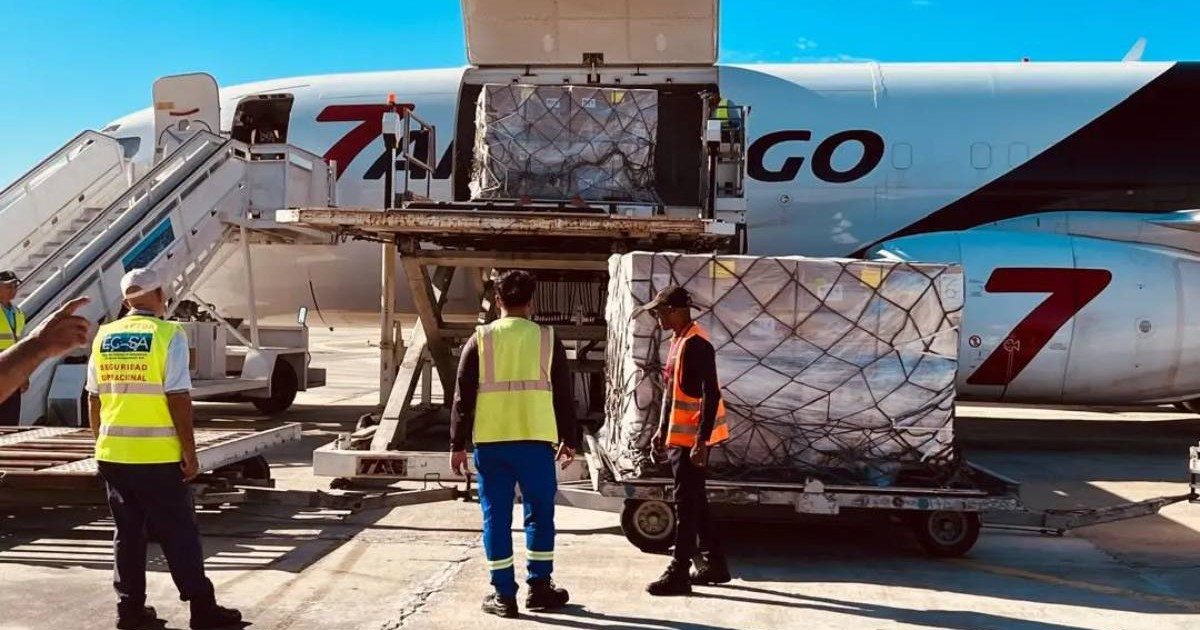
On Thursday, a fresh shipment of humanitarian aid from the United States government touched down at Abel Santamaría International Airport in Santa Clara, destined for the Diocese of Cienfuegos.
Cáritas Cuba announced that the shipment was received by Father Manel Homar Toboso, the vicar general of the Diocese of Cienfuegos, and Ana Isabel Palenque Guillemí, director of Cáritas Cienfuegos.
This delivery, similar to previous ones, includes 700 food kits and 700 hygiene product kits. Distribution will begin immediately through the Parish of Lajas and its surrounding communities.
Volunteers from Cáritas will directly deliver these kits to homes previously identified as experiencing food insecurity and limited access to water.
The selection criteria focus on supporting the most vulnerable groups: seniors over 60, individuals with disabilities or bedridden, pregnant or nursing women, and children under five years old.
This aid shipment arrives just a day after the U.S. Embassy in Cuba announced new deliveries for five provinces: Camagüey, Ciego de Ávila, Cienfuegos, Matanzas, and Pinar del Río.
The diplomatic mission reported a meeting with Carmen María Nodal Martínez, the director of Cáritas Cuba, to coordinate these upcoming shipments and praised Cáritas' efforts in supporting the Cuban people.
The consignment to Cienfuegos is part of a $100 million humanitarian program approved by the U.S. administration. Of this, $60 million is funneled through the Cuban Catholic Church — via Cáritas Cuba and Catholic Relief Services — while the remaining $40 million is distributed through other independent organizations.
The Church has clarified that Cáritas does not receive these funds in cash. Instead, the money is used to purchase the products in the United States and cover distribution logistics, ensuring the Cuban government does not intervene at any stage.
The program officially commenced on July 21, with the first shipment of nearly 18 tons of supplies departing Miami, and initial local deliveries made in Bejucal and Alquízar.
In early September, a similar shipment landed in Santa Clara for families in Quemado de Güines and Rancho Veloz, Villa Clara. U.S. Ambassador Mike Hammer visited the province from September 13 to 15 to personally oversee the distribution.
This Thursday's delivery to the Pearl of the South marks the program's expansion into the southern region. The Diocese of Cienfuegos covers the province of the same name and the municipality of Trinidad in Sancti Spíritus, consisting of 22 parishes.
The entire program is projected to benefit between 100,000 and 120,000 families across Cuba. However, Arturo González Amador, the bishop of Santa Clara, cautioned from the outset that the reach is limited, stating, "This is humanitarian aid, not a permanent social assistance project."
U.S. Humanitarian Aid to Cuba: Key Questions Answered
What is the purpose of the U.S. humanitarian aid shipment to Cuba?
The shipment aims to provide immediate relief to vulnerable populations in Cuba by supplying food and hygiene kits to those experiencing food insecurity and limited access to water.
Who receives the aid in Cuba?
The aid targets the most vulnerable groups, including seniors over 60, individuals with disabilities, pregnant or nursing women, and young children.
How is the aid program funded and managed?
The program is funded by a $100 million budget from the U.S. government, with $60 million managed through the Cuban Catholic Church and the remainder through other independent entities.