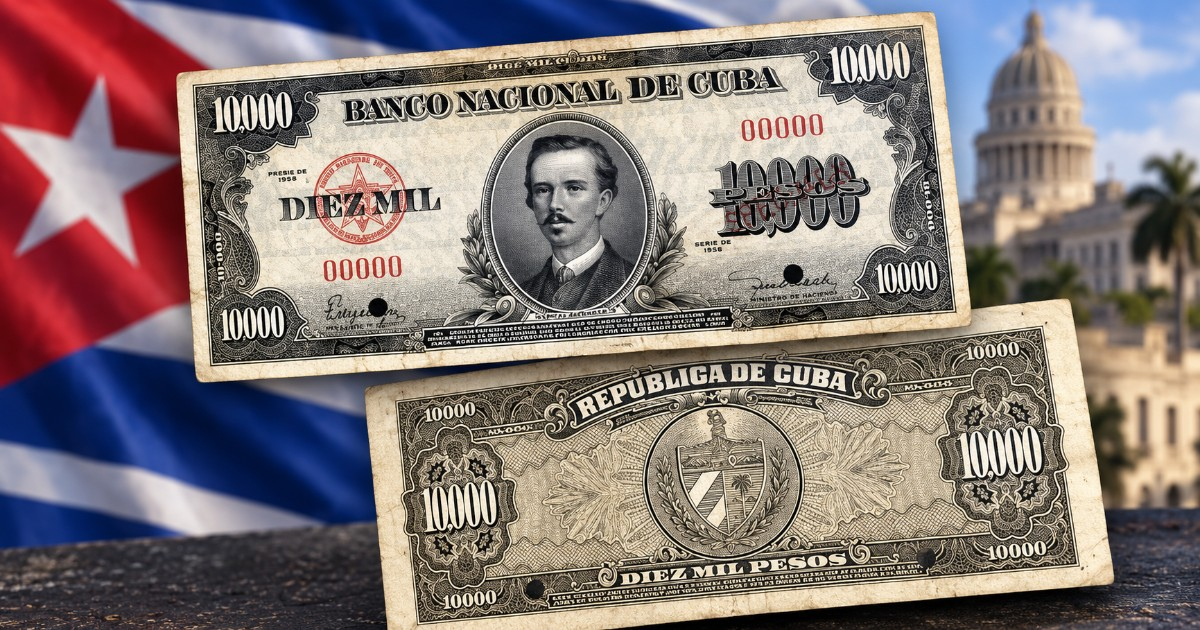
The introduction of 10,000 and 20,000 Cuban peso bills is not an economic remedy but rather a sign of a deep-rooted crisis, according to Cuban economist Pedro Monreal. He warns that the Cuban peso is losing its function as a measure of labor value.
On Tuesday, Monreal shared his insights in an analysis titled "When a Bill is Worth More Than a Month's Salary," in reaction to the Central Bank of Cuba's (BCC) announcement of these new high-denomination bills, which are now the largest ever released on the island.
Economic Imbalance Highlighted
Monreal draws a stark comparison: the minimum wage in Cuba is approximately 3,210 CUP monthly, with the average state salary just above 7,000 CUP. This means a single 20,000 peso bill represents nearly three average paychecks.
"The 'technical solution' prevails over economic and political logic. When labor loses its incentives, the structural crisis becomes permanent," Monreal commented on his X account.
Contrasting with Stable Economies
In stable economies, the highest denomination bill is only a small part of the average monthly income. For instance, a $100 bill compared to an average income of about $6,000 in the United States or a 10,000 yen bill with an income of around 400,000 yen in Japan.
"When the highest value bill greatly exceeds the monthly salary, it typically indicates chronic inflation, monetary duality, or a dollarized circuit, not a payment system anchored in labor," Monreal cautioned.
Monetary System Criticism
Monreal argues that the gap is not a technical oversight but reflects who the Cuban monetary system truly serves: "The currency structure aligns with dollar-based commerce—remittances, foreign currency markets, and informal pricing—not with a demand rooted in wages and pensions."
The economist also criticized the 176 economic measures approved by the National Assembly in June, presented by Prime Minister Manuel Marrero Cruz.
According to Monreal, these measures "manage the duality but do not anchor the CUP to work outcomes," as they propose successive devaluations, currency exchanges, and greater partial dollarization without addressing the disconnect between the peso and labor income.
Official Justification and Public Reaction
Juana Lilia Delgado Portal, the BCC's president, justified the issuance of the new bills by citing "current pricing conditions and monetary circulation."
The 10,000 CUP bill features Haydée Santamaría and is mostly gray and green, while the 20,000 CUP bill depicts Vilma Espín in yellow and brown. Distribution started in Havana and will gradually extend nationwide.
Popular response on social media was filled with irony and frustration. "I guess they'll pay salaries every three months now," quipped one user. Another comment circulating was, "Now we're almost Colombians."
Worsening Economic Indicators
Monreal's analysis is further validated by the context: on Wednesday, the dollar in the informal Cuban market hit 700 CUP, setting a new record, while official inflation was reported at 20.70% annually in July. However, independent economists estimate it at around 70% when including the informal market.
This marks the second expansion of the currency system in under six months, with 2,000 and 5,000 CUP bills introduced on April 1, also due to cash shortages. Cuba's basic basket is estimated at about 96,000 CUP monthly, a gap nearly 30 times the current minimum wage.
Understanding Cuba's Currency Crisis
Why are new high-denomination bills being introduced in Cuba?
The new 10,000 and 20,000 peso bills are being introduced as a response to the country's economic conditions, specifically addressing cash shortages and inflation. However, they also reflect deeper structural issues within the Cuban economy.
What does the introduction of these bills indicate about Cuba's economy?
The introduction of these high-denomination bills suggests chronic inflation and a monetary system that is increasingly disconnected from labor value, highlighting the systemic economic challenges Cuba faces.
How does the Cuban peso compare to other currencies?
In stable economies, high denomination bills represent a small fraction of monthly income, unlike in Cuba. In the U.S., for example, a $100 bill is a small part of the average monthly income of about $6,000.