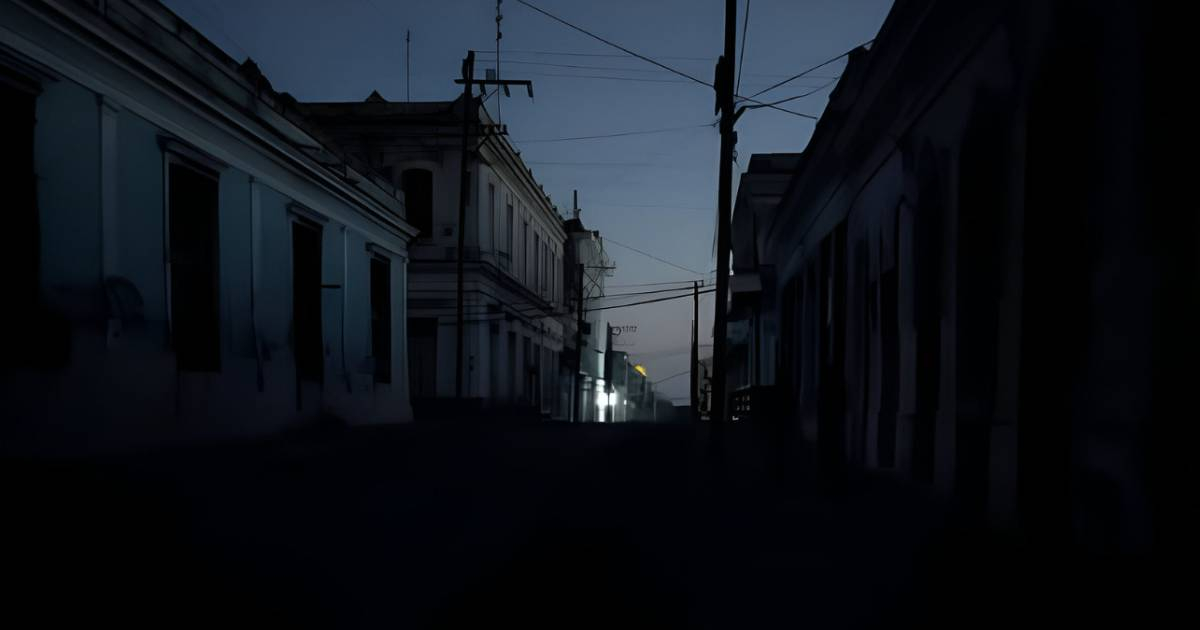
On Tuesday, Cuba endured yet another full day of power outages, with the maximum shortfall reaching 2,168 MW by 8:10 PM, surpassing initial expectations. As of Wednesday, the electricity deficit is again projected to exceed 2,100 MW.
According to the official report from the Unión Eléctrica (UNE), the power supply was disrupted throughout the entire day on Tuesday and persisted into the early hours, with the National Electric System (SEN) unable to meet demand at any point.
The peak shortfall hit 2,168 MW due to the unexpected shutdown of unit 6 at the Máximo Gómez thermal power plant in Mariel, worsening an already dire situation.
Wednesday's Energy Forecast
For Wednesday's peak hours, UNE estimates an availability of merely 1,100 MW against a demand of 3,200 MW. If these conditions persist, a deficit of 2,100 MW and an impact of up to 2,130 MW are anticipated.
The forecast only accounts for the integration of 30 MW from unit 4 of Energás Varadero and 70 MW from unit 6 of the Nuevitas thermal power plant, which is far below the required capacity to meet demand.
Power Plant Challenges and Maintenance Issues
However, there was a slight change in the scenario outlined in the morning report. At 1:12 PM, UNE announced that unit 6 of the Máximo Gómez plant, which had caused Tuesday's higher-than-expected impact, was back online.
The deterioration of the thermal power infrastructure remains a significant issue. Five units are still out of order: units 5 and 8 in Mariel, unit 6 in Nuevitas, unit 2 in Felton, and unit 6 in Renté. Additionally, three units are undergoing maintenance in Santa Cruz, Renté, and Nuevitas.
Compounding the lack of thermal generation is a scarcity of fuel. A total of 106 distributed generation plants are halted due to this, along with the Regla and Melones barges and the fuel oil plants in Mariel and Moa.
Solar Energy Expansion Efforts
Meanwhile, authorities continue to invest in solar energy expansion. The Mayabeque Electric Company reported progress on the El Vidrio Solar Park in San José de las Lajas, where photovoltaic modules are being installed.
The state company stated that 214 solar panels had been set up at the site so far, although it did not specify when the park will become operational or its total capacity contribution to the SEN.
Solar parks that are already operational produced 4,784 MWh on Tuesday and reached a peak output of 744 MW during the period of highest sunlight. However, this contribution diminishes as the evening approaches, precisely when demand increases and the nighttime peak draws near.
Persistent Power Supply Crisis
The situation was already alarming by early Wednesday. Havana experienced 468 MW affected and 146 circuits out of service, while nationwide availability hovered around 1,000 MW compared to a demand of 2,750 MW.
September has seen several days with power disruptions near or above 2,000 MW. On September 5th, the shortfall reached 2,396 MW, while on September 1st, it was 2,292 MW, and the peak last Monday hit 1,915 MW.
In August, the Unión Eléctrica warned that the period from September to December would be particularly challenging, due to scheduled maintenance coinciding with breakdowns at several thermal plants.
The impact is once again being felt directly in Cuban households: 24-hour outages and a forecasted deficit for this Wednesday equivalent to nearly two-thirds of national demand during peak consumption hours.
Understanding Cuba's Ongoing Power Crisis
Why is Cuba experiencing such significant power outages?
Cuba is facing severe power outages due to unexpected shutdowns in thermal power units, inadequate maintenance, fuel shortages, and insufficient energy generation capacity.
What measures is Cuba taking to address the energy crisis?
Cuba is investing in solar energy projects, such as the El Vidrio Solar Park, to expand renewable energy capacity, although these contributions are currently insufficient to meet peak demand.
How are Cuban households affected by the power outages?
Cuban households are experiencing continuous power outages that last 24 hours, with energy deficits affecting up to two-thirds of national demand during peak hours.