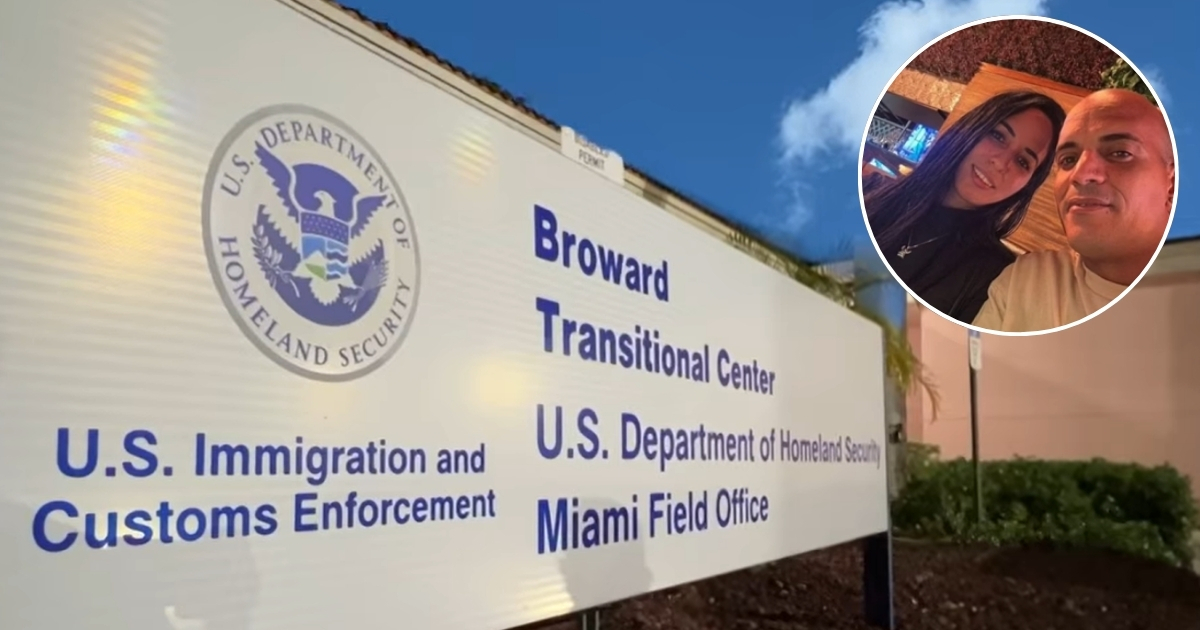
Eduardo Ortiz, a 35-year-old Cuban national, remains detained by ICE in Florida for 17 months despite entering the United States through a CBP One appointment and being granted a two-year parole. His family anxiously awaits the outcome of an appeal as they strive for his release.
Detention Under Private Management
Ortiz is held at the Broward Transitional Center (BTC) in Pompano Beach, a private facility managed by GEO Group under a contract with immigration authorities. He recounted to Univision 23 that he was apprehended while commuting to his construction job in the Florida Keys.
"I was on my way to work, riding in the truck with a friend. He was driving, and I was asleep next to him," Ortiz described during a video call from the detention center.
Legal Efforts to Secure Release
His partner insists that Ortiz committed no violations during his time at liberty and is now pursuing legal avenues to alter his situation.
"We are currently in an appeals process and waiting for its conclusion. We have filed a habeas corpus," she explained.
Immigration attorney José Guerrero, who analyzed the case for Univision but does not represent Ortiz, mentioned that individuals who entered via CBP One could be classified as "arriving aliens," which prevents them from requesting bail before an immigration judge.
"If they haven't achieved residency, a defined immigration status, they could be arrested and are unfortunately considered as arriving aliens to the United States, not eligible for bail," Guerrero pointed out.
He further explained that this status also limits options available in immigration court. "In court, he can only defend an asylum case because the judge lacks jurisdiction over that residency application," Guerrero added.
Community Support Amid Challenges
Ortiz celebrated his 35th birthday within the detention center and credits the support from fellow migrants for helping him endure months of confinement.
"We Cubans support each other a lot. The Colombians, too, we help each other and give each other strength," he shared.
During the interview, Ortiz also revealed his refusal to sign a voluntary deportation to Africa or another third country.
ICE has sent Cubans to third countries when direct deportation to Cuba was not feasible. These destinations have included African nations such as South Sudan, Liberia, Equatorial Guinea, and the Central African Republic, where two Cuban citizens were deported in early September.
Policy Changes Affecting Parole Holders
The Trump administration abolished the CBP One appointment system on January 20, 2025. Subsequently, authorities began revoking temporary stay permits granted to individuals who entered through various migration programs. In April 2026, Cubans who had entered with CBP One appointments received notifications of parole revocations.
Ortiz's situation unfolds following a federal judge's order in Florida in August to release another Cuban detained by ICE after entering through CBP One, concluding that his detention violated due process guarantees.
Ortiz, meanwhile, is determined not to accept voluntary departure to a third country, citing his family as the driving force behind his fight to remain in the United States.
"I love her, I love my mom and my sister, they are my reason for being," he expressed.
"We are fleeing from a dictatorship, from repression, from everything," Ortiz stated.
The case of Eduardo Ortiz highlights the intricacies of the U.S. immigration system. Stay updated on ICE, parole, CBP One, and deportations in our U.S. Immigration section.
Understanding ICE Detention and Parole Revocations
Why was Eduardo Ortiz detained by ICE?
Eduardo Ortiz was detained by ICE despite entering the United States legally through a CBP One appointment, due to his status as an "arriving alien," which prevents him from applying for bail.
What options does Ortiz have to gain his release?
Ortiz's family is pursuing legal measures, including an appeal and a habeas corpus, to reverse his detention and secure his release.
What are the implications of the parole revocations for CBP One entrants?
Following the revocation of paroles for those entered via CBP One, individuals face increased risk of detention and limited options in immigration court, as seen in Ortiz's case.