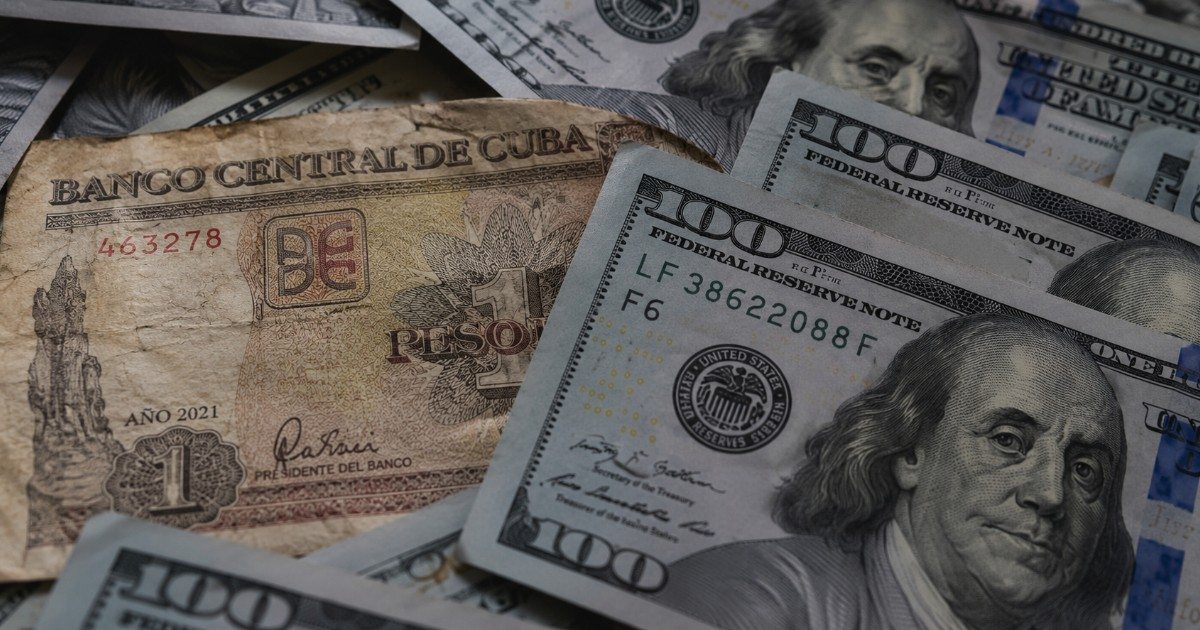
Cuba's economy is once again leaning towards a greater presence of the dollar and other foreign currencies, yet a complete dollarization is not unavoidable just yet.
Economist Pavel Vidal believes that the fate of the Cuban peso hinges on the nation's ability to stabilize its finances, restore confidence in its national currency, and address an exchange system characterized by numerous rates and a vast informal market.
In an analysis released on Monday by elTOQUE, Vidal delved into the implications of the Cuban government's new regulations designed to expand foreign currency operations. He posed a question that is becoming increasingly relevant given the island’s economic situation: Will Cuba ultimately become entirely dollarized?
The Current Shift Towards Foreign Currency
Recent official decisions, according to Vidal, mark another step in reversing the de-dollarization process initiated in 2004. These moves distance the country from the 2021 monetary reform objective, which aimed to re-establish the Cuban peso as the sole currency of the economy.
The latest change was implemented on September 10, with new regulations that simplify the opening and operating of foreign currency bank accounts.
The Central Bank of Cuba's Resolution 102/2026 allows individuals and entities to open foreign currency accounts without prior authorization and broadens the range of operations that can be conducted through these accounts by private individuals, legal entities, and non-state economic actors.
Implications for Businesses and the Economy
The new regulations also enable private businesses to accept cash payments in dollars, euros, or other foreign currencies and to deposit this money directly into foreign currency accounts. These funds can be used for imports, transfers, and other authorized transactions.
Vidal notes that these measures particularly increase the dollarization of transactions among companies and in wholesale trade. In these areas, foreign currency can be used by mutual agreement, while in retail trade, the Cuban peso remains the main currency, although foreign cash is also accepted.
The economist recalls that dollarization is not a new phenomenon in Cuba. Between 1993 and 2004, the peso coexisted with the dollar in banks, businesses, and much of the consumer market, until authorities later initiated efforts to reduce the use of the U.S. currency.
Economic Recovery and International Reintegration
Currently, Vidal sees forces that might drive the country back in the opposite direction. A potential economic recovery and increased international reintegration for Cuba would likely enhance commercial, financial, and investment ties with the United States and the Cuban diaspora in Florida.
An increase in remittances, travel, investments, trade, and financing from the U.S. would lead to a greater influx of dollars. Businesses and investors linked to these flows would have incentives to conduct some of their operations and maintain balances in dollars, reducing their exposure to the exchange risk of the Cuban peso.
Considering Partial Dollarization
Under these circumstances, greater dollarization appears to Vidal as a probable trend. Still, the economist cautions that it doesn't necessarily mean Cuba should completely abandon its currency.
He highlights that partial dollarization offers advantages, such as providing stability in an economy battered by inflation, depreciation, and a loss of trust in the banking system. During a stabilization phase, allowing dollarized operations could further facilitate capital inflow and financing while the peso regains some of its functions.
The downside arises when the process lasts too long. Vidal warns that dollarization can deepen disparities between those with access to foreign currency and those relying solely on peso income, especially when full convertibility is absent and multiple exchange rates coexist.
A complete dollarization would also have significant repercussions for economic policy: Cuba would lose instruments to control the money supply, interest rates, and bank credit. While the dollar can offer monetary stability, the country would have fewer tools to respond to internal or external crises, the analysis explains.
Steps to Preserve the Cuban Peso
Vidal believes that conditions still exist to attempt to save the peso. Cuba has not yet entered a hyperinflation scenario, and despite its significant depreciation, the national currency continues to serve as a payment means in most domestic markets.
He suggests measures to prevent excessive dollarization, including further reducing the fiscal deficit, progressively unifying official exchange rates, formalizing and expanding the exchange market, strengthening the Central Bank's reserves, and raising interest rates to encourage peso savings.
He also proposes granting the Central Bank greater institutional autonomy in the future.
Vidal's conclusion leaves two possible paths. If dollarization progresses without macroeconomic stabilization, fiscal deficit control, and monetary and exchange reforms, it will be nearly impossible to prevent it from becoming nearly total. Conversely, if stability, convertibility, and credibility of the Cuban peso can be restored, there would still be room to contain this process and preserve a functional national currency.
Meanwhile, the debate arises amid renewed pressure on the national currency: on Tuesday, the dollar reached 698 CUP in the informal market, while the euro hit 795 CUP.
Understanding Cuba's Economic Challenges
What is the current state of dollarization in Cuba?
Cuba is experiencing increased use of the dollar and other foreign currencies, with recent regulations allowing more operations in foreign currency. However, it has not reached complete dollarization.
What factors could lead to further dollarization in Cuba?
A potential economic recovery and increased ties with the United States and Cuban diaspora could lead to more dollar inflows, encouraging businesses to operate in dollars to minimize exchange risks.
What measures does Pavel Vidal suggest to save the Cuban peso?
Vidal suggests reducing the fiscal deficit, unifying exchange rates, strengthening the Central Bank's reserves, and increasing interest rates to promote peso savings, alongside granting greater autonomy to the Central Bank.