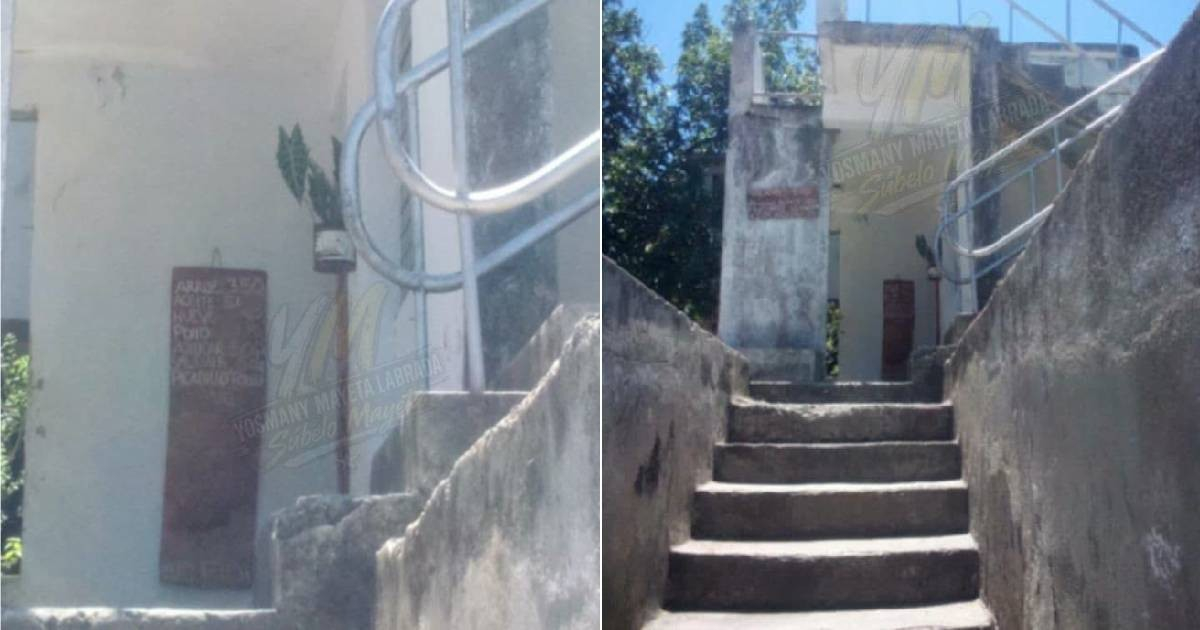
An old family medical clinic in Santiago de Cuba has been repurposed into a residence, with a sign on its walls advertising the sale of essentials such as rice, oil, eggs, chicken, sugar, and ground meat.
These images, shared on Tuesday by independent journalist Yosmany Mayeta Labrada, starkly illustrate the collapse of a program that the Cuban regime touted for decades as one of its major health achievements.
"There are pictures that tell the story of a crisis without the need for lengthy speeches," Mayeta Labrada noted upon releasing the photographs.
What is depicted in these images is far from an isolated incident. In the comments section of the post, a Santiago de Cuba resident described a similar scenario in the Rajayoga area: "There's a clinic next to a shed that has been turned into a clothing store, and that clinic hasn't operated for years, yet people live there on two floors. These are the silent revolutionary achievements."
The Structural Decline of Cuba's Health System
The deterioration of this program is tied to a deepening structural health crisis over recent years. According to data from the National Office of Statistics and Information shared by independent outlet elTOQUE, from 2010 to 2022, 37 family medical clinics closed in Cuba, alongside 63 hospitals, 187 maternity homes, and 45 dental clinics.
Even the state-run outlet Tribuna de La Habana acknowledged in early 2025 that in the Diez de Octubre municipality of Havana, "many clinics have been closed and turned into homes," and "not all clinics have doctors."
Infrastructure Neglect and Housing Crisis
The Cuban Institute for Freedom of Expression and the Press documented in 2025 a "noticeable deterioration" of clinics in Havana, with facilities resembling abandoned houses. In Pinar del Río, one clinic was shut down due to inadequate conditions, forcing patients to travel over 10 kilometers to the nearest polyclinic. By 2026, health authorities in Villa Clara admitted that more than half of the clinics were in "poor or terrible condition."
Mayeta Labrada highlights the irony behind the abandonment of health spaces: "One crisis fills the void left by another."
Cuba is grappling with an unprecedented health crisis alongside a housing deficit that by 2026 exceeded 929,000 homes, with 35% of existing housing in poor or critical condition. The construction plan for 2025 was only 22% completed. Consequently, empty clinics have become an emergency solution for health workers who lack housing.
Healthcare Workforce and Systemic Collapse
Simultaneously, the country lost over 30,000 doctors between 2021 and 2024, dropping from 106,131 to 75,364 registered professionals. The Public Health Minister, José Ángel Portal Miranda, admitted before Parliament in July 2025 to an "unprecedented structural crisis," with only 30% of basic medications available. By February 2026, he informed the AP agency that the system was "on the verge of collapse."
Mayeta Labrada’s probing question is directed squarely at the state: "How did a system that hailed the Family Doctor as an achievement end up losing community spaces while doctors, nurses, and patients bear the brunt?"
"Once, people went there to have their blood pressure checked, receive a consultation, or find the neighborhood doctor. Today, even the walls tell a different story," the journalist concludes.
Understanding Cuba's Health and Housing Crisis
What is the current state of family medical clinics in Cuba?
Many family medical clinics in Cuba have been closed or repurposed into housing due to a deepening structural health crisis, with reports indicating a significant decline in the number of operational clinics across the country.
How has the healthcare workforce in Cuba changed recently?
Cuba has seen a substantial reduction in its healthcare workforce, losing over 30,000 doctors from 2021 to 2024, which significantly impacts the country's ability to provide adequate medical care.
What factors contribute to the housing crisis in Cuba?
Cuba's housing crisis is exacerbated by a construction shortfall, with only 22% of planned housing builds completed in 2025, along with over 929,000 homes needed and a significant portion of existing housing in poor condition.