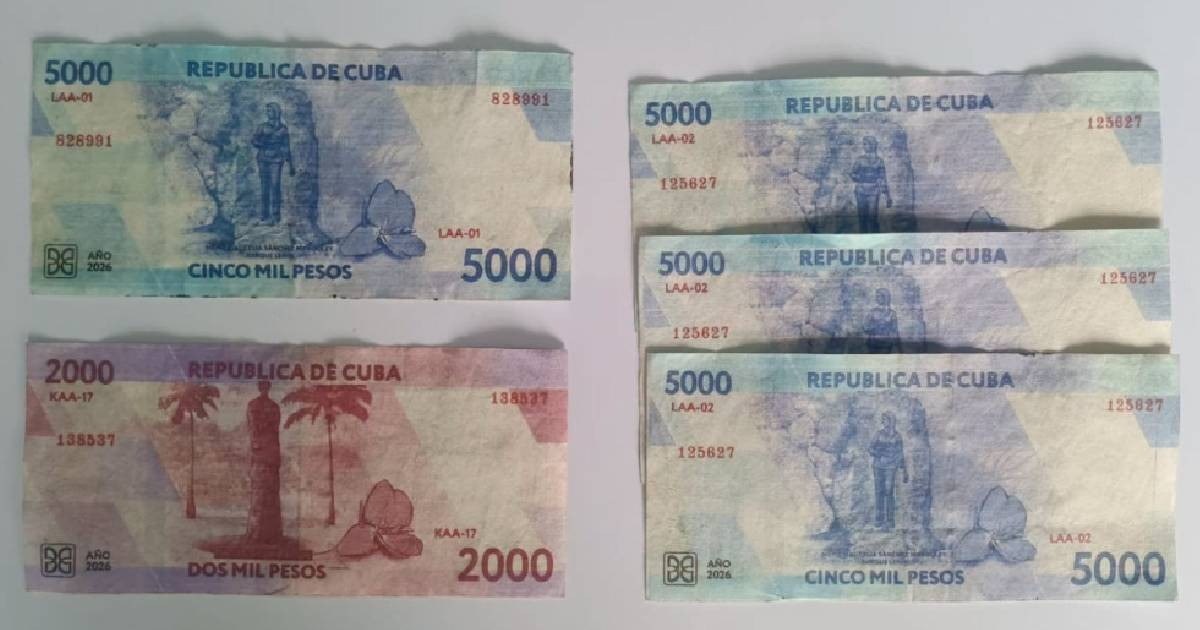
In the city of Manzanillo, located in Granma province, six individuals have been apprehended under the suspicion of possessing and attempting to distribute counterfeit currency, specifically 2,000 and 5,000 Cuban peso (CUP) bills. This information emerged from a report shared on Tuesday by the pro-government Facebook profile "Entérate con Aytana Alama."
The suspects were reportedly identified while trying to use the fake money to settle payments at various popular local venues, including a café near the children's hospital, businesses around Céspedes Park, and the Sky Club, all of which are frequented by many people.
The online post warned, "Fake bills in the 2000 and 5000 series are circulating. Recently, the police in Manzanillo detained six individuals carrying this counterfeit cash," and it included images of the seized bills, which were from the series LAA-01 and LAA-02 (5,000 CUP) and KAA-17 (2,000 CUP).
Ongoing Issues with Currency Forgery
This incident adds to a series of warnings about counterfeit versions of the new high-denomination bills introduced by the Cuban Central Bank (BCC) starting April 1, 2026, first in Havana and then gradually across the country.
These denominations, the highest ever in the history of the Cuban peso, were launched to address the rampant inflation and cash shortages plaguing Cuba's economy. The 5,000 CUP note features an image of Celia Sánchez Manduley, while the 2,000 CUP note showcases Mariana Grajales Cuello, marking a historic first for Cuban currency to feature female figures from national history.
Not long after their introduction, reports of counterfeit bills began to surface. The most recent prior incident occurred on August 17 in Guantánamo, where two young individuals were detained after trying to pay with a fake 2,000 CUP bill during the San Joaquín festivities. A self-employed worker identified the counterfeit and notified authorities.
Patterns of Counterfeiting and Legal Repercussions
In July 2026, Guantánamo also witnessed a different type of forgery: legitimate 200 CUP bills were altered to resemble 1,000 CUP notes, detectable when held up to light. Additionally, early August saw warnings about forged 500 CUP notes, identifiable by printing, color, or texture discrepancies.
Each time the BCC releases new denominations, counterfeiters swiftly replicate them, exploiting the public's unfamiliarity with the security features of the newly introduced bills. The BCC has urged citizens to check serial numbers, series, and security features before accepting any currency.
Under Cuban law, counterfeiting, altering, introducing, or circulating counterfeit money is a serious offense, punishable by four to ten years of imprisonment, reflecting the gravity of such crimes for those convicted.
Frequently Asked Questions About Counterfeit Currency in Cuba
What are the new denominations of Cuban currency introduced in 2026?
The Cuban Central Bank introduced the 2,000 and 5,000 peso bills in 2026. These are the highest denominations in Cuba's history, featuring Celia Sánchez Manduley and Mariana Grajales Cuello, respectively.
How can one identify counterfeit Cuban peso bills?
Counterfeit bills can often be identified by anomalies in printing, color, or texture. It's important to verify the serial numbers, series, and look for security features before accepting any currency.
What are the legal penalties for circulating counterfeit currency in Cuba?
In Cuba, the penalties for counterfeiting, altering, introducing, or circulating fake currency can range from four to ten years in prison, indicating the severity of such offenses.