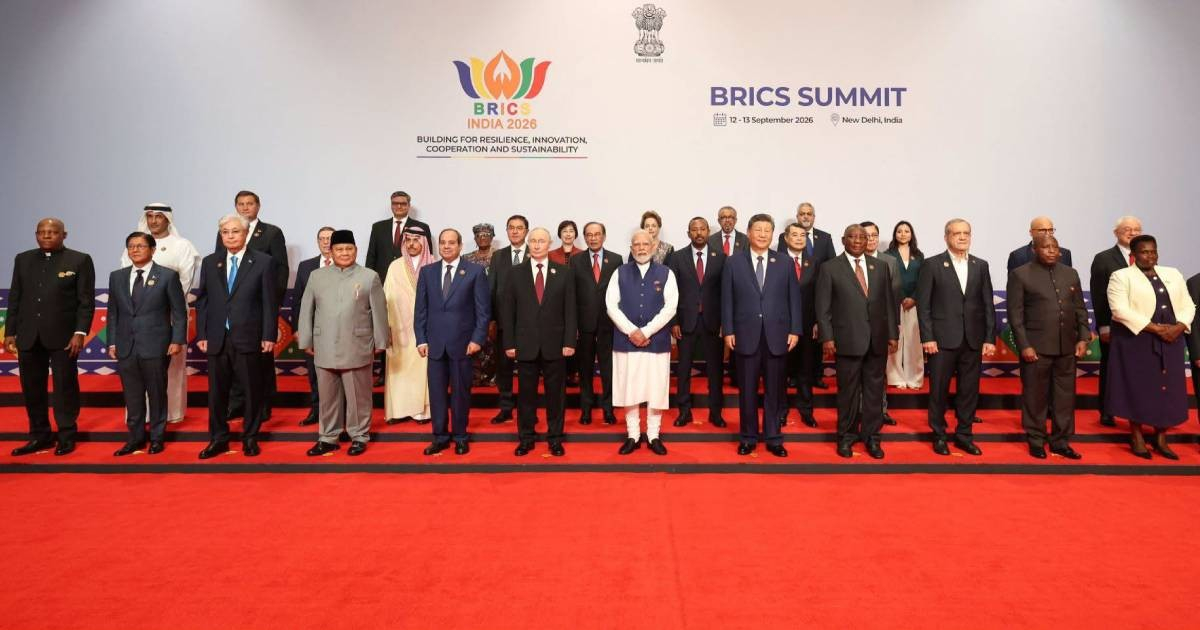
The Cuban regime has reiterated its desire to secure full membership within the BRICS alliance, despite the fact that the bloc is not currently considering expansion, and Russia has recently expressed its unwillingness to support the island's inclusion.
On Tuesday, Carlos Jorge Méndez, Cuba's First Deputy Minister of Foreign Trade and Investment, stated that full membership for Cuba would be advantageous not only for Havana but also for the organization itself.
"It would be beneficial for us and for the organization," Méndez remarked to the Russian state media outlet Sputnik, following the 18th BRICS Summit held in New Delhi on September 12 and 13.
The Role of Cuba as a BRICS Partner
Currently, Cuba is involved with the bloc as a partner country, a status that allows participation in BRICS activities but lacks voting rights or decision-making power. Méndez argued that Cuba's cooperative experience could add value to the group.
"From Cuba, we contribute our experience in cooperation and solidarity, as well as our perspective on how Southern countries can support each other and work towards economic integration for the benefit of their populations," he stated.
Summit Outcomes and Diplomatic Efforts
The New Delhi summit was described by Méndez as a step forward in establishing a multipolar world order, emphasizing economic cooperation opportunities among countries of the so-called Global South. The Cuban delegation was led by Foreign Minister Bruno Rodríguez Parrilla, who participated in the open session on Sunday and held bilateral meetings with representatives from various countries.
The final declaration of the summit included a condemnation of the U.S. economic, commercial, and financial embargo against Cuba, a stance that Havana frequently promotes in international organizations and forums.
Challenges to Full Membership Aspiration
Despite Cuba's aspirations for full membership, these ambitions face challenges, particularly given the recent stance of one of its key allies. At the start of September, Russia announced that it would not support Cuba's application for full member status at this time. The Russian Embassy in Havana, referencing the Izvestia newspaper, stated that an expansion of the BRICS is "not currently on the agenda."
New member admission requires the consensus of the full members, meaning that Havana cannot progress in its ambition without the backing of Moscow and the other countries within the bloc.
Cuba made its official request to join the BRICS in October 2024 and was granted partner status in the same month. Since then, the regime has continued its diplomatic efforts to deepen its involvement with the group. In July 2025, Miguel Díaz-Canel attended the Rio de Janeiro summit, representing Cuba as a partner country.
Méndez's recent comments indicate that Havana remains steadfast in its goal of achieving full membership, even though there is currently no agreement within the BRICS to initiate another round of expansion.
Understanding Cuba's Quest for Full BRICS Membership
Why does Cuba want to become a full member of BRICS?
Cuba believes that full membership in BRICS would enhance its international influence and allow it to contribute its experience in cooperation and economic integration among Southern countries.
What obstacles does Cuba face in joining BRICS as a full member?
Cuba's quest for full membership is challenged by the lack of consensus among current BRICS members, particularly Russia's recent refusal to support its application without a group-wide agreement on expansion.
What was Cuba's involvement in the latest BRICS summit?
Cuba participated as a partner country, with its delegation led by Foreign Minister Bruno Rodríguez Parrilla, engaging in the open session and holding bilateral talks with other nations' representatives.