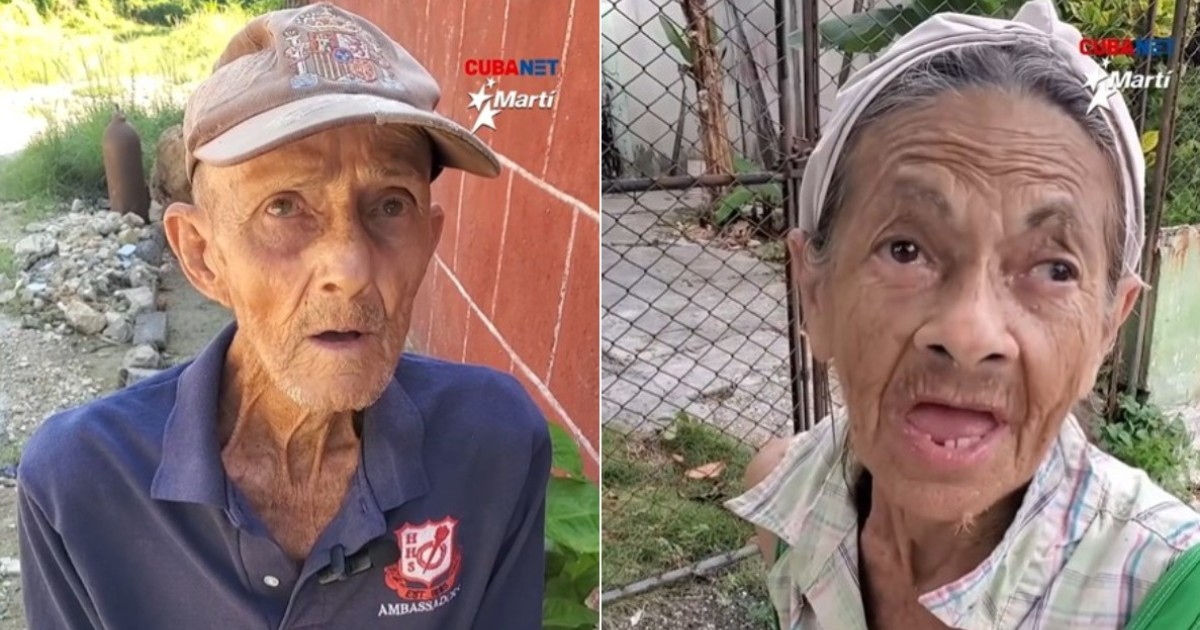
A poignant video produced by CubaNet News and Marti Noticias captures the stark realities faced by elderly Cubans today. As reporters traverse the streets, they ask senior citizens how they envisioned their old age and how they are actually living now. The responses are heartbreaking: hunger, neglect, inadequate pensions, and the resignation that the best course of action for their children is to leave the country.
"I always thought my old age would be as peaceful as possible. Now, I’m about to turn 82 in October, and it's been a disaster," one woman laments. Her monthly pension of 3,000 Cuban pesos falls short of even covering her daily yogurt.
She adds, "I sell bags and coffee on the street just to afford a meal, and even that is scarce."
Another elder, a former mechanical engineer at a Cuban company, reminisces about the days when he and his wife, a former banker, could meet all their needs with their salaries. Now, he receives 3,210 pesos a month, which he describes bluntly as "simply not enough for anything."
A man outlines the gradual dismantling of the basic ration: "They took away the chicken, the ground meat, the soap, the salt, the sugar, the coffee, the cigarettes," he lists. "All of us old folks are dying of hunger," he declares.
The struggles extend beyond food scarcity. One elderly man describes the queues for pension payments as "endless" and notes the absence of essential medications for his ailments.
Emigration serves as a backdrop in many of these stories. Several interviewees mention their children have been living abroad for years. When asked if they would urge their children to return in hopes of change, the answer is a resounding no.
"The best thing anyone can do here is leave, because there is no future for anyone in this country," one respondent states.
Asked to sum up what it means to grow old in Cuba, the answers reflect decades of unfulfilled promises: "This is death," "Growing old in Cuba is sad," "Very tough," "It boils down to needing a substantial change in our situation," and "Aging is like a sunset. The day fades away, and so do people. The whole world knows it, but many choose to close their eyes to the truth."
The statistics back up the grievances voiced by these elderly individuals. According to a survey conducted by the Cuban Independent Trade Union Association of 506 retirees across five provinces, 99% reported that their pensions do not cover basic needs like food, housing, and medication; 90.7% continued working after retirement, and 99.4% deemed their pension amount unfair relative to their years of labor.
As of September 2025, the official minimum pension is set at 4,000 pesos, which is less than 10 U.S. dollars on the informal exchange market and only covers a fraction of the basic food basket, estimated to cost between 12,000 and 30,000 pesos per person.
Economist Javier Pérez Capdevila estimates that an individual requires approximately 96,060 pesos monthly to meet basic needs, with 70,070 pesos needed solely for food.
This grim reality unfolds in the most aged nation in Latin America and the Caribbean. By the end of 2024, 25.7% of Cuba's population—over 2.5 million people—were 60 years old or older, according to the National Office of Statistics and Information. This percentage has increased by 6.3 points in a decade, driven by low birth rates, mass youth emigration, and a declining total population.
Understanding the Challenges of Aging in Cuba
What are the main challenges faced by elderly Cubans?
Elderly Cubans face numerous challenges including inadequate pensions that do not cover basic needs, food scarcity, long queues for pension payments, and lack of access to essential medications.
How does emigration affect the elderly population in Cuba?
Emigration significantly impacts elderly Cubans as many of their children and younger relatives leave the country in search of better opportunities, often leaving the seniors without familial support.
What are the economic realities for retirees in Cuba?
With pensions as low as 4,000 pesos a month, retirees struggle to afford basic necessities. The cost of the basic food basket far exceeds the pension amount, forcing many to continue working post-retirement.