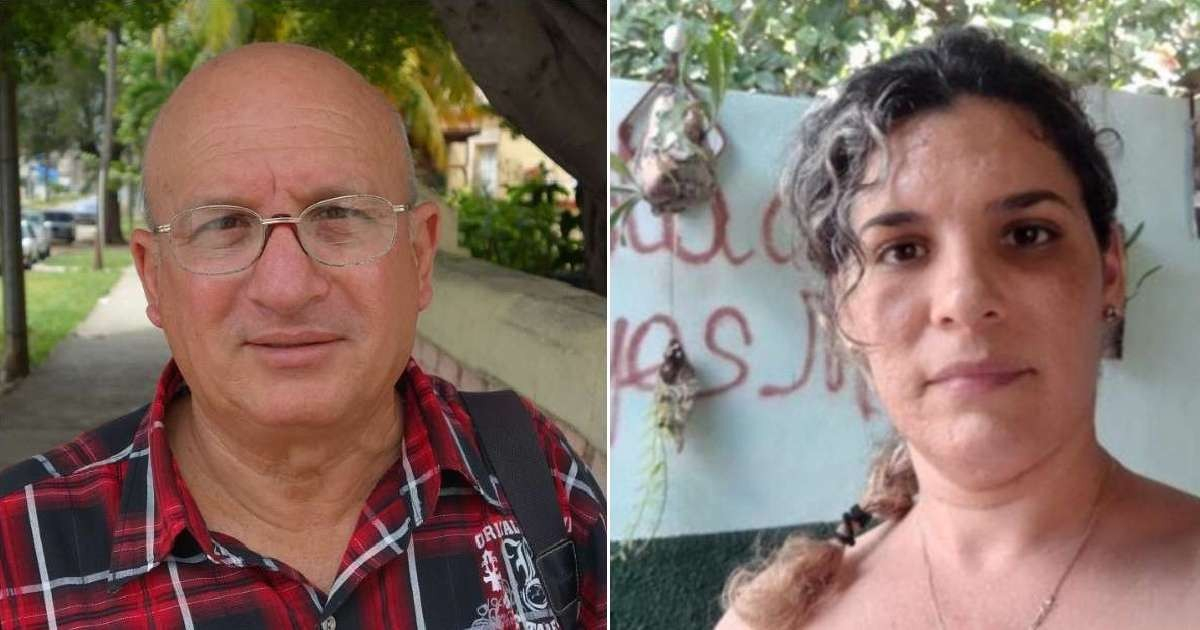
Félix Navarro Rodríguez and Saylí Navarro Álvarez, a father and daughter duo who are both Cuban political prisoners, have been nominated for the European Parliament's Sakharov Prize for Freedom of Thought. This nomination was confirmed on Sunday by a newly established committee of former Cuban political prisoners dedicated to this cause.
The nomination was spearheaded by activists and former political prisoners Normando Hernández, Pablo Pacheco, and Ángel de Fana, as reported by Martí Noticias.
What sets this organizing committee apart is its intergenerational nature, bringing together individuals who have experienced political imprisonment at various times since 1959, making it the first of its kind in the history of Cuban activism.
The committee's expressed goal is to highlight the plight of political prisoners in Cuba and to advocate for the immediate release of the Navarros.
Ongoing Struggle for Freedom
Félix and Saylí have been imprisoned for participating in the anti-government protests on July 11, 2021, in Perico, Matanzas. Félix is serving a nine-year sentence at Agüica prison, while Saylí is enduring an eight-year sentence at La Bellotex women's prison, both located in the same province. Amnesty International recognized them as prisoners of conscience in October 2024.
Their detention conditions have been repeatedly condemned. In April, Félix was reportedly beaten and dragged in handcuffs for more than 100 meters by a prison officer, then moved to a solitary confinement cell. When Saylí reported the assault over the phone from La Bellotex, her prison privileges were reduced in retaliation. Their family has also reported that Saylí has been denied furloughs and access to a minimum-security regime on three occasions.
International Attention and Support
The European Parliament will discuss the Navarros' case on September 16, with a resolution vote scheduled for the following day. In June 2026, the institution passed a resolution condemning systematic repression in Cuba and demanding the release of all political prisoners, whose numbers were estimated at 1,281 by the end of May that year.
Félix Navarro, a member of the Pedro Luis Boitel Party for Democracy and honorary president of the Council for Democratic Transition in Cuba, has a long history of activism. He was sentenced to 25 years in prison in 2003 during the Black Spring when the regime incarcerated 75 dissidents, journalists, and activists. He was released in January 2025, only to be re-arrested for his involvement in the July 11 protests.
Recognition and Historical Context
On September 10, Félix received the 2026 Democracy Award from the National Endowment for Democracy (NED), sharing the honor with political prisoner Maykel "Osorbo" Castillo and former prisoner Luis Manuel Otero Alcántara. The award was accepted on his behalf due to his continued imprisonment.
The Sakharov Prize, the European Parliament's highest accolade for human rights, is named after Soviet physicist and dissident Andrei Sakharov and was first awarded in 1988 to Nelson Mandela and Anatoli Marchenko. Cuba has a notable history with this prize: Oswaldo Payá received it in 2002, the Ladies in White—a movement Saylí is part of—in 2005, and independent journalist Guillermo "Coco" Fariñas in 2010. The winner of this year's prize is typically announced in October.
Understanding the Sakharov Prize and Cuban Political Prisoners
What is the Sakharov Prize for Freedom of Thought?
The Sakharov Prize for Freedom of Thought is the European Parliament's highest award for human rights, named after Soviet physicist and dissident Andrei Sakharov. It honors individuals and groups who have dedicated their lives to the defense of human rights and freedom of thought.
Why were Félix and Saylí Navarro nominated for the Sakharov Prize?
Félix and Saylí Navarro were nominated for their courageous stand against the Cuban regime and their participation in the July 11, 2021, anti-government protests. They are recognized as political prisoners and prisoners of conscience by Amnesty International.
How has the international community responded to the situation of Cuban political prisoners?
The international community, including the European Parliament, has condemned the repression in Cuba and called for the release of all political prisoners. Resolutions and awards like the Sakharov Prize and the Democracy Award highlight global support for Cuban activists.