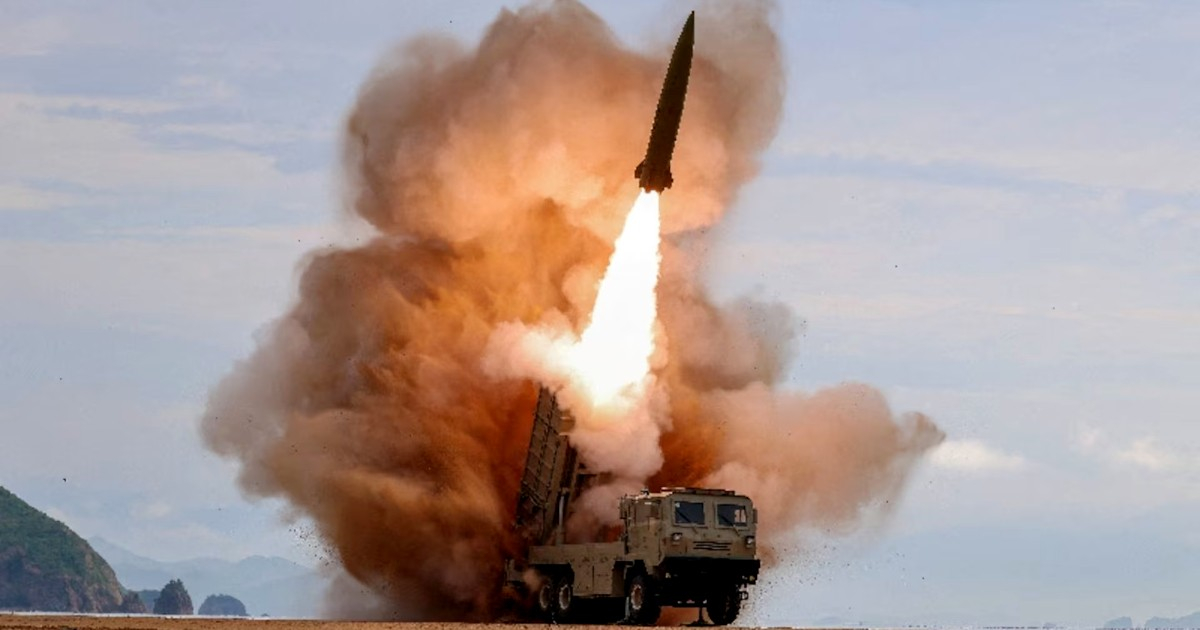
North Korea announced on Monday that it had conducted a "joint firepower assault drill" last Saturday, which involved launching short-range ballistic missiles, as reported by the country's state-run news agency, KCNA.
This military exercise occurred just a day after South Korea, the United States, and Japan wrapped up their trilateral drill named "Freedom Edge."
The Joint Chiefs of Staff in South Korea reported detecting the launch of several short-range ballistic missiles from the port city of Wonsan on the country's eastern coast at approximately 5:20 a.m. local time. The missiles were fired toward the Sea of Japan, traveling around 250 kilometers before landing in the sea, according to Reuters.
KCNA elaborated that the drill involved five army units and tested multiple weapon systems, including various attack drones, tactical cruise missiles, large-caliber thermobaric multiple rocket launchers, and tactical ballistic missiles. The agency stated that "all systems demonstrated massive destructive power by hitting targets with 100% accuracy."
An artillery director quoted by KCNA asserted that the exercise would boost troop morale and enhance their capability to "completely annihilate the enemy" when commanded.
Integrated Military Capabilities
Analyst Lim Eul-chul, a professor at the Institute for Far Eastern Studies at Kyungnam University in Seoul, emphasized that "this was not a test of a single weapon system, but a display of an integrated attack network," capable of coordinating drones, cruise missiles, ballistic missiles, and rocket artillery under unified command.
The expert suggested that Pyongyang is collecting operational data for actual deployment and practicing tactics aimed at overwhelming the missile defense systems of South Korea and the U.S. with simultaneous attacks using weapons with varying flight characteristics.
Political Tensions and Diplomatic Nuances
The absence of Kim Jong-un from the exercise and the two-day delay in releasing the official report led Lim to conclude that Pyongyang aimed to present the event as a "technical and practical" drill while gauging tensions with Washington.
The missile launch occurred amid a diplomatically ambiguous period. President Donald Trump had previously ordered a reduction in the annual "Ulchi Freedom Shield" exercise as a gesture of goodwill towards Pyongyang. In mid-August, Trump mentioned having "very positive" exchanges with Kim, anticipating a meeting before the year's end.
Nonetheless, Kim Yo Jong, the sister of North Korea's leader, stated that she was unaware of any recent communication between Washington and Pyongyang.
The cycle of engagement and tension is not unfamiliar: during his first term, Trump and Kim transitioned from mutual threats to three historic summits that ultimately failed to yield any nuclear agreement. Now, as Trump extends an olive branch once more, North Korea continues its missile launches and strengthens its military alliance with Russia, having sent between 14,000 and 15,000 troops to fight in Ukraine.
The missile launch on Saturday marks the 13th known ballistic missile event by North Korea in 2026, highlighting the gap between diplomatic rhetoric and the reality on the ground.
Understanding North Korea's Military Drills
What was the purpose of North Korea's recent missile launch?
The recent missile launch by North Korea was part of a "joint firepower assault drill," aimed at testing various weapon systems and demonstrating their destructive capabilities.
How did South Korea and the United States respond to the missile launch?
South Korea's Joint Chiefs of Staff detected the launches, and the exercise followed a recent trilateral drill with the United States and Japan, named "Freedom Edge."
Why was Kim Jong-un absent from the exercise?
The absence of Kim Jong-un and the delayed report suggest North Korea's intention to present the drill as a technical event while managing diplomatic tensions with the U.S.