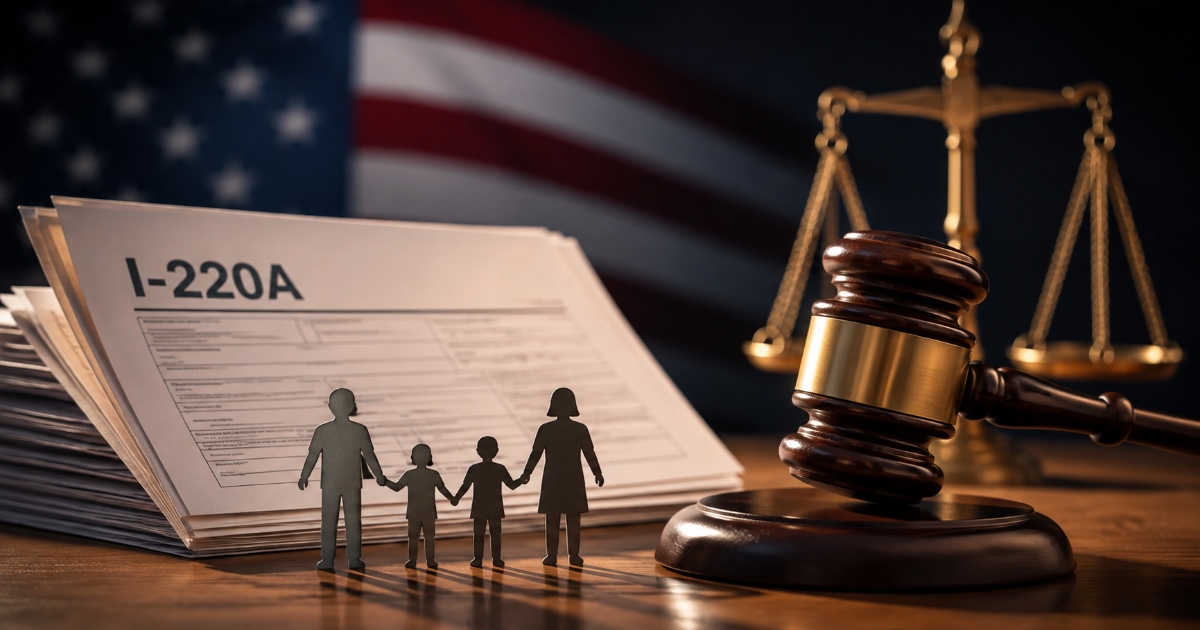
This Thursday, a federal court in Miami will evaluate a case that could significantly impact the Cuban community in the United States. A total of 992 migrants are pursuing a legal path that would allow individuals who received an I-220A form to benefit from the Cuban Adjustment Act, according to EFE.
The case, titled "Bello-Rubio vs. Department of Homeland Security," will be presented before Judge Jacqueline Becerra of the Southern District of Florida. The outcome could set a precedent for around 500,000 to 600,000 Cubans trapped in immigration uncertainty, as suggested by those advocating for the lawsuit.
The I-220A Form Controversy
At the heart of the legal battle is the I-220A, an "Order of Release on Recognizance" issued to many Cubans after being processed by U.S. immigration authorities upon entry.
The lawsuit aims to determine whether the conditions under which these migrants were released can be legally recognized as parole. If so, it would enable many to apply for permanent residency under the 1966 Cuban Adjustment Act, provided they meet other legal requirements.
The federal government argues that the I-220A does not constitute parole and will seek dismissal of the lawsuit, among other reasons, due to the court's lack of jurisdiction to grant the requested remedies.
Initial Stage in a Long Legal Battle
This Thursday's hearing does not guarantee that hundreds of thousands of Cubans will automatically gain residency. It represents an initial stage in a legal struggle aiming to open that possibility for them.
The lead attorney for the plaintiffs, Mark Prada, seeks to have the lawsuit certified as a class action, potentially broadening the impact of a favorable decision to other similarly processed Cubans.
"We are trying to certify a national class of all Cubans under various definitions, based on how they were processed at the border, because many different things were happening," Prada explained to EFE.
He acknowledged that even a victory at this stage would not immediately resolve the affected individuals' immigration status.
"After that, they must apply for residency and win that battle, but at least it gives these people an opportunity," he stated.
The hearing was postponed twice: initially scheduled for August 26, then moved to September 2, and finally set for September 10.
Personal Stories of Uncertainty
Behind the legal proceedings are thousands of families waiting for a definitive immigration resolution. A Cuban named "Alan," who has lived in the U.S. for five and a half years, shared with EFE that his wife received an I-220A after crossing the border four years ago. They live in constant fear of deportation tearing their family apart.
"It’s complicated because you feel bad, disappointed, frustrated, and very scared," he recounted.
For Alan, being forcibly returned to Cuba would be devastating: "Deportation would be like dying alive."
This case arises amid heightened immigration policy enforcement under the Trump administration, leaving many Cubans without permanent residency in uncertainty.
A Cato Institute analysis showed a significant increase in Cuban arrests by ICE during Trump’s first year in office. Syracuse University’s TRAC data recorded 1,642 deportation orders against Cubans in June 2026.
As the lawsuit unfolds, Congressman Mario Díaz-Balart has stated his continued efforts to find a resolution for Cubans with I-220A and voiced opposition to their deportation to Cuba, as he mentioned in an interview with Telemundo 51.
For thousands of Cubans who have been waiting for answers for years, this Thursday's hearing might not end their immigration limbo but could be a crucial step in determining if they will eventually have the chance to apply for the Cuban Adjustment Act.
Stay updated with all the details and developments in our U.S. Immigration section.
FAQs on the Cuban Adjustment Act Case
What is the significance of the I-220A form in this lawsuit?
The I-220A form, an "Order of Release on Recognizance," is central to the lawsuit because if recognized as parole, it could allow many Cuban migrants to apply for permanent residency under the Cuban Adjustment Act.
How many Cubans could be affected by the outcome of this case?
The case could potentially impact between 500,000 and 600,000 Cubans who are currently in a state of immigration uncertainty.
What challenges does the lawsuit face?
The lawsuit faces challenges such as the federal government's argument that the I-220A does not constitute parole and the court's jurisdiction to grant the requested remedies.