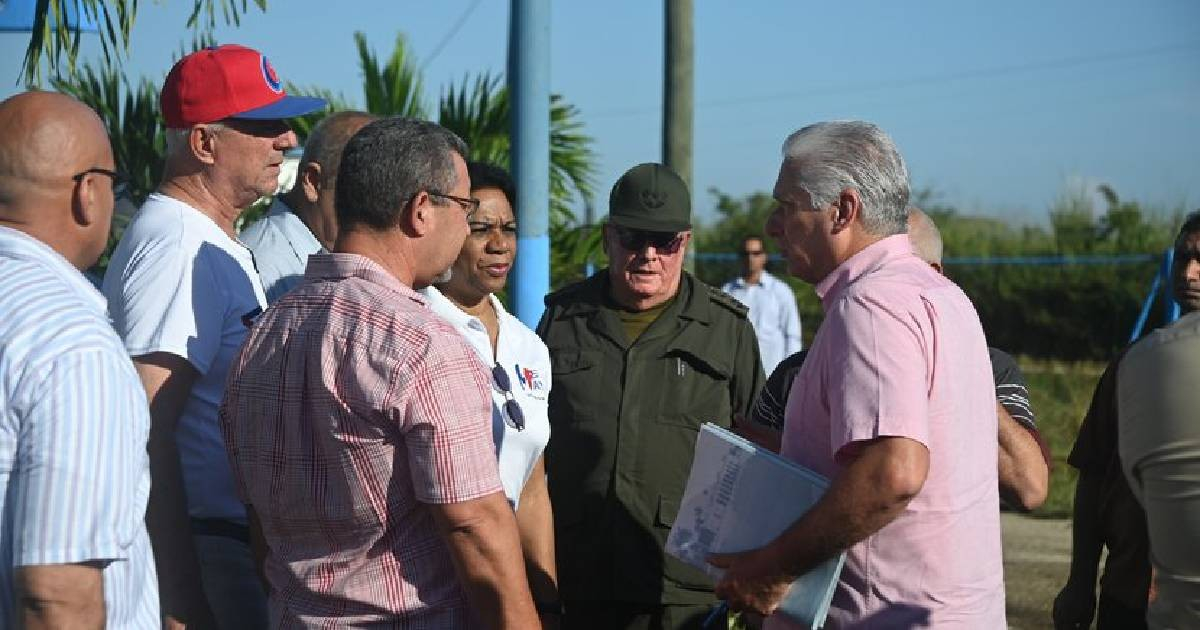
In the midst of a severe water crisis affecting millions of Cubans, Cuban leader Miguel Díaz-Canel toured Mayabeque province on Tuesday to inspect "El Gato," the main water supply system for the eastern part of Havana. The regime presented this visit as part of ongoing official efforts to address the country's critical water issues.
"El Gato" system comprises 17 wells and supplies water to over 27% of the capital's population, covering the municipalities of Regla, Guanabacoa, San Miguel del Padrón, Habana del Este, Cotorro, and Diez de Octubre.
Accompanying the leader were key government figures, including the Minister of the Revolutionary Armed Forces, Álvaro López Miera; Deputy Prime Minister Inés María Chapman Waugh; the Minister of Energy and Mines, Vicente de la O Levy; and the President of the National Institute of Hydraulic Resources, Antonio Rodríguez Rodríguez, according to the Cuban Presidency and Government website.
Addressing Infrastructure and Power Challenges
The investment plan discussed during the visit aims to fix leaks in wells and pipelines, complete pumping equipment, and ensure the electrical stability of the facility. Díaz-Canel outlined a two-phase strategy: an initial phase focusing on achieving electrical assurance with electronic groups to prevent service disruptions during blackouts, followed by a transition to renewable energy sources.
This visit to "El Gato" marks Díaz-Canel's third inspection related to water issues in less than two weeks. On August 28, he oversaw the installations at Paso Seco in Boyeros, and on September 3, he toured the Southern Basin System, where he admitted that the regime cannot guarantee the 10 to 12 hours of electrical stability required for normal pump operations.
Short-Term Solutions Amid Worsening Crisis
The official plan includes using generators for 29 water sources in Havana as a short-term solution, while the crisis worsens. By July 2026, more than 500,000 residents in Havana faced irregular water access, and nationally, 2.7 million Cubans were reported to have difficulties with water supply, according to data collected by the Los Angeles Times from the National Institute of Hydraulic Resources.
With 87% of Cuba's water supply system dependent on the electrical grid, each blackout results in simultaneous pumping interruptions. By June 2026, the hydraulic system was operating with just 37% of the required fuel.
Beyond Water: Broader Economic Visits
Díaz-Canel's tour wasn't solely focused on water. He also visited the "Boris Luis Santa Coloma" Sugar Agroindustrial Complex in Madruga, urging managers to combine sugarcane harvesting with local productions like syrup and cane molasses. The tour continued to "La Esperanza" farm, where he praised producer Lázaro Fundora—who manages over 30 hectares, 200 beehives, and solar panels—calling him "a wise man." The final stop was the "Cuban-Vietnamese Friendship" Base Business Unit in San José de Las Lajas, dedicated to poultry genetic improvement.
The pattern of these tours has sparked skepticism. A slide inadvertently leaked by Canal Caribe on July 17 revealed that the internal objective of these visits included measures to "prevent a social outbreak," beyond merely addressing the structural issues faced by the population.
Díaz-Canel has promised that the initial results of improved water supply will be visible by the end of September, with further consolidation expected in October.
Understanding Cuba's Water Crisis
What is the main cause of Cuba's water supply issues?
Cuba's water supply issues are primarily due to infrastructure problems, dependency on an unstable electrical grid, and insufficient fuel for the hydraulic system.
How is the Cuban government addressing the water crisis?
The government is implementing a plan that includes repairing infrastructure, ensuring electrical stability, and using generators for key water sources as a short-term solution.
Who accompanied Díaz-Canel during his visit to Mayabeque?
Díaz-Canel was joined by Álvaro López Miera, Inés María Chapman Waugh, Vicente de la O Levy, and Antonio Rodríguez Rodríguez.