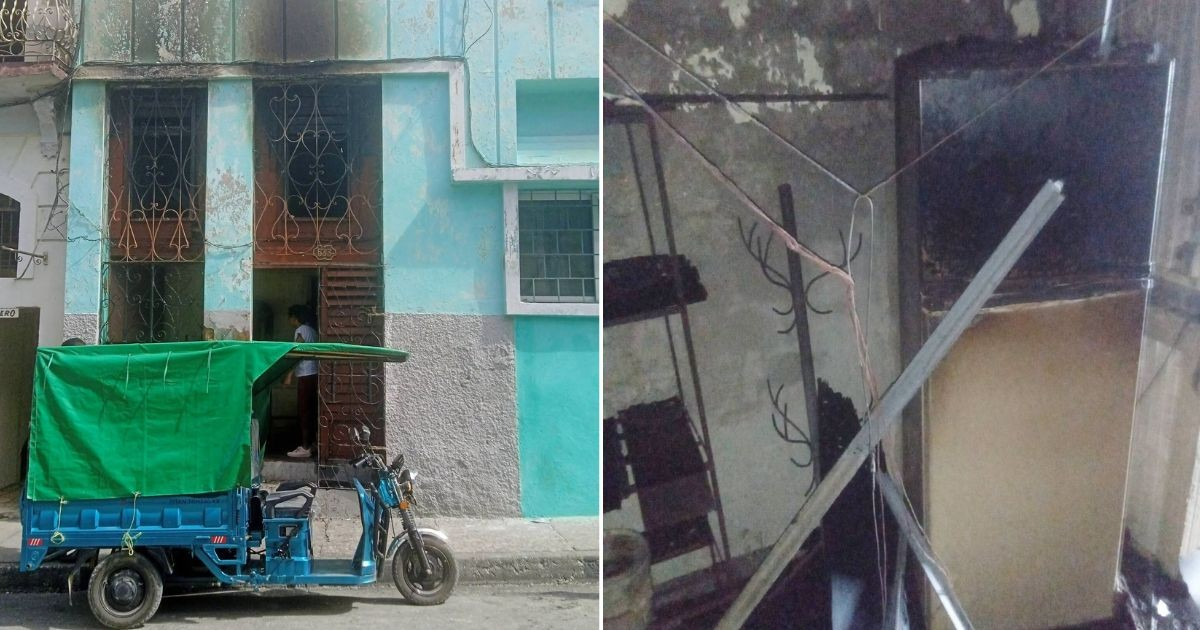
On Monday night, yet another fire broke out in the heart of Santiago de Cuba, marking the second such incident in less than a week following a previous blaze that partially or completely damaged five homes.
This time, investigators concluded that the fire was ignited by a short circuit in an unoccupied residence.
Aris Arias Batalla, the provincial vice president of the Cuban Volunteer Firefighters Association in Santiago de Cuba, shared on Facebook that the fire took place at 533 Aguilera Street, located between Clarín and San Agustín. He noted that the building had previously operated as a store and was being prepared to resume commercial activities.
According to Arias, the cause of the fire was pinpointed to a short circuit in the living room area, nestled between the false ceiling and the roof, leading to overheating in that section.
Although the report does not directly link the fire to the erratic power supply, the firefighter highlighted the unstable conditions surrounding the restoration of electricity and the potential dangers posed by deteriorating electrical systems.
"We are not immune to the imbalance that occurs once power is restored, with low voltage and intermittent outages being factors that could contribute to these incidents," Arias pointed out.
He urged residents, especially those in older homes, to inspect their electrical systems for faulty connections or wires inadequate for modern electrical loads.
Arias also mentioned the increasing use of rechargeable lithium batteries, power stations, and other electrical devices in Cuban households amidst the ongoing energy crisis.
At the time of the fire, the residence was unoccupied, confirmed Domingo Ortiz Mendoza, who was responsible for its oversight.
The primary material damage involved a commercial refrigerator and a partially damaged domestic one. Other assets remained secure in a room that the flames did not reach, according to the report.
Neighbors reported that electricity had been restored around 7:00 p.m., and about 40 minutes later, they detected a burning smell and saw smoke.
Firefighters from Command 1 Martí, supported by Command 4 Vista Alegre, responded promptly to contain the blaze and successfully extinguished it.
The fire mobilized several firefighting units in Santiago de Cuba's city center on Monday night before the precise cause and extent of the damage were known.
Images from the scene depicted a thick column of smoke rising above the buildings.
This incident occurred a mere six days after another destructive fire impacted five homes in Pasaje Soler, between Princesa and Santa Rosa streets, also within Santiago de Cuba's central area.
Understanding the Risks of Power Instability in Cuba
What caused the recent fire in Santiago de Cuba?
Investigators determined that a short circuit caused the fire. It occurred in an unoccupied residence, specifically between the false ceiling and the roof.
How does power instability contribute to fires in Cuba?
Unstable power conditions, such as low voltage and intermittent outages, can exacerbate risks in already deteriorating electrical systems, potentially leading to fires.
What precautions are recommended for Cuban residents?
Residents, particularly those in older buildings, are advised to inspect their electrical installations for faulty wiring and ensure that they are adequate for modern electrical demands.