The Miami International Airport (MIA) is missing an advanced braking system found at over 120 airports across the United States, which is specifically designed to stop airplanes that overrun the runway's end. This revelation was made by Local 10 on Monday.
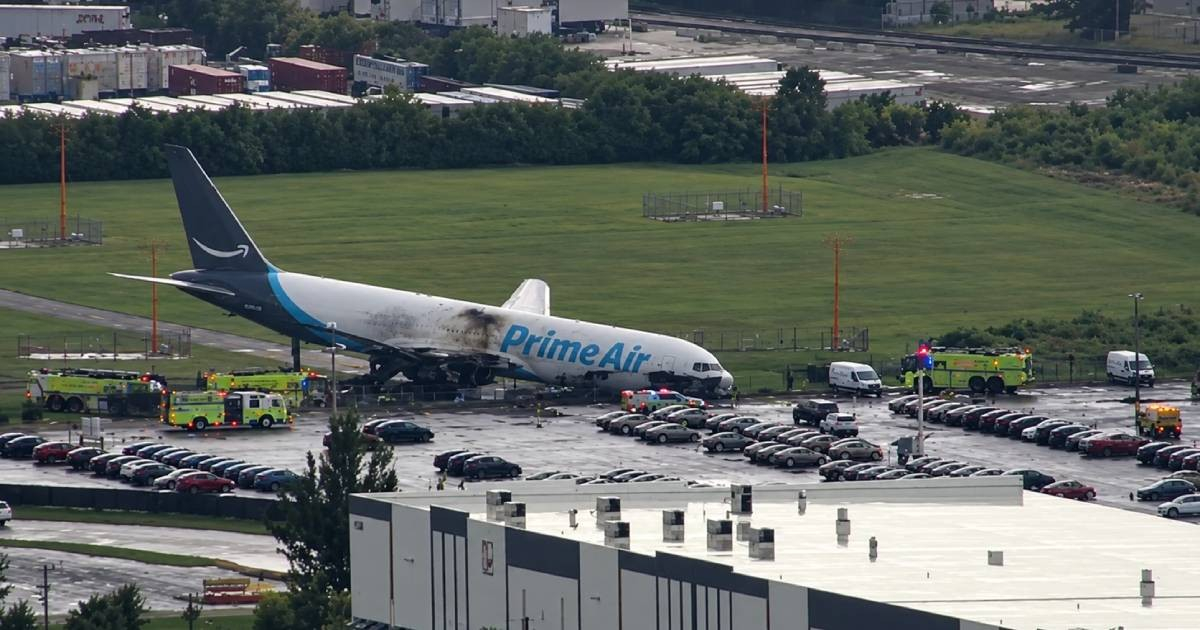
The news comes just a day after a cargo Boeing 767, operated by 21 Air for Amazon Prime Air, veered off the runway, crossed a roadway, and collided with several vehicles in a nearby parking area. The incident resulted in five fatalities and five injuries.
The system in question is known as the Engineered Materials Arresting System (EMAS), intended to halt aircraft that fail to stop before reaching the runway's end.
Captain Francisco Díaz, who claimed to have piloted the same aircraft involved in the accident a decade ago, explained to Local 10 that the system uses a deformable material placed beyond the runway.
"It prevents the plane from leaving the airport premises. It's a soft concrete placed after the runway, and if the plane enters that area, it turns into mud, stopping its progress," he explained.
According to data from the Federal Aviation Administration (FAA) cited by the channel, these systems have helped save at least 497 lives in 26 aircraft overruns in the U.S.
However, MIA is not currently required to have EMAS. The airport has a safety area of approximately 1,000 feet (305 meters) at the runway's end, one of the alternatives considered by FAA standards.
The plane involved in Sunday's accident managed to surpass this area and ended up outside airport grounds, sparking discussions about the possible installation of an EMAS system.
Analyzing the Incident and Future Precautions
Díaz also reviewed footage of the landing, describing what is known in aviation as an "unstable approach."
"You notice a slight downward tilt, and then, upon reaching the landing zone, it hovers in the air. In fact, it makes two small bounces before the main landing gear hits the ground," he explained.
According to Díaz, the expected procedure in such a scenario would be to abort the landing and attempt it again.
Nevertheless, Díaz urged caution, noting that the accident's causes remain unknown.
"We don't know if there was a mechanical failure. We don't know if the systems, like hydraulics or brakes, had issues," he pointed out.
The pilot also shared his personal connection to the accident aircraft, registered as N1997A.
"It was the first Amazon Prime aircraft about 10 years ago [...] I flew this specific tail number 10 years ago," he stated.
Using the accident to highlight safety concerns, Díaz urged authorities to consider integrating EMAS into the airport's planned investments.
"Miami Airport is investing $9 billion in infrastructure. Please include a system like EMAS for all runways," he appealed.
On Monday, MIA continued experiencing delays and cancellations due to the accident, with authorities advising passengers to check their flight status before heading to the terminal.
The FAA and the National Transportation Safety Board (NTSB) are investigating the incident. So far, the cause of the Boeing 767 overrunning the runway remains undetermined, and it is unclear if an EMAS would have altered the outcome.
Critical Questions About Runway Safety and EMAS Implementation
What is the purpose of the Engineered Materials Arresting System (EMAS)?
EMAS is designed to stop aircraft that overrun the end of a runway by using a crushable material that absorbs the plane's energy, preventing it from leaving the airport area.
Why doesn't Miami International Airport have an EMAS system installed?
Currently, MIA is not mandated to have EMAS as it has a 1,000-foot safety area at the runway's end, an alternative considered by the FAA. However, recent events have sparked discussions about its potential installation.
How many lives have EMAS systems saved in the United States?
According to the FAA, EMAS systems have contributed to saving at least 497 lives in 26 incidents involving aircraft runway overruns across the United States.