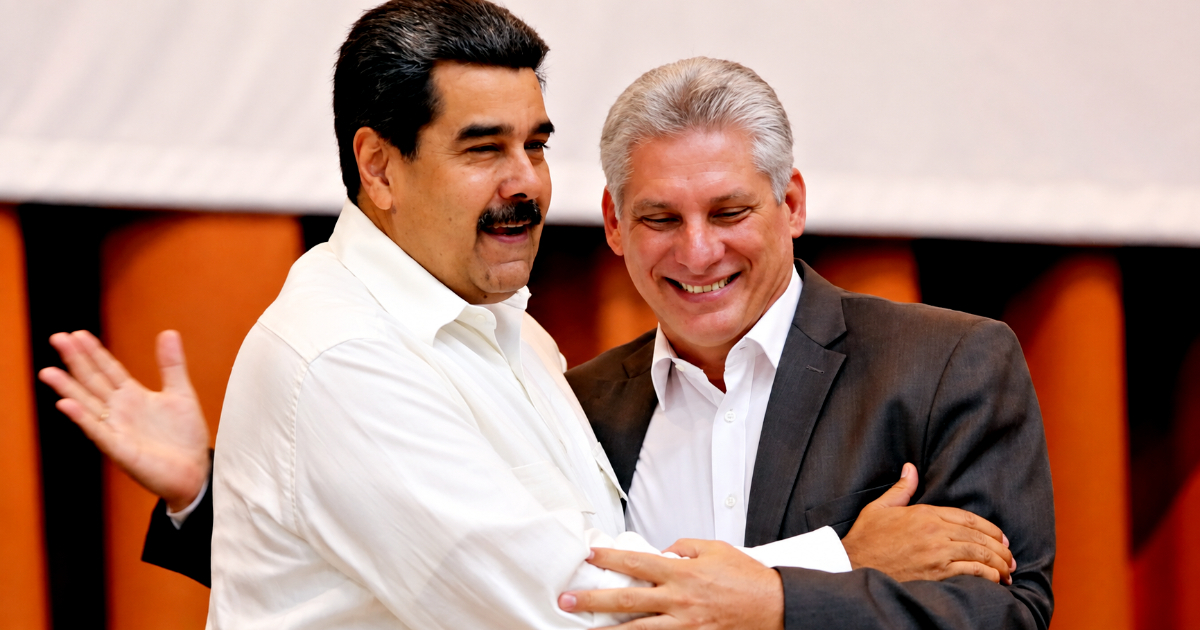
The Cuban regime has explicitly raised the possibility of a scenario similar to the capture of Nicolás Maduro in Venezuela, suggesting that a similar operation could target a key Cuban leader.
This weekend, the head of the Directorate of Personal Security, a branch of the Ministry of the Interior (MININT) responsible for protecting Raúl Castro, Miguel Díaz-Canel, and other regime leaders, highlighted this concern.
During the 65th anniversary celebration of this institution, attended by Raúl Castro and Díaz-Canel, Brigadier General Emir Mesa Corona recalled the 32 Cubans who died in Venezuela during the U.S. operation that led to Maduro's capture. He openly questioned how the regime's forces would respond if an attempt were made to capture one of their leaders.
"If they fought like lions outside of Cuba, what will each member of the country's leadership, the Revolutionary Armed Forces, Military Counterintelligence, the Ministry of the Interior, and every revolutionary Cuban do the day they attempt to attack us or dream of kidnapping or assassinating one of our main leaders?" Mesa Corona declared, according to a report by the Cuban Presidency.
The significance of this statement lies in who made it, the audience, and the context: the official responsible for preventing attacks on the leaders, during an event presided over by Raúl Castro and Díaz-Canel, just eight months after U.S. forces captured Maduro despite the security measures in place to protect him.
The Legacy of the 32 Fallen in Venezuela
Raúl Castro dedicated part of his message to honoring the 32 Cubans who died during the U.S. operation on January 3, urging that their actions serve as a model for the Directorate of Personal Security.
"May the blood they shed never be forgotten and may their example become the guiding principle in the daily work of this Directorate," Castro stated in a letter read during the event by the Minister of the Interior, Lázaro Alberto Álvarez Casas.
Mesa Corona presented them as "a paradigm and symbol," asserting that they demonstrated "what material the children of this nation are made of." He then posed the question of what would happen if the target were not Maduro, but a major Cuban leader.
U.S. Options Remain Open
The concern reflected in the Security Directorate's discourse has a notable precedent. In June, U.S. Secretary of War Pete Hegseth was directly asked about the possibility of a similar operation targeting Díaz-Canel.
"Options, options, options. Our job is to present options at different scales, depending on what the President of the United States, who is the commander-in-chief, wants to do," Hegseth responded.
When specifically asked if the capture or elimination of Díaz-Canel remained a possibility, Hegseth did not rule it out, emphasizing that "all those options are on the table" and that any decision would ultimately be up to President Donald Trump.
These statements followed Hegseth's visit to the Guantánamo Naval Base, where he used the operation against Maduro to issue a warning to the Cuban regime. He highlighted the inability of Maduro's defenses to withstand U.S. forces: "Russian air defenses and Cuban guards were no match for our operators, our Rangers."
Bolstering Security in Havana
Subsequent signals indicate that the Cuban government has taken seriously the potential for a U.S. action against its leadership. In August, CiberCuba reported, based on a New York Times investigation citing U.S. officials, that Havana had increased security measures around Raúl Castro and Díaz-Canel to thwart any U.S. attempt to capture or eliminate them.
While none of these elements prove that Trump ordered such an operation, they provide context for the recent statements by the Security Directorate's chief.
Following the capture of Maduro, Hegseth did not dismiss the possibility of similar actions against Díaz-Canel. Reports later suggested that Havana had reinforced its leadership's protection.
Now, the official responsible for this protection publicly questions what would happen if someone attempted to "kidnap or assassinate" a top Cuban leader.
Díaz-Canel's Military Concerns
Díaz-Canel has also acknowledged the possibility of direct military action from the U.S. against Cuba. In June, he stated that the U.S. considered three scenarios: provoking social unrest, forcing dialogue under pressure, or executing direct military aggression.
Faced with the latter, Díaz-Canel warned that an invasion would result in a "bloodbath of incalculable consequences," fitting into a rhetoric of resistance that the regime has intensified since Maduro's capture.
Shortly after the operation in Venezuela, Díaz-Canel declared that Cuba "does not threaten, it prepares" and was ready to defend itself "to the last drop of blood."
The regime's resistance narrative extends beyond military threats, permeating political and military discourse. After Maduro's capture, the Ministry of the Revolutionary Armed Forces proclaimed that "the order to cease fire will never be given" if it means "surrendering to the enemy." They even urged eliminating the words "surrender" and "defeat" from their vocabulary.
Raúl Castro's Enduring Presence
Raúl Castro's recent public appearance was steeped in this military narrative. He was portrayed as a man of "firmness" and "invincible guerrilla lineage," while the chief of Personal Security stated that at 95, Castro remains "ready to defend the Revolution."
The metaphor of being "with the foot in the stirrup" has been associated with Castro since he formally stepped down as head of the Communist Party in 2021, promising to remain vigilant in defending the system until his life's end.
Official propaganda has continually revisited this imagery, linking it to more combative expressions. On May Day, a message attributed to Raúl declared readiness for "the machete charge."
However, this rhetoric is now tied to a more concrete scenario. The head of the body responsible for physically protecting the leadership explicitly mentions the potential threat of kidnapping or assassination, using the example of Cubans killed during Maduro's capture.
Maduro's Capture as a Precedent
For decades, the Cuban regime has used the threat of U.S. intervention as a political mobilization tool and justification for its military apparatus. However, Maduro's capture by U.S. forces set a new precedent, demonstrating the capability to conduct operations aimed at extracting a leader despite military and intelligence defenses.
This precedent had a direct cost for Cuba: 32 of its forces died during the operation. Eight months later, those same casualties are presented by Raúl Castro as a "guideline" for Personal Security.
The chief of this body publicly questions how the Revolutionary Armed Forces, MININT, Military Counterintelligence, and "every revolutionary Cuban" would respond if a Cuban leader faced a similar threat to what occurred in Venezuela.
While Washington has not announced plans for such an operation in Cuba, when questioned about the possibility of capturing or eliminating Díaz-Canel, the Secretary of War did not dismiss it, affirming that "all those options are on the table."
Havana seems to no longer treat this scenario as mere abstract propaganda about a potential "invasion." Reports of reinforced security for its leadership, Díaz-Canel's warnings, and the words of the chief of Personal Security suggest that the possibility is part of their political and security discourse.
The Maduro precedent looms large, as the Cuban regime publicly considers a scenario where one of its leaders might become the target of a capture operation and declares readiness to fight to prevent it.
FAQs on Cuban Leadership Security Concerns
What prompted the Cuban regime to consider a "Maduro scenario"?
The Cuban regime raised the possibility of a "Maduro scenario" following the U.S. operation in Venezuela that led to Nicolás Maduro's capture, which also resulted in the deaths of 32 Cubans. This has sparked concerns about a similar operation targeting Cuban leaders.
How has the Cuban government responded to potential threats from the U.S.?
In response to potential U.S. threats, the Cuban government has reportedly increased security measures around its leaders, particularly Raúl Castro and Miguel Díaz-Canel, to prevent any capture or assassination attempts.
Has the U.S. confirmed plans for an operation against Cuban leaders?
The U.S. has not publicly confirmed any plans for an operation against Cuban leaders. However, the Secretary of War did not rule out the possibility when questioned, stating that "all those options are on the table."