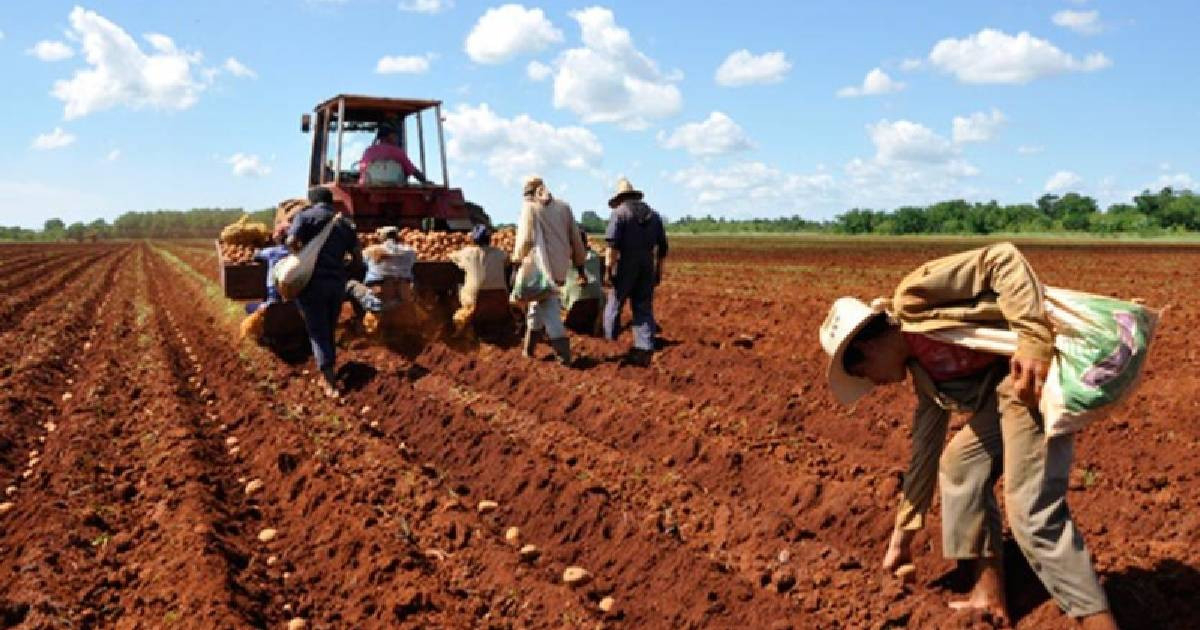
In a groundbreaking move, cooperatives in Artemisa province have begun importing fuel directly, a development made possible by the inclusion of such measures in the new package of 176 Economic and Social Transformations. However, the cost in foreign currency is leaving the majority of farmers—those who are most in need—unable to make these purchases.
Juan Carlos Alcolea Torres, who serves as the president of the National Association of Small Farmers (ANAP) in Artemisa, has confirmed that the Credit and Service Cooperatives (CCS) Frank País, located in Güira de Melena, and José Antonio Echeverría from Alquízar, are now importing oil directly.
Additionally, a farmer from the CCS Vicente Pérez Noa in San Antonio de los Baños is participating in this initiative, with five other farming entities gearing up to join, according to the official newspaper, El Artemiseño.
Led by Pablo Orlando Pérez Guzmán, the CCS Frank País has successfully imported over 150,000 liters of oil, which has been distributed among various cooperative groups in the region.
Challenges of High Costs and Limited Access
The oil was initially priced at $2.50 per liter and has now dropped slightly to $2.40, which, although cheaper than the informal market rate, is still significantly higher than the previous subsidized price of 13.99 Cuban pesos, the source noted.
Pérez acknowledged, "In total, the amount surpassed 150,000 liters. Yet, more than half of our cooperative's farmers are unable to purchase this oil, even though we buy it at $2.50 initially and now at $2.40, compared to the $7 per liter price here."
Navigating Bureaucratic Hurdles
The transition from the historically subsidized price to the new foreign currency model is a major leap for producers. "Operating under this model is extraordinarily costly, and shifting from the subsidized 13.99 pesos to the current dollar rates is a tough adjustment," Pérez remarked.
The cooperative has attempted to mitigate the issue by providing between 20 and 50 liters to certain producers who are unable to afford the fuel, though Pérez admits it's insufficient for all. Despite these challenges, over half of their land is either planted or being prepared for planting.
The bureaucratic process has proven to be quite complex. "We are among the few that import directly, not through micro-enterprises. This has required substantial effort: initially, it took 18 days to navigate contracts, permits, fire department certifications, and approvals from Citma and Cupet. The journey from Mariel to us takes 15 days or more," Pérez explained.
Broader Energy Crisis
Farmer Julián Leal Muñoz warned that the operation will barely cover costs, providing no real profit margin, yet he stressed that there is no other choice. "Planting all available areas will be challenging, but we can't leave lands unused. We must produce on every farm and aim to sell in foreign currency to buy more oil and boost production," Leal stated.
This situation unfolds in the midst of Cuba's most severe energy crisis in decades. Following the arrest of former President Nicolás Maduro on January 3, Venezuela ceased its oil shipments to the island, and Mexico also scaled back its cooperation, amid sanctions imposed by the Trump administration on the Caribbean nation.
In May, the Minister of Energy and Mines, Vicente de la O Levy, publicly acknowledged that Cuba was entirely without fuel or diesel, having only associated gas.
The partial dismantling of the state monopoly over fuel importation has allowed private and cooperative sectors to enter the fray, creating a significant influx of foreign currency.
Between January and June, Cuba purchased nearly $96 million worth of fuel from the United States. While this benefits the non-state sector, it does not address the collapse of the national electrical system.
Understanding the Fuel Import Challenges in Artemisa
Why can't most farmers afford the imported oil?
The high cost of oil, priced in foreign currency, makes it unaffordable for many farmers who are used to subsidized rates, leaving them unable to purchase the necessary fuel for their operations.
What are the bureaucratic challenges faced by cooperatives importing fuel?
Cooperatives face extensive bureaucratic procedures, including securing contracts, permits, and certifications from multiple agencies, which can delay the import process significantly.
How does the energy crisis in Cuba affect fuel imports?
The energy crisis, exacerbated by reduced oil shipments from Venezuela and Mexico, has forced Cuba to allow private and cooperative sectors to import fuel, yet this has not resolved the broader energy issues facing the nation.