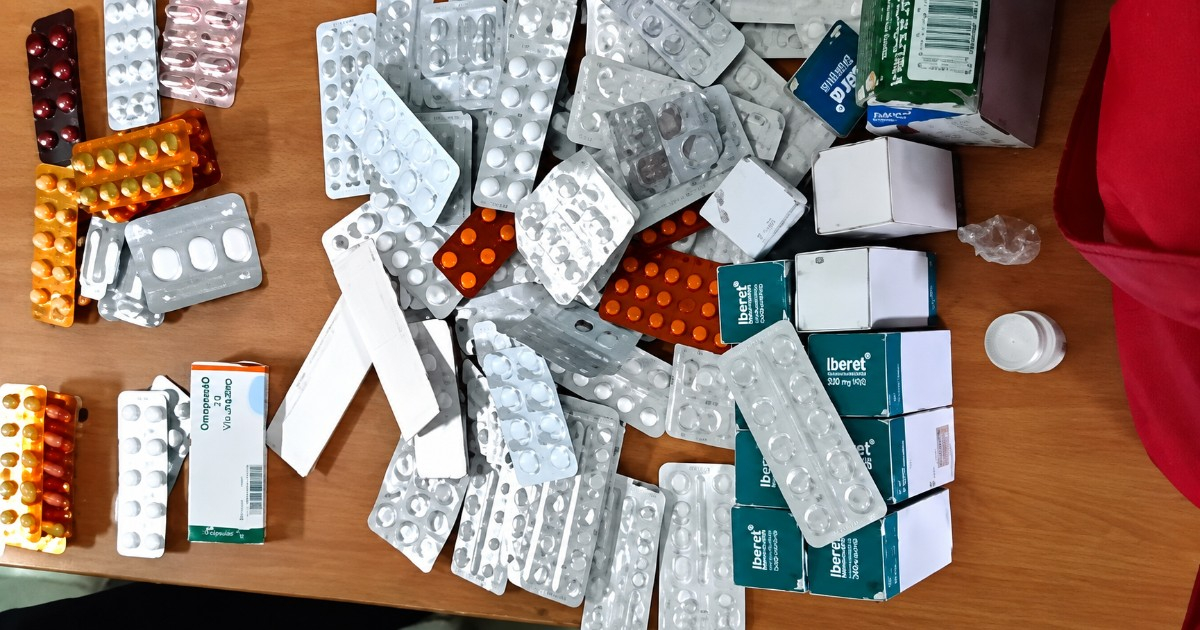
In a recent operation, the Revolutionary National Police (PNR) seized a substantial quantity of medications allegedly being sold illegally in the Sueño neighborhood of Santiago de Cuba. This action was reported on Friday by the state-affiliated website "Santiago de Cuba Hoy," which is linked to the Ministry of the Interior (MININT).
The confiscated items included both locally produced drugs and those sold under strict control through the state-run pharmacy network, according to the authorities. The official source noted that those involved were unable to provide legal documentation for the origin of the products. However, details such as the number of arrests or the identities of the suspects were not disclosed.
Photographs from the raid reveal a large assortment of blister packs, boxes, and loose pills of various colors scattered across a table, suggesting a domestic setting. Some of the packaging bore the abbreviation "BICA," which is likely associated with Bicalutamide, a medication that requires controlled distribution.
Authorities have stated that investigations are ongoing to trace the source of these pharmaceuticals and to ascertain if additional individuals are connected to the scheme.
Recurring Pharmaceutical Raids Highlight a Broader Issue
This operation is not an isolated incident. Earlier this year, in February, the PNR conducted another seizure targeting illegal drug sales at the 18 Plantas de Garzón, also in Santiago de Cuba, which sparked reactions on social media.
Such patterns are observed across the island. In June, two women were arrested in Holguín for similar offenses; in December 2025, seven people were detained in Havana; and in October of the same year, a Villa Clara court sentenced an individual to six years in prison for selling medications and medical supplies illegally, including tramadol and diphenhydramine.
The Underlying Pharmaceutical Crisis
The backdrop to these raids is Cuba's most severe pharmaceutical shortage in decades. As of April, only 30% of the national essential drug list—190 out of 651 medications—was available in state pharmacies.
In August, Ciego de Ávila reported a shortage of 457 medications unavailable in its local pharmacy network. In February, Villa Clara authorities admitted to a deficit of 368 out of 636 essential drugs, acknowledging that "all pharmacological families are affected."
This chronic scarcity forces the population to turn to the informal market, where drugs are circulated without medical oversight and sold at exorbitant prices, often with the risk of being adulterated.
Efforts and Limitations of Regulatory Actions
The State Center for the Control of Drugs (CECMED) has issued warnings about counterfeit or adulterated medications in circulation. Despite over 5,000 inspections and joint operations by the Ministry of Public Health (MINSAP) and MININT, these actions fail to address the fundamental issue: the persistent shortages that the dictatorship has neither been able nor willing to resolve over decades.
Under the current Cuban Penal Code, illegal sales of controlled medications can result in prison sentences of up to 10 years, with even harsher penalties if the drugs are classified as narcotics or psychotropics.
FAQs on Cuba’s Pharmaceutical Shortage
Why is there a pharmaceutical crisis in Cuba?
Cuba is experiencing a severe pharmaceutical shortage due to long-standing issues with supply and distribution, exacerbated by economic constraints and government mismanagement.
What are the consequences of buying medications from the informal market in Cuba?
Purchasing drugs from the informal market can lead to the use of adulterated or counterfeit medications, posing significant health risks to individuals.
How are the Cuban authorities responding to illegal drug sales?
The Cuban authorities have conducted numerous inspections and raids to curb illegal drug sales, although these measures have not effectively addressed the root causes of the pharmaceutical shortage.