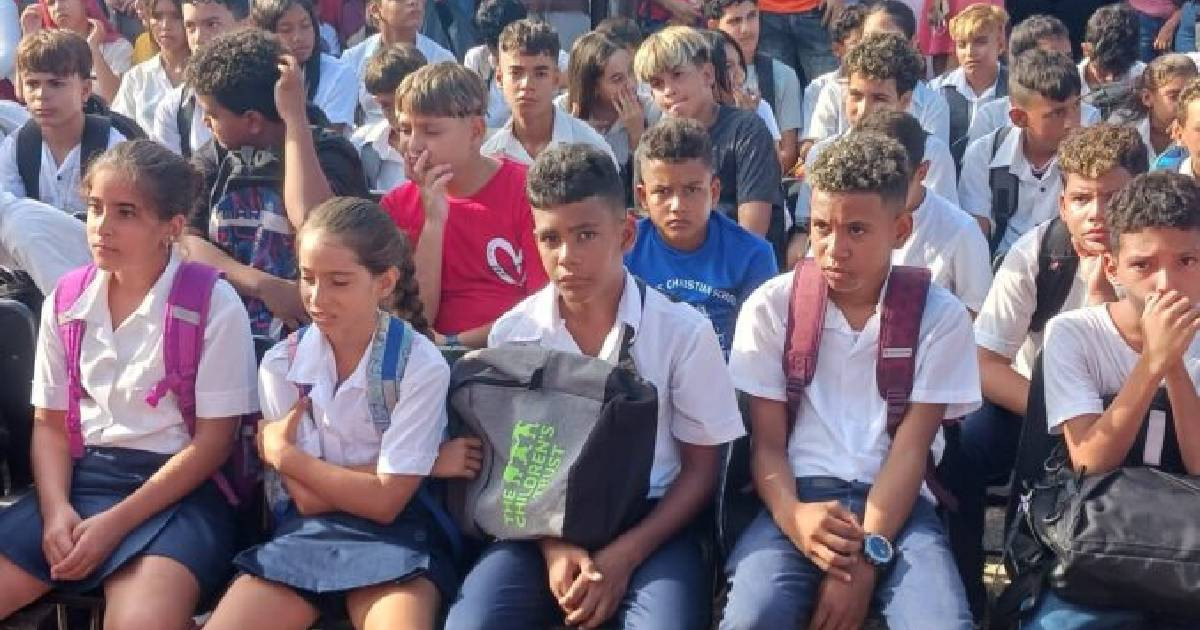
Manuel Abelardo Ortiz Uriarte, the provincial director of Education in Granma, traveled across most of the municipalities in the region to oversee the start of the 2026-2027 school year. He reported that there is "joy in the schools" and "good class attendance," although he acknowledged that fuel shortages severely hampered the distribution of materials "like never before."
"As of this Thursday, we have visited eight of the municipalities in Granma. There is joy in the schools, a good attendance to classes, and a commitment to this process. A positive atmosphere is noticeable in this regard," Ortiz stated, according to a report by Radio Bayamo.
Nonetheless, in the same statement, the official admitted that delivering resources to mountainous areas proved extraordinarily challenging.
"It has been very complex, like never before, but thanks to not being alone in this. In the mountains, we utilized all possible routes to deliver the missing materials," he explained.
To navigate the fuel shortage, authorities turned to both state and non-state economic actors, relying on the fact that textbooks and study programs for the first and second improvement phases were already in the communities before the school year began.
In Granma, there are 42 boarding schools serving 4,560 students, and the energy crisis forced adjustments to their stay schedules, with some centers operating in 15-day cycles every two or three months depending on their location.
The provincial authorities' propagandistic tone mirrors the central government's narrative. President Miguel Díaz-Canel presided over the opening ceremony at the University of Matanzas, describing the reopening of classrooms amidst the crisis as "the most revolutionary."
Similarly, Education Minister Naima Ariatne Trujillo Barreto referred to the start as "a big celebration" despite acknowledging "tremendous difficulties."
The Cuban educational system is grappling with a shortage of at least 24,000 teachers, equivalent to 12.5% of the planned positions, while only 20% of students received new uniforms.
The dire economic context exacerbates the situation further. A recent video revealed that a basic school snack, such as bread, guava paste, and soda, costs around 500 pesos, in a country where the average monthly salary was 7,074 pesos in April, according to the National Office of Statistics and Information.
Economist Javier Pérez Capdevila estimated in June that an individual requires approximately 96,000 pesos monthly to cover basic needs, with 70,000 pesos allocated solely to food, a gap that renders even school snacks inaccessible for most Cuban families.
While the official newspaper Granma romanticized the recent start of the school year, it had to concede that "material shortages, serious energy difficulties, and adversities of all kinds have aligned this time like never before, with a truly adverse effect on the education system."
The previous school year, 2025-2026, was ended prematurely due to the energy crisis, a precedent the regime tends to downplay while celebrating the start of the new academic year as an achievement.
Challenges in Cuban Education During the Fuel Crisis
How is the fuel shortage affecting schools in Granma?
The fuel shortage has severely complicated the distribution of educational materials, particularly to mountainous regions, making it extraordinarily challenging for schools to operate smoothly.
What measures are being taken to address the fuel shortage in Cuban schools?
Authorities have collaborated with both state and non-state economic actors to mitigate the fuel shortage, utilizing available resources and ensuring that textbooks and study programs were distributed to communities prior to the school year.
What is the current state of the teacher shortage in Cuba?
Cuba is facing a deficit of at least 24,000 teachers, which represents 12.5% of the planned teaching positions, significantly impacting the quality and availability of education in the country.