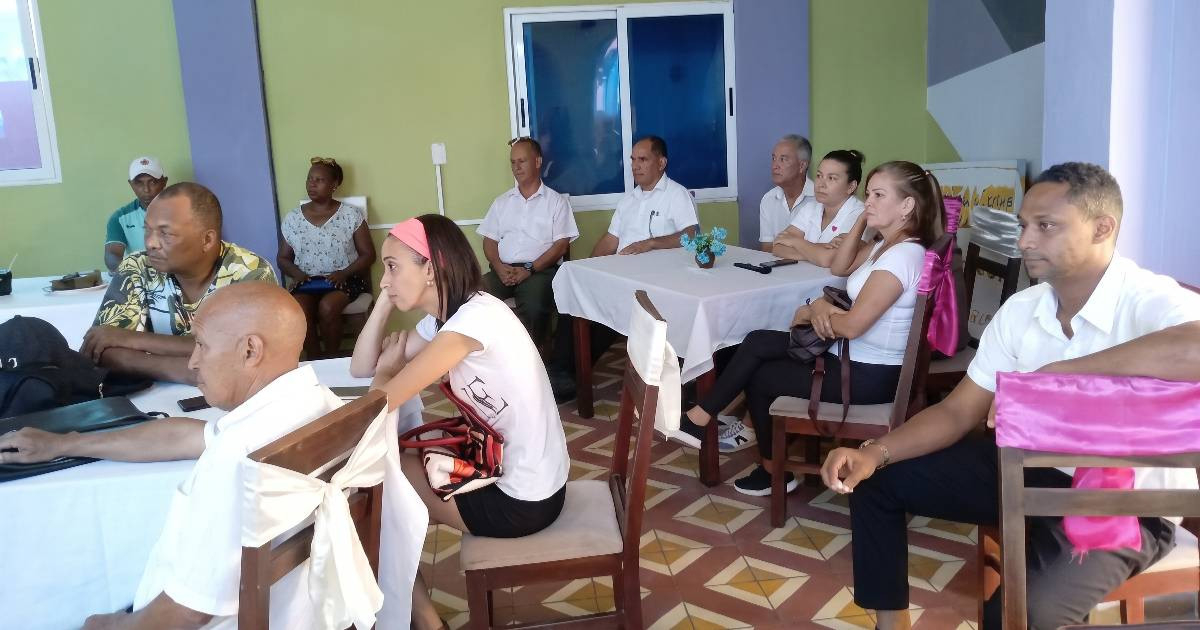
In the municipality of Manuel Tames, Guantánamo, employees of the Commerce and Gastronomy company have been left without their salaries for two months, as reported by Radio Guantánamo on Friday during a review of the province's operational and socio-economic meeting.
This issue was addressed in a gathering led by Yoel Pérez García, the first secretary of the Communist Party in Guantánamo, alongside key provincial and municipal authorities through an audio conference.
The official report merely acknowledged a "delay in salary payments" to these workers, failing to clarify the reasons behind the non-payment or detail any specific actions being taken to rectify the situation.
This case adds to other economic and social challenges discussed during the meeting, such as water supply issues in various areas and the effectiveness of pension payments with contributions from the non-state sector.
The information released by the authorities did not specify when the overdue wages for Commerce and Gastronomy workers in Manuel Tames would be settled.
This situation is the latest manifestation of a liquidity crisis plaguing the eastern province. In July, officials admitted that the province's banks lacked sufficient cash to meet operational needs and warned of sanctions against state and private merchants refusing electronic transfer payments.
The Bank of Credit and Commerce (Bandec), for instance, was only able to secure a little over 35% of the nearly 15 million pesos needed daily for operations.
Due to the banking system's shortcomings, the provincial government turned to a solution that independent economists have criticized as makeshift, involving 113 private businesses to manage cash pension payments for over 3,000 retirees.
Yaritza León Mustelier, the provincial director of the Banco Popular de Ahorro, described this involvement as an act of "human interest in providing an essential service to society," as reported by the official newspaper Venceremos.
This pattern of non-payment in the Commerce and Gastronomy sector is mirrored in other provinces. A public complaint in August highlighted that employees in the same sector in Guáimaro, Camagüey, had gone nearly six months without pay, despite a 90 million peso allocation by the Provincial Bank that never reached the workers.
Additionally, in Camagüey, teachers at the Vicente Chávez mixed school in Vertientes reported in July that they had not received their salaries for two months. The only official response they received was "there is no money."
In July, the government approved raising the minimum wage from 2,100 to 3,210 pesos per month. However, independent economists warn that this amount is negligible compared to an estimated cost of living exceeding 50,000 pesos monthly per person.
Meanwhile, Guantánamo is witnessing massive gatherings outside the Banco Popular de Ahorro, where citizens are unsuccessfully attempting to withdraw cash.
The situation has evolved from a banking difficulty into a social problem, recognized by Venceremos in describing the province's condition.
Key Issues Facing Guantánamo Workers
Why haven't the Commerce and Gastronomy workers in Guantánamo been paid?
The official report acknowledges a delay in salary payments but does not provide specific reasons for the non-payment or detail measures to resolve it.
What has been the response of the provincial government to the banking crisis?
The provincial government has enlisted 113 private businesses to manage cash pension payments for over 3,000 retirees, a move criticized by economists as makeshift.
How has the salary delay affected other sectors in Cuba?
The salary delay is not isolated to Guantánamo; similar issues have been reported in Camagüey, affecting both commerce and education sectors.