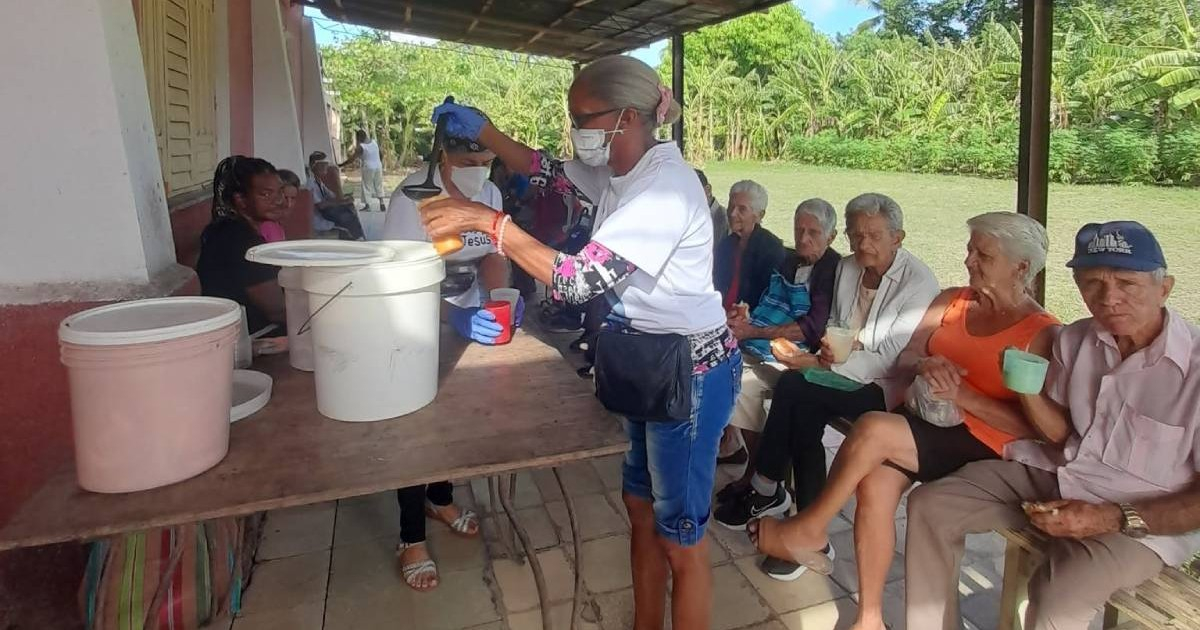
In the small town of Minas, located in Camagüey province, a Christian pastor has voiced his outrage after Cuban authorities barred his church from distributing breakfasts to the elderly and sick on the streets. Instead, those in need must now make their way to the church to receive help.
Pastor Juan Carlos Dobal Rodríguez took to Facebook to express his discontent, explaining that the initiative, known as "A Breakfast with Jesus," continues but under restrictive conditions imposed by the state that undermine its original mission.
"This time, the elderly from the Home had to leave their residence to partake in this breakfast with Jesus. Many ill individuals had to walk several blocks to reach us because we were prohibited from going out to the streets as we had been doing," the pastor shared in his post.
Restrictions on Outreach Efforts
This community service project aimed to reach vulnerable sectors, including seniors, the sick, and those in need, by bringing them breakfast and a Christian message directly to their locations. However, due to government mandates, the church must now hold the event within its premises every Tuesday at 8:30 a.m.
"It's not our preferred method, but we're restricted as a church from conducting our outreach beyond the temple, where all these individuals who need a meal and, most importantly, God's love, are found," Dobal Rodríguez clarified.
Photos accompanying the post depict volunteers wearing religious-themed T-shirts serving drinks and bread to groups of elderly individuals under zinc roofs. Printed on their shirts is a verse from Matthew 25: "For I was hungry, and you gave me food; I was thirsty, and you gave me drink; I was a stranger, and you took me in."
Religious Restrictions Intensify in Cuba
This incident is part of a broader pattern of religious restrictions documented in Cuba. As noted by the United States Commission on International Religious Freedom (USCIRF), the regime's Office of Religious Affairs requires state approval for any activities outside regular worship, including public social assistance efforts.
Restrictions have tightened in 2026, with notable incidents including the arrest of Pastor Rolando Pérez Lora for praying publicly in April and reports of state security agents in civilian clothing attending a Good Friday procession in Havana. In June, another pastor was detained following a peaceful religious demonstration in Cabaiguán.
The Alliance of Christians in Cuba recorded approximately a thousand violations of religious freedom in 2024, highlighting the extent of the regime's control over faith communities.
Churches Step Up Amid Economic Crisis
Amidst the economic crisis, Cuban churches have increasingly taken on humanitarian roles. In June, Caritas Camagüey launched a soup kitchen for the homeless in the provincial capital, contrasting sharply with the obstacles placed by the state on those attempting to extend similar services beyond church walls.
Pastor Dobal Rodrigues concluded his post with a poignant reflection aimed at critics questioning the church's role in Cuba's crisis: "The church in Cuba is so deeply embedded within the community that it cannot be viewed superficially." He remains hopeful for a future where street outreach is possible once more: "We pray to God to once again take 'A Breakfast with Jesus' to the streets of Minas for this community."
Understanding Religious Restrictions in Cuba
What restrictions are placed on religious activities in Cuba?
Religious activities outside regular worship require state authorization. This includes social assistance projects carried out in public spaces, which are restricted by the regime's Office of Religious Affairs.
How have religious restrictions in Cuba changed in 2026?
In 2026, there has been an escalation in restrictions, including arrests of pastors for public prayers and increased surveillance during religious events, reflecting a tightening grip on religious freedoms.
What role are churches playing in Cuba's economic crisis?
Churches have stepped up to provide humanitarian aid, such as soup kitchens for the homeless, showing a commitment to support vulnerable communities despite state-imposed limitations.