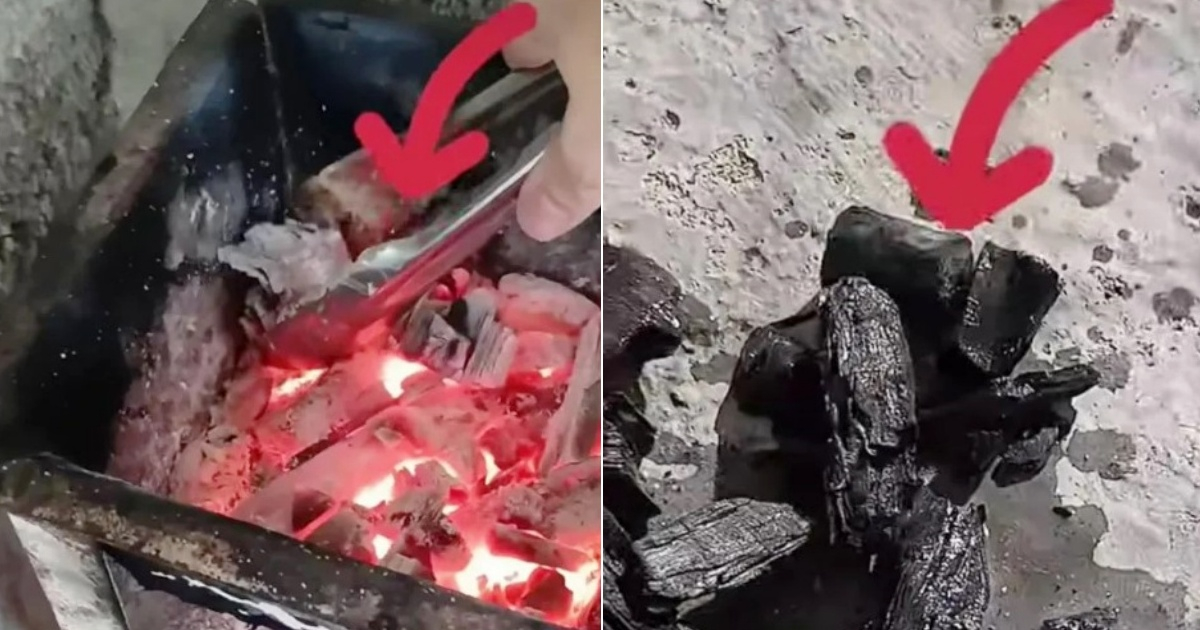
A 22-second video shared on Facebook by Cuban content creator Suramia Castro has taken social media by storm this week, showcasing a simple yet effective household technique for reusing leftover burning charcoal after cooking.
Suramia's Facebook video quickly amassed 537,984 views, 12,682 likes, and 537 comments, underscoring how the topic of charcoal strikes a deep chord among Cubans both on the island and abroad.
Step-by-Step Charcoal Recycling
Suramia's approach is as straightforward as it is efficient: instead of allowing still-burning charcoal pieces to burn out completely after cooking, they are immediately submerged with tongs into a container of cold water to extinguish them.
Once cooled, the pieces are laid out to dry thoroughly in the sun, ready to be reignited for the next cooking session.
"Here, I'll teach you how to recycle your burning charcoal, my dear. This method has helped me stretch a sack of charcoal much further. Plus, it's been economical for me since every time I buy a sack, the prices are higher," the creator explains in the clip.
Her conclusion is straightforward: "Once this charcoal is dry, you can reuse it as if new, with no issues."
In response to the implicit question of whether water-doused charcoal works the same, she answers without hesitation: "When it's dry, just light it again."
The Resonance of Practical Advice
The video's success is no accident. Charcoal has become the de facto household fuel for millions of Cuban families amidst the collapse of electricity supplies and the practical disappearance of liquefied gas.
The state-owned company CUPET indefinitely suspended the distribution of liquefied gas in Santiago de Cuba and other eastern provinces starting January 2026. Power outages affected up to 72% of Cuban territory simultaneously in August.
In this context, a sack of charcoal can now cost over 4,000 pesos in several provinces, compared to the 900-1,400 pesos it cost in December 2024, representing nearly half of a professional's monthly salary, which averages at 6,930 pesos.
The irony is that Cuba exported charcoal worth 61.8 million dollars in 2023, ranking as the ninth-largest global exporter of the product, while its citizens lack cooking fuel.
A Growing Survival Trend
Suramia's video joins a burgeoning wave of survival tutorials that have flooded Cuban social media over the past two years.
In April 2025, a Cuban woman went viral on TikTok for showing how to light charcoal using oil, gasoline, or paper, capturing the situation with a phrase: "This is what most Cubans are cooking with."
In November 2025, the sawdust stove, capable of burning for up to 24 hours, gained popularity.
By March 2026, creator Yumail released a tutorial on lighting charcoal without fuel using nylon and polystyrene, which also went viral.
Pinar del Río photographer Mikely Arencibia Pantoja summed it up in July with a widely circulated phrase: "There was a time when charcoal was for country folk, outdoor parties, or those who wanted a special flavor in their food. Today, in Cuba, charcoal supports millions of households. It's sad that it was charcoal, not progress, supporting the nation's kitchens."
Key Insights on Cuba's Charcoal Challenges
Why is charcoal so important in Cuba right now?
Charcoal has become a crucial fuel source for millions of Cuban families due to the collapse of electricity supplies and the scarcity of liquefied gas.
How does Suramia Castro's method help Cubans?
Suramia's method allows Cubans to reuse leftover charcoal, making each sack last longer and helping them save money as prices for charcoal continue to rise.
What is the current cost of charcoal in Cuba?
In some provinces, a sack of charcoal can cost over 4,000 pesos, a significant increase from the 900-1,400 pesos it was priced at in December 2024.