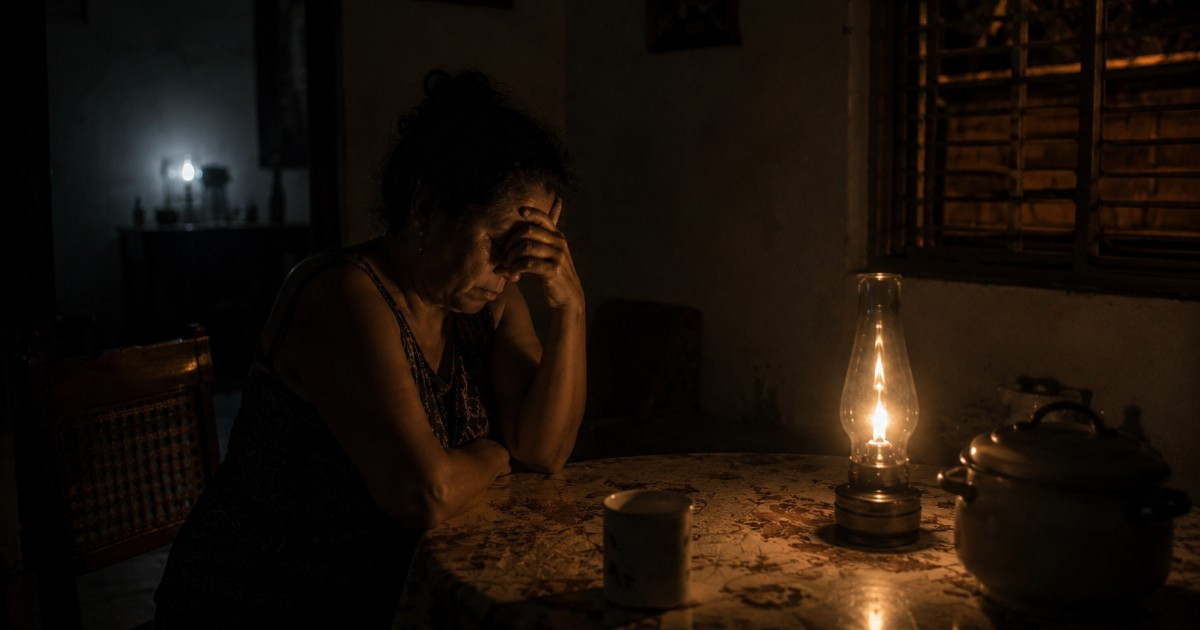
Elena Pérez, a resident of the Arroyo Arenas neighborhood in La Lisa, Havana, took to Facebook on Thursday to voice her outrage against the electric authorities and the government, accusing them of failing to provide consistent power service for five consecutive days.
"Today is Thursday, September 3, and since Sunday, August 30, this circuit 2073 has faced continuous disruptions," Pérez lamented. She described an exhausting cycle of interruptions: "They pretended to restore the service, but it was a facade—the power kept coming and going until it was completely out."
Pérez accused local operators of blatant corruption, asking, "Who benefits from the electricity that rightfully belongs to us?" She directly challenged the authorities in La Lisa and the province, questioning, "Why are we not given the same rights as other circuits?"
Her frustration was palpable as she condemned what she saw as deliberate neglect: "The government knows, the Party knows, and they mock us. Nobody, absolutely nobody, listens to us."
Her words captured a sense of desperation extending beyond mere inconvenience: "They've turned Cuba into a living hell," she declared, concluding, "They're all guilty, every single one, the first to break the law."
Public Outcry Over Unequal Power Distribution
In recent months, numerous Havana residents have publicly decried the prioritization of certain electrical circuits, which receive uninterrupted service, while others endure blackouts lasting over 30 hours.
This week, baritone Ulises Aquino Guerra criticized the uneven distribution of electricity in the Kholy district of Playa municipality, highlighting that his circuit received only 55 minutes of power over six consecutive days.
"Fifty-five minutes of electricity in six days is hardly a 'socialist' distribution," Aquino remarked with irony, contrasting it with other areas of the same municipality that enjoy two or more hours of power.
At the end of August, a La Lisa resident demanded "clarity and transparency" from Energy and Mines Minister Vicente de la O Levy regarding the criteria for prioritizing certain circuits over others.
"It's puzzling to have more than 30 hours without electricity and then only two hours with it, while a nearby circuit never loses power. The reasons for these decisions remain unknown," she stated.
In July, a mother in Calabazar, Boyeros municipality, accused state electric workers of illegally selling electricity meant for her neighborhood, while other circuits and private businesses received constant supply in exchange for money.
The woman detailed that for months, her area received power for only a short period each day, while small businesses and prioritized circuits enjoyed 24-hour service. According to her account, one night, locals confronted the responsible crew, catching them red-handed: "The utility vehicle, a basic necessity, was loaded with beer cases, they had wads of cash, and they were as drunk as skunks, reveling and making a profit at the expense of the people's suffering," she recounted.
Understanding Cuba's Power Outage Crisis
What are the main reasons behind power outages in Cuba?
The outages are often attributed to outdated infrastructure, mismanagement, and alleged corruption within the power distribution system, compounded by economic challenges faced by the country.
How are residents responding to the electricity crisis in Cuba?
Residents are increasingly using social media platforms to voice their grievances, demanding transparency and fairness in the distribution of electricity. Some have organized community actions to hold accountable those responsible for the irregularities.
What actions have been taken to address the unequal power distribution?
While some government officials have been called to address these issues, substantive action and clear communication remain limited, leading to heightened public frustration and calls for reform.