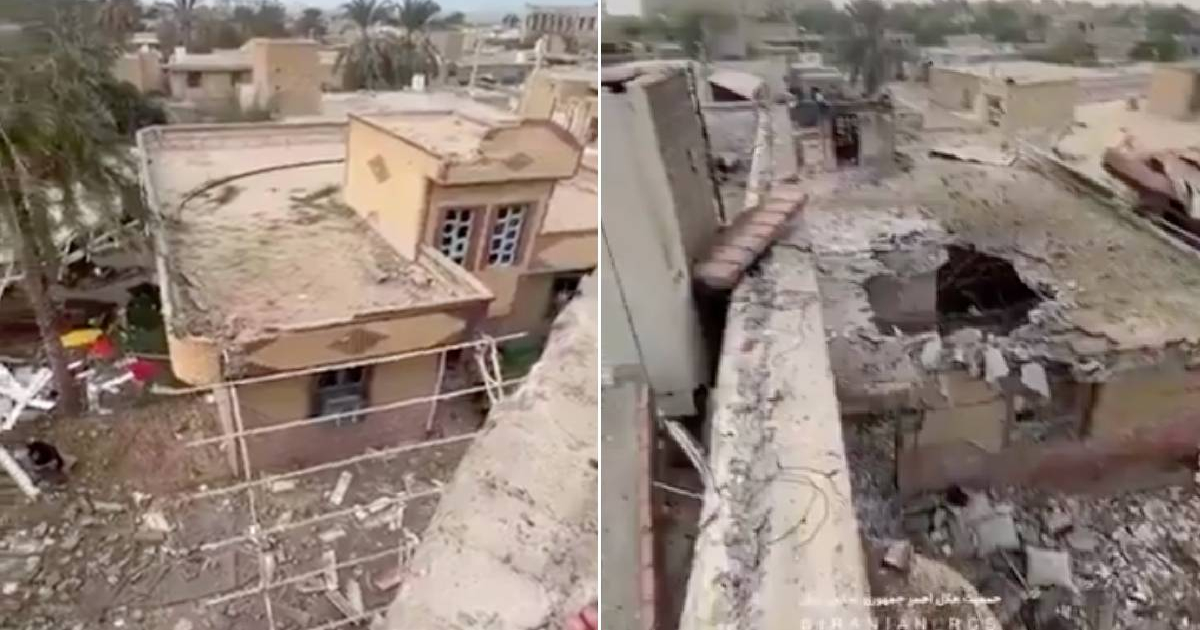
This Wednesday, Iran condemned a U.S. attack that resulted in four deaths during a wedding celebration, labeling it a war crime, as reported by EFE on its verified X account.
Accompanying the news were images depicting a thick column of black smoke rising from what appears to be an urban area, likely connected to the site of the impact.
Tehran's accusation, framed within the context of international humanitarian law, describes the incident as a war crime. Under the Geneva Conventions, such a classification is possible when an attack intentionally, disproportionately, or negligently results in civilian casualties.
Information currently available confirms that four individuals were killed during the wedding in Bandar Koohestak, Sirik County, which was targeted by a U.S. strike.
As of now, there has been no official response from the Washington administration regarding Iran's accusation, leaving the U.S. perspective on the incident unrepresented and the operational reasons behind the attack unexplained.
This accusation arises amid the longstanding hostility between Iran and the United States, a relationship fraught with decades of diplomatic strains and instances of direct and indirect military confrontations across various Middle Eastern theaters.
Unanswered Questions and Legal Implications
The immediate context of the conflict or military operations preceding this specific attack has yet to be clarified with the available sources.
EFE also reported Iran's accusation via its video channel under the title "Iran Accuses U.S. of War Crime Following Fatal Airstrike," enhancing the coverage by the Spanish agency and indicating broader attention to the incident than initially reported on social media.
From an international law perspective, labeling an act as a war crime carries significant legal implications: those responsible could be prosecuted in international courts, including the International Criminal Court. However, effective jurisdiction over powers like the United States is practically limited, as Washington does not recognize the court's authority.
The identities of the victims, reportedly including a minor, the type of weaponry or aircraft used, and the operational circumstances of the attack remain unconfirmed pending further information from both governments.
The international community has yet to issue any known public statements regarding the incident, adding uncertainty to an episode that, if confirmed in full, could elevate tensions between Tehran and Washington to a new level of diplomatic and military urgency.
Frequently Asked Questions about the Iran-U.S. Conflict
What qualifies as a war crime under international law?
A war crime involves violations of international humanitarian law, such as deliberately targeting civilians, causing disproportionate harm, or failing to take precautions to prevent civilian casualties.
How does the Geneva Convention relate to this incident?
The Geneva Conventions provide a framework for international humanitarian law, which includes protections for non-combatants and stipulates conditions under which attacks can be classified as war crimes.
Why might the U.S. not recognize the International Criminal Court's authority?
The United States does not recognize the ICC's authority due to concerns over sovereignty and the potential for politically motivated prosecutions against its military and officials.