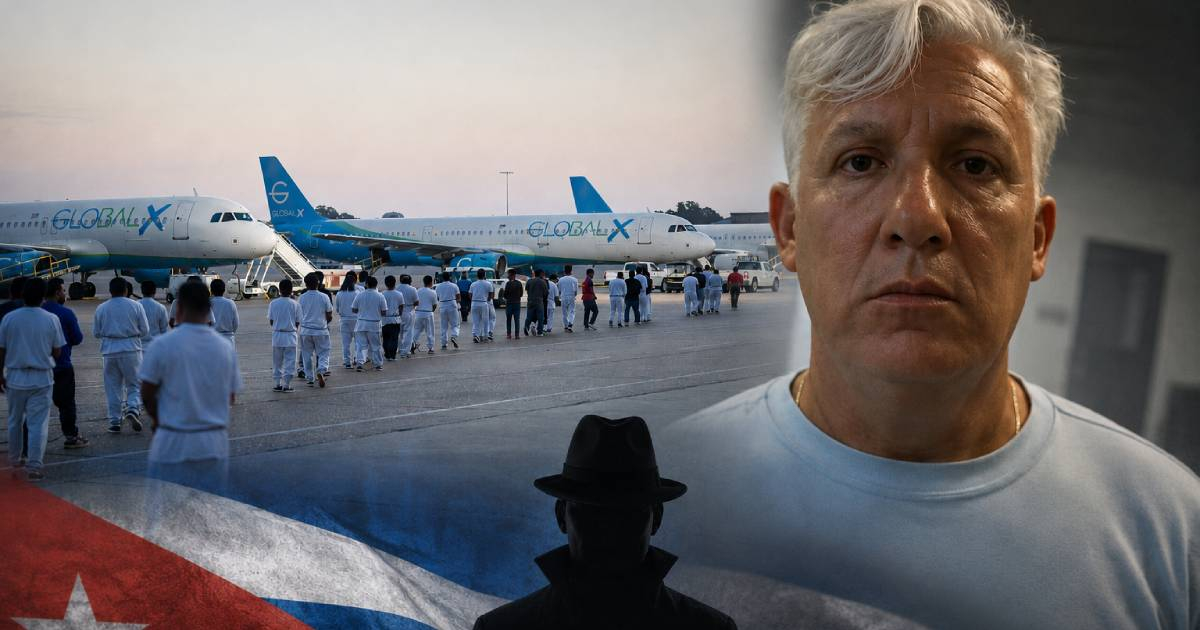
The U.S. Immigration and Customs Enforcement (ICE) has deported Fernando Armando Valdés Pérez, a 61-year-old Cuban-Guatemalan man identified by American authorities as an asset of the Cuban regime's intelligence service. Valdés Pérez allegedly infiltrated exile circles for years, including the network surrounding Luis Posada Carriles.
The deportation occurred on August 7, as disclosed by Martí Noticias through an official ICE statement.
Valdés Pérez, who lived in Kendall, Florida, was apprehended on July 10 at Miami International Airport during a coordinated operation involving ICE, the Federal Bureau of Investigation (FBI), and U.S. Customs and Border Protection (CBP).
U.S. authorities claim he fraudulently secured permanent residency in the country by deliberately concealing his ties to the Cuban regime.
The Decades-Long Infiltration
The most significant aspect of this case dates back decades. According to ICE, since the mid-1990s, Valdés Pérez was tasked with infiltrating Cuban exile and opposition groups in Latin America and the United States to gather intelligence for Havana.
ICE reports he managed to earn the trust of Luis Posada Carriles, a prominent and controversial figure in the anti-Castro exile community, who passed away in May 2018 at the age of 90 in South Florida.
Valdés Pérez is also said to have maintained close contact with other notable figures within the Cuban and Cuban-American communities in South Florida for years.
Deportation and Lack of Espionage Charges
Following his arrest, Valdés Pérez was subjected to immigration proceedings until his deportation on August 7. ICE did not specify his destination, nor did they reveal what information he may have provided to Cuban intelligence or about whom or what organizations he reported.
The statement also did not mention any criminal charges of espionage against him.
Matthew Elliston, director of ICE's Enforcement and Removal Operations office in Miami, warned that "individuals who conceal connections to foreign intelligence services and exploit our immigration system pose a serious threat to the integrity of that system and our national security."
He emphasized that ICE will continue collaborating with other federal agencies to identify, detain, and deport individuals who have fraudulently obtained immigration benefits.
Broader Context of Cuban Intelligence Activities
The case of Valdés Pérez is part of a broader pattern of U.S. actions against Cubans linked to Havana's intelligence or security apparatus.
In March 2025, ICE and the FBI apprehended Tomás Emilio Hernández Cruz, a 71-year-old former high-ranking Cuban intelligence officer residing in West Park, Florida. He was accused of immigration fraud for concealing his involvement with Cuban intelligence and the Communist Party.
A month later, Daniel Morejón García, a former Ministry of the Interior official implicated in the repression of the July 11 protests, was arrested in Miami and deported to Cuba in May 2025.
In these instances, U.S. immigration authorities have focused on whether the individuals concealed critical information about their backgrounds or connections to Cuban institutions when applying for immigration benefits in the United States.
Valdés Pérez's case emerges amid renewed allegations from Washington concerning Cuban intelligence activities.
In mid-July, the State Department released a report titled "Cuba: The Capital of 21st Century Communism," presented by Secretary of State Marco Rubio. The report accuses Havana of conducting espionage operations on U.S. soil for decades and identifies 18 signal intelligence facilities in Cuba, some linked to China and Russia.
Cuban Foreign Minister Bruno Rodríguez Parrilla dismissed the accusations, calling the report a "slanderous pamphlet."
Rubio, however, asserted that Cuba is "the only country that has systematically planted and covered up spies within the U.S. system."
This deportation highlights the ever-evolving immigration landscape. Stay updated on the latest developments in our U.S. Immigration section.
Understanding Cuban Intelligence Activities in the U.S.
What are the charges against Fernando Armando Valdés Pérez?
Fernando Armando Valdés Pérez was deported for fraudulently obtaining permanent residency by concealing his ties to the Cuban regime. No espionage charges have been announced against him.
Who is Luis Posada Carriles?
Luis Posada Carriles was a prominent and controversial figure in the anti-Castro Cuban exile community known for opposing the Cuban regime.
What is the significance of the ICE report on Cuban intelligence?
The report highlights Cuba's longstanding espionage activities in the U.S., identifying 18 intelligence facilities in Cuba, some with ties to China and Russia.