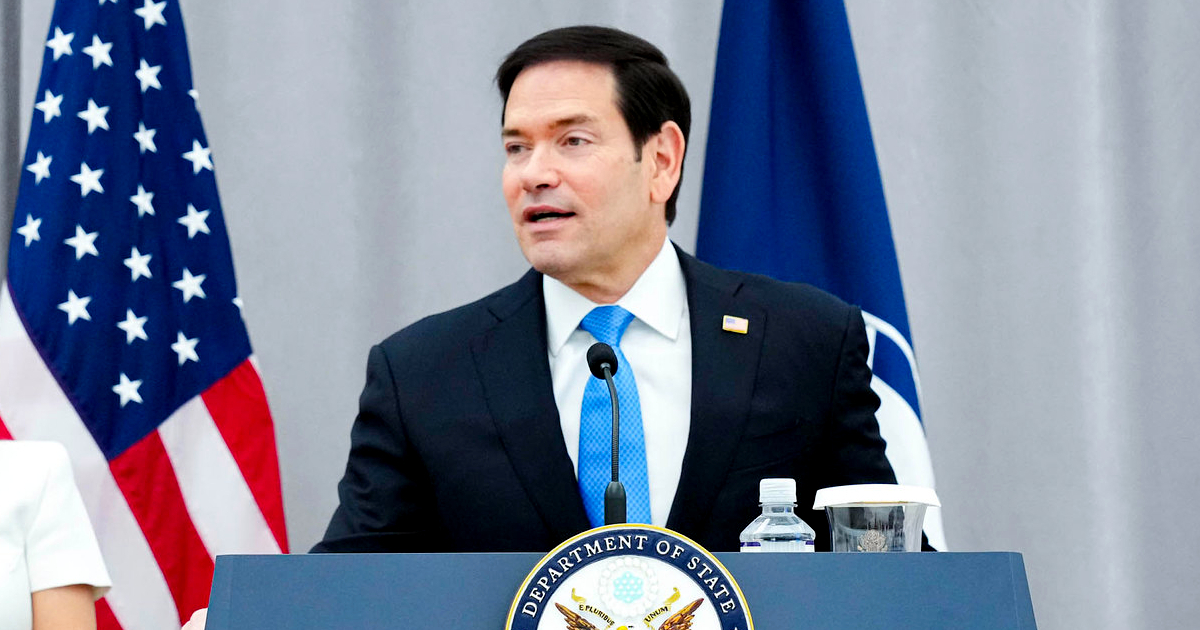
U.S. Secretary of State Marco Rubio has spoken about the ramifications of the immigration policy under Donald Trump's administration, highlighting the Cuban community as one of those heavily affected.
In a conversation with journalist Sergio Novelli, mainly focused on the situation in Venezuela and the future of Venezuelan migrants in the U.S., Rubio emphasized that the measures from Washington are not targeting any specific nationality.
"This is not aimed at Venezuelans. It's a general policy," stated the U.S. diplomat before specifically mentioning other communities.
A Broad Impact on Various Communities
Rubio pointed out, "We are witnessing cases involving Cubans for the first time. We're also seeing similar situations with Haitians, Salvadorans, and people from various countries around the globe, as this nation ultimately has laws that must be upheld."
His comments come at a sensitive time for many Cubans in the U.S., particularly those stuck in limbo with forms like I-220A and other non-permanent immigration statuses.
Current Legal Challenges and Uncertainties
In June alone, immigration courts issued 1,642 deportation orders for Cuban nationals. Reports have surfaced of increased detentions during ICE appointments, court-ordered expulsions, and cases of Cubans choosing voluntary departure to avoid detention.
Additionally, a Miami federal court has scheduled a hearing on September 10 for the Bello-Rubio v. Noem case, involving 992 Cubans seeking legal recognition of their releases as parole, potentially paving the way for eligibility under the Cuban Adjustment Act.
Administrative Hurdles from Trump Era Policies
Many Cubans are also caught up in pending processes with the United States Citizenship and Immigration Services (USCIS). Two memos from the Trump administration had previously halted the processing of asylum requests, permanent residency, work permits, citizenship, and other benefits for nationals of numerous "high-risk" countries, including Cuba.
A recent federal court order in California mandated USCIS to resume standard processing of these applications. Though the agency agreed to comply, it expressed disagreement with the ruling and hinted at possibly seeking a judicial review.
Rubio's Perspective on Immigration Policy
Rubio's statements, also made on Tuesday, are particularly significant for the Cuban community in the U.S., as many face uncertainty regarding their legal status and the consequences of Trump's stringent immigration policies.
During the interview, Rubio blamed the Biden administration for what he described as an unchecked immigration surge, which the current government is attempting to address.
"This country was overwhelmed by massive immigration that no nation can handle. This administration and this president were elected with a promise to fix it," Rubio declared.
The Debate Over Temporary Statuses
The Secretary of State also defended the notion that temporary immigration protections should not become indefinite.
"In terms of temporary statuses, they must eventually come to an end," Rubio argued, pointing out that these protections were extended for so long that they essentially became permanent.
However, Rubio acknowledged that the decisions made in Washington have real-life consequences for individuals and families who have established themselves in the U.S. over time.
"I understand it's a challenging issue because when you face something like what happened to this country, there are real-life consequences that are sometimes hard to accept or witness," he stated.
Case-by-Case Considerations
When asked about the response to immigrants worried about losing their protections, Rubio clarified that immigration decisions are not directly within the State Department's purview and depend on each person's particular history.
"Every case is different," he noted, differentiating between political asylum seekers, those under temporary status, and individuals who entered the country on a visa. "It all hinges on how that person entered the country, their current status, and the type of visa used for entry," he explained.
He also discussed those who overstayed their visas, stressing that authorities must review each situation individually. "Every case is individual," Rubio emphasized.
Although these remarks were made in response to questions about Venezuelans, Rubio had previously clarified that the immigration crackdown also affects Cubans and other groups.
Possibility of New Special Measures?
Another significant moment during the interview occurred when Rubio was asked about the potential for the Trump administration to introduce a special immigration mechanism similar to past measures.
"Anything is possible," he replied. However, the Secretary of State immediately noted that such an initiative is not currently under consideration. "That's not being discussed at this moment," he specified.
Rubio explained that the administration avoids prematurely announcing potential immigration programs or benefits because these announcements could be misconstrued outside the U.S. as an opportunity to enter the country.
"Every time a project like that is discussed in advance, it fosters the perception that there's a special permit to enter the United States," he stated.
According to Rubio, even if individuals do not meet the criteria for a potential measure, the mere announcement can create expectations and serve as an incentive for new migration flows.
"Right now, this administration aims to prevent another wave of mass immigration to the United States," he summarized.
Rubio's words thus leave open the theoretical possibility of future immigration measures, but they do not constitute an announcement of a new program nor confirm that the Trump administration is currently preparing a special protection.
For Cubans impacted by immigration changes, Rubio's message combines two elements: an explicit acknowledgment that the Cuban community is feeling the impact of certain measures for the first time and Washington's insistence on enforcing laws and reviewing each case based on individual circumstances.
Understanding the Impact of U.S. Immigration Policy on Cubans
What impact has Trump's immigration policy had on Cubans in the U.S.?
Trump's immigration policy has led to increased deportations and legal uncertainties for Cubans in the U.S., with many facing detention or being forced to leave voluntarily.
How are Cuban migrants affected by temporary status changes?
Temporary statuses are meant to expire, and recent policy shifts have led to these protections becoming less reliable, impacting many Cubans who have relied on them for an extended period.
Could there be new immigration measures for Cubans?
While Rubio indicated that new measures are theoretically possible, there are currently no discussions or plans in place for special immigration programs targeting Cubans.