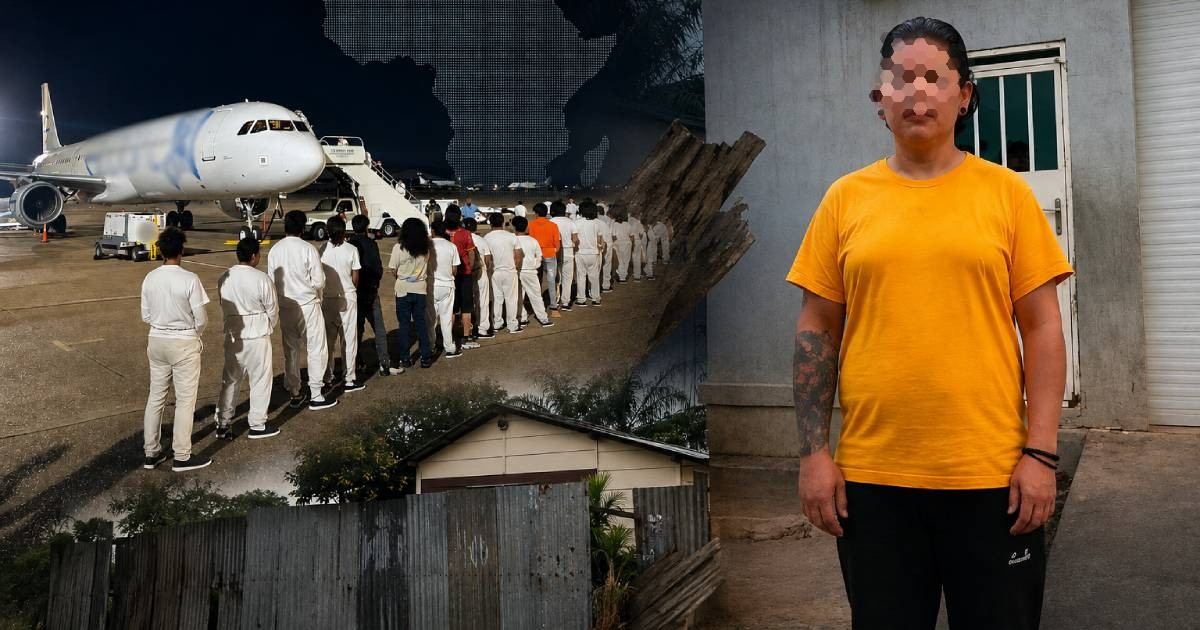
Daniel Fuentes, a 31-year-old transgender Cuban woman who once lived in Miami, has found herself in a precarious situation after being deported to the Central African Republic. In an interview with the Tampa Bay Times, Fuentes revealed that she has had to alter her appearance and behavior to hide her gender identity.
"Here, security guards advise me not to go out because it's not safe for me," Fuentes shared from Bangui, the country's capital. The fear of stepping outside looms large as she tries to remain inconspicuous in an environment where her identity makes her particularly vulnerable.
"Living with uncertainty in a place where LGBTQ rights are not acknowledged is a double challenge. I am longing for this to be over," she expressed.
Fuentes entered the United States in 2024 through an appointment secured via CBP One, initially receiving humanitarian parole and later working at a beauty salon in Miami. On March 23, ICE apprehended her, detaining her for four months before deporting her in July on a grueling 21-hour flight to Bangui.
She claimed she was not informed in advance about her deportation to the Central African Republic.
On the same flight were 35 other immigrants, including Cuban nationals Yasmany Moreno, 32, and Arístides Fernández, 37, who also spoke to the Tampa Bay Times about the uncertainty they face in the African nation.
Moreno recounted learning of his destination five hours into the flight when an agent informed him. "Honestly, I thought it was a bad joke," he recalled. Suffering from diabetes and asthma, Moreno fell ill for four days after the journey, which he endured while shackled at the wrists, waist, and ankles.
"It's an utterly inhumane situation. What are we doing here? It's a question we ask ourselves daily," said Moreno, who had lived in the United States for a decade and owned a small transportation business in South Florida.
Fernández described the ordeal as a "kidnapping." After being detained in January following an immigration hearing in Miami, he spent seven months in various detention centers before being transferred to Africa.
"We didn't sign any documents and have no idea what to do with our lives. No human being should have the right to do this to another," he declared.
The three Cubans are currently staying at Maison Confort, a modest hotel in Bangui, without their passports and uncertain of their fate. According to the report, leaving the hotel requires a five-dollar fee to a guard, and they've been warned they might have to vacate in 90 days.
Deportations to third countries allow the United States to expel certain migrants when they cannot be sent back to their home countries directly. In Cuba's case, challenges in executing some deportation orders have left individuals with final removal orders within U.S. borders for years.
The situation is particularly precarious in the Central African Republic. The U.S. Department of State has issued a Level 4 travel advisory for the country due to crime, kidnappings, and terrorism, among other risks.
Nevertheless, the Department of Homeland Security defended its stance to the Tampa Bay Times: "Once a person is no longer in ICE custody, ICE is no longer responsible for them."
Héctor Díaz, managing partner at Your Immigration Attorney in Miami, called the situation a "clear abuse of humanitarian rights," highlighting that deportees are trapped without clear legal options.
"Sending people to Africa is truly outrageous. They are essentially in limbo," he stated.
The policy of third-country deportations continues to spur legal battles in the United States, with thousands of Cubans under removal orders. Between October 2025 and June 2026, over 4,000 Cubans were issued deportation orders in Florida alone.
Daniel Fuentes' case underscores the plight of vulnerable individuals deported by the United States to third countries. Follow all the details on immigration processes, deportations, and rights in our U.S. Immigration section.
Understanding Third-Country Deportations and Their Impact
What are third-country deportations?
Third-country deportations involve sending migrants to countries that are not their home nations when direct deportation is not feasible.
Why is the Central African Republic considered a risky destination for deportees?
The U.S. Department of State has issued a Level 4 travel advisory for the Central African Republic due to high risks of crime, kidnappings, and terrorism.
What challenges do deported individuals face upon arrival in third countries?
Deported individuals often face uncertainty, lack of legal support, and difficulty integrating into unfamiliar and potentially hostile environments.