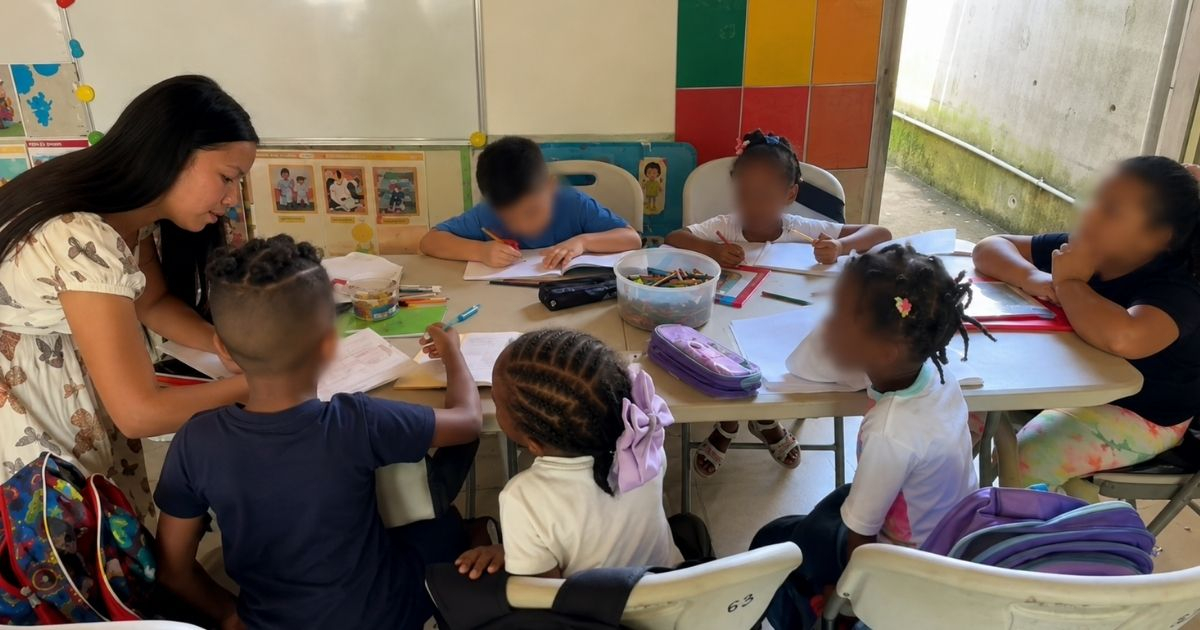
In the Mexican city of Tapachula, Cuban children and teenagers currently make up the majority of the approximately 120 migrant students who have begun a new school cycle in a local educational initiative. Tapachula has become a temporary, and sometimes permanent, settlement for many families from Cuba.
This information was reported by Diario del Sur, noting that the "Education Without Borders" program has enrolled students from Mexico, Cuba, Honduras, El Salvador, and Haiti, ranging in age from three to 17 years.
Esther Berenice, who oversees the primary education level, mentioned that most of the students are Cuban, although the program continues to welcome children from other nations. These students are spread across preschool, primary, and secondary levels, attending classes at the CEDECO facilities in Tapachula.
Due to the diverse ages, academic levels, and educational backgrounds of these children, the program operates under a multigrade system. While the curriculum follows the New Mexican School model, teachers must adapt it to an ever-changing student population due to the transient nature of migration.
The predominance of Cuban students in these classrooms isn't unprecedented. Earlier reports from May by Diario del Sur highlighted that both Cuban and Haitian students were the majority in the Migrant Education Program, a situation linked to families choosing to stay in Tapachula amid shifts in U.S. immigration policies.
Challenges arise in classrooms due to the mix of educational systems and languages. Haitian students, for instance, often arrive speaking Creole and may not be fluent in Spanish. Teachers use translators and technological aids to communicate, even enlisting bilingual students to help as interpreters for their peers.
Additionally, the program must be flexible with academic activities, accommodating children who join at different academic levels or enter partway through the school year. Since 2021, "Education Without Borders" has served over 1,150 children from more than 15 nationalities, according to Diario del Sur.
On July 10, 25 students graduated from a multicultural class named the "Generation of Peace," a milestone previously covered by the local Chiapas newspaper, which emphasized the diverse nationalities of the students within the program.
Enrollment for the 2026-2027 cycle remains open, allowing children in transit to join even if their families lack complete academic documentation. This occurs against the backdrop of a broader migration phenomenon in Tapachula, where local authorities noted a significant increase in Cuban residents during 2026, some awaiting immigration processes, others having been deported from the United States.
Estimates on the Cuban population in Tapachula vary widely; in May, Mayor Yamil Melgar Bravo cited over 10,000 Cubans in the city, while Human Rights Watch later reported around 800 deported Cubans stranded specifically in Tapachula. Such figures should not be seen as equivalent due to differing contexts.
Human Rights Watch also documented that Cubans were the most significant group among third-country nationals deported by the U.S. to Mexico between January 2025 and March 2026, with 4,353 Cuban nationals sent back during that time.
The extended stay has led many to integrate into Tapachula's daily life. For instance, a Cuban migrant has become a children's basketball coach, while others engage in informal work as they seek to regularize their status.
For families remaining in Tapachula, their children's education is no longer merely a stopgap in their migratory journey. The fact that Cubans now comprise the majority of the 120 students in the program also illustrates how the prolonged presence of Cuban nationals is reshaping the composition of the migrant population in this southern Mexican border city.
FAQs about the Migrant Education Program in Tapachula
What is the "Education Without Borders" program?
"Education Without Borders" is an educational initiative in Tapachula that provides schooling for migrant children from various countries, adapting to the diverse needs of its students.
How does the program accommodate students with different educational backgrounds?
The program uses a multigrade approach, allowing flexibility in teaching to address the varied ages, academic levels, and educational experiences of its students.
Why are Cuban children the majority in this program?
Cuban children are the majority due to the increasing number of Cuban families choosing to stay in Tapachula, influenced by changes in U.S. immigration policies and the challenges of their migration journey.