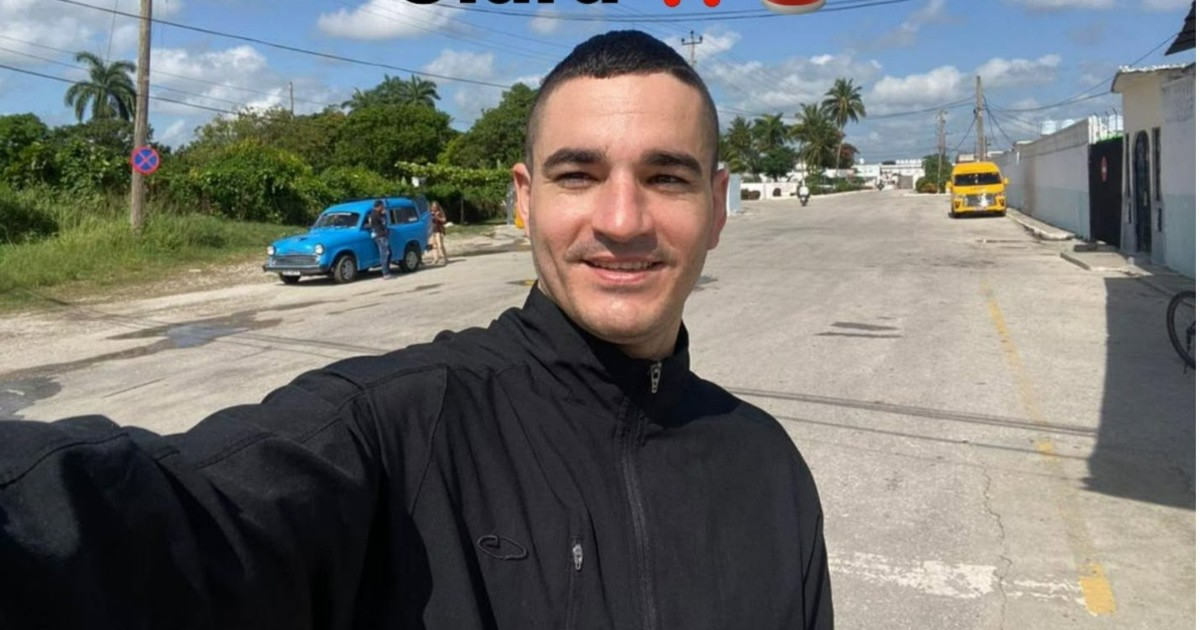
Former political prisoner Andy García Lorenzo, a prominent figure from the July 11, 2021 protests in Santa Clara, was apprehended this past Sunday for merely walking and filming with his phone. His sister, Roxana García Lorenzo, publicized the incident on Facebook, stating that he was taken to the Third Unit of the National Revolutionary Police.
Roxana shared that Andy was detained on 2nd Street La Vigía, and a State Security officer informed the family of his 24-hour detention for alleged "Public Disorder." In a sarcastic note, she commented, "Walking and filming in the street is considered a crime in Cuba."
“Simply being out in the street is enough; they don’t need a reason to arrest you. Just opposing the regime is sufficient for rights violations,” Roxana decried.
From the police station, Andy managed to call his parents, confirming his arrest. He informed them of his refusal to eat during his detention, except for water and liquids provided by his family, to prevent possible poisoning—a tactic reportedly used by authorities in the past, according to his sister's account.
Defying State Security's orders to leave, Andy's parents stood firm outside the Third Unit, reminiscent of their December 2024 protest at Guamajal prison, where they remained during his 16-day hunger strike over confiscated personal letters.
His brother-in-law, Jonatan López, an exiled activist in Germany, first raised the alarm: “Andy García has just been detained in Santa Clara. His parents are stationed at the third unit. Please share. Andy García is not alone.”
This arrest follows two months after State Security formally threatened him. On June 26, agents warned Andy at the Villa Clara State Security Crimes Unit of potential severe penalties—including decades in prison, life imprisonment, or even the death penalty—for posting images of military facilities, as per Cuba’s Penal Code article 116 on espionage.
This pressure was likely sparked by his social media activism, particularly the dissemination of protests against prolonged power outages in Santa Clara, where blackouts lasted up to 20 hours daily.
García Lorenzo was initially arrested during the July 11 protests in Santa Clara, sentenced to four years for contempt, public disorder, and assault, despite prosecutors seeking seven years. He served his full sentence in Guamajal, released in July 2025, and continued his activism by publicizing the identity of one of his abusers.
His experience highlights a systematic pattern of harassment against July 11 protest ex-prisoners. In May, Yoan de la Cruz was detained in San Antonio de los Baños; in July, Leonardo Romero Negrín was violently arrested in Central Havana. As of April 2026, Justice 11J documented 775 political prisoners in Cuba, with 338 linked to the July 11 protests.
“If anything happens to Andy, we hold State Security accountable for any harm,” warned Roxana García Lorenzo, emphasizing that “distance won't prevent us from making denunciations and ensuring the world hears what happens to him.”
Understanding the Arrest of Andy García
Why was Andy García arrested in Santa Clara?
Andy García was arrested for walking and filming on the street, which authorities labeled as "Public Disorder."
What actions did Andy García's family take following his arrest?
His parents protested outside the Third Unit of the National Revolutionary Police, despite orders to leave, and his sister shared the incident on social media.
What threats did Andy García face prior to his arrest?
He was warned by State Security of severe penalties for posting images of military facilities, citing potential charges under Cuba's espionage laws.