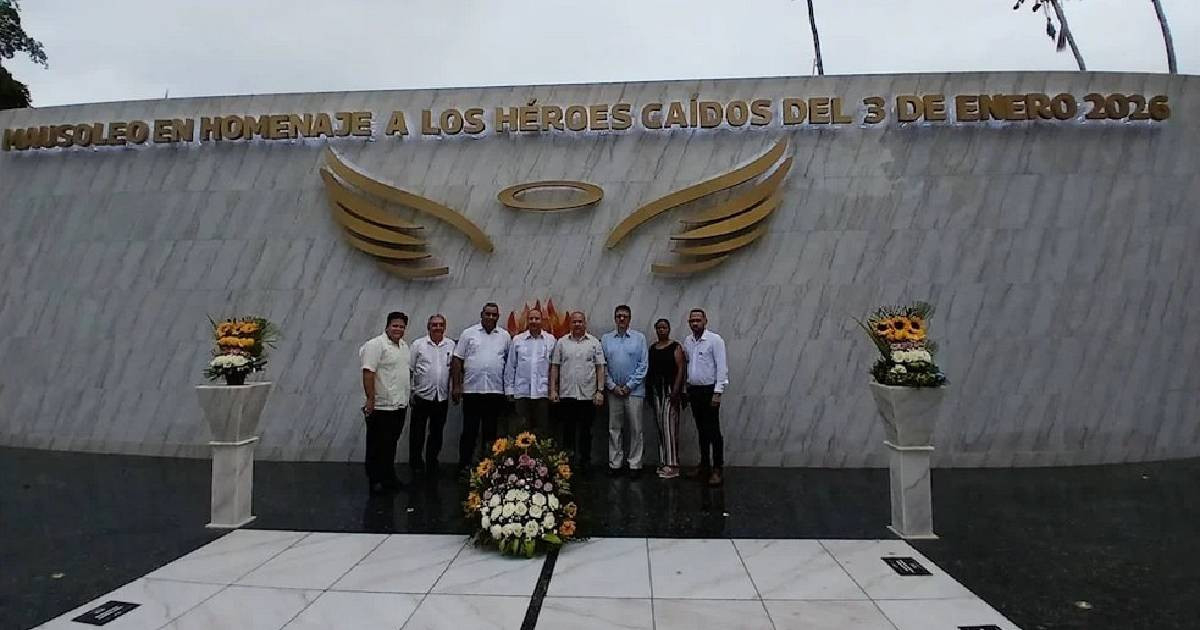
Months after the Cuban regime honored 32 military personnel and agents from Cuba's Revolutionary Armed Forces (FAR) and Ministry of the Interior (MININT) who died during Nicolás Maduro's capture, a report by elToque raises questions about the official narrative. Several journalists, activists, and individuals close to the case argue that some of these Cubans were not killed by U.S. forces but were instead eliminated by the Venezuelan regime itself.
Operation Details and Emerging Doubts
The operation leading to Maduro and his wife Cilia Flores's arrest occurred on January 3, 2026, mainly at the Fuerte Tiuna military complex in Caracas. The 32 Cubans were part of Maduro's personal security team. Twelve days later, a plane landed in Havana carrying their ashes, and the Cuban dictatorship commemorated them as heroes who "resisted" the attack.
Despite this, doubts have surfaced from within Venezuela. Prominent journalist and human rights advocate Luis Carlos Díaz emphasized the need for inquiry: "We have a duty to question what happened to the Cuban agents guarding Nicolás Maduro because we suspect they didn't fall in a clash with U.S. soldiers. Most likely, Venezuelan agents eliminated them during the operation."
Controversial Claims and Investigations
Rafael Uzcátegui, a sociologist and director of the NGO Peace Laboratory, expressed similar concerns on social media in April, suggesting that chilling hypotheses exist about the execution of Cuban security officials, not by U.S. forces. He stressed the need for an independent investigation to uncover the truth about that day.
Supporting these suspicions, a series of documented events have come to light. In late January 2026, Venezuela's General Directorate of Military Counterintelligence (DGCIM) detained several active and former members of the Scientific, Penal, and Criminal Investigations Corps (CICPC) for refusing to falsify forensic reports from January 3 at Fuerte Tiuna.
Allegations of Coercion and Torture
César Batiz, director of the independent Venezuelan outlet El Pitazo, revealed that the pressure on these officials had a specific aim: "altering bullet trajectories, modifying photographic evidence, and erasing proof that might implicate internal responsibilities in the events at Fuerte Tiuna."
Runrun.es, another Venezuelan media outlet, reported that detainees were tortured. A protected source recounted that one agent was tortured after being apprehended, emphasizing his ethical integrity and long-standing service.
In March 2026, the UN's International Independent Fact-Finding Mission on Venezuela addressed the issue at the Human Rights Council. Expert María Eloísa Quintero stated that "around 30 CICPC personnel and their families were detained after officials allegedly refused to falsify evidence related to the January 3 military attack." The CICPC's director, Douglas Rico, denied the number but did not refute the reasons behind the detentions.
Among those detained is chief forensic photography inspector Joharlinn Enrique Luzardo Noria. His sister, Kiolis Luzardo, recounted in an interview that he was summoned to Fuerte Tiuna on January 3, conducted forensic work for five days, submitted his report, and was called to a meeting on January 23 from which he never returned, as the DGCIM detained him.
Kiolis described her brother's ordeal: "They hung him by the hands with a chain, kept him off the ground for days, subjected him to cold, electrocuted him, and fed him once a day."
From prison, Luzardo expressed his bafflement to his sister: "I did my job; I submitted everything observed on January 3. I shouldn't have to make anything up, and I don't understand why I'm here."
The Cuban regime, which published the identities of the 32 deceased in the state-run newspaper Granma and unveiled a monument in Caracas in their honor in June, has neither responded to these claims nor initiated any investigation into the true circumstances of their deaths.
Questions Surrounding the Deaths of Cuban Agents
What were the roles of the 32 Cuban agents involved in the operation?
The 32 Cuban agents were part of Nicolás Maduro's personal security detail during the operation in Caracas.
Why is there suspicion surrounding their deaths?
There is suspicion because several sources suggest that these agents were not killed by U.S. forces, as officially claimed, but were potentially eliminated by Venezuelan agents during the operation.
What actions have been taken to investigate these claims?
While some Venezuelan officials have been detained for not falsifying evidence, there has been no independent investigation into the true circumstances surrounding the deaths of the Cuban agents.