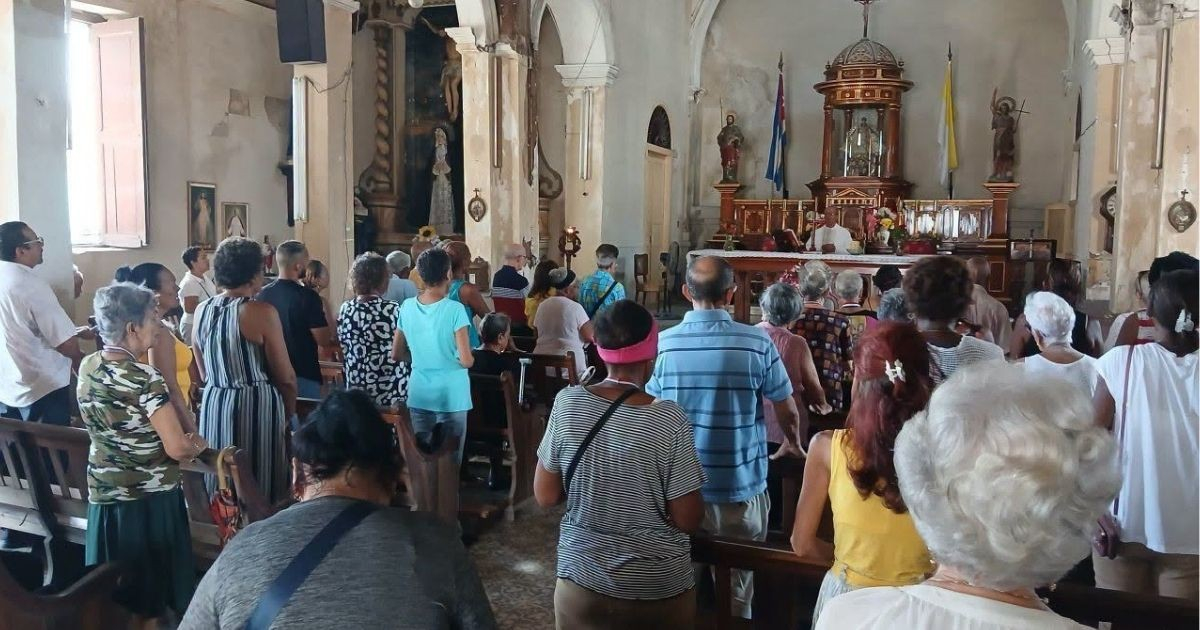
A church in Santiago de Cuba recently held a mass dedicated to the Cuban diaspora and families separated by the ongoing exodus, emphasizing the importance of maintaining connections with those who have left the island and now reside in various countries globally.
The Santo Tomás Apóstol Parish shared an excerpt from a homily delivered by Father José Manuel Hernández del Toro during a "Holy Mass for Cubans Who Have Emigrated." The priest highlighted the significance of remembering family members who have departed the country, stating, "Today we remember our relatives who have left this land." He urged attendees to keep in mind those living far from Cuba.
Father Hernández remarked, "Cubans are everywhere in the world, even in the remote regions of Russia and Asia, and they are our brothers and sisters." He stressed the importance of maintaining a sense of belonging and unity among those who remain on the island and those who have emigrated, saying, "Let us learn to embrace the sense of brotherhood because they were born on this land, just like us."
This message resonates deeply amid the mass migration that has significantly reduced Cuba's population in recent years, causing widespread family separations. The parish's publication sparked numerous reactions from Cubans living abroad, with many expressing gratitude for acknowledging the diaspora and the pain of family separation.
One individual shared that they left "with a broken heart," while another expressed appreciation for remembering those who "involuntarily had to leave our homeland." Others voiced hope for the reunification of Cuban families and emphasized that from abroad, they continue to hold their loved ones and friends on the island in their thoughts.
The reactions highlight a reality that goes beyond mere demographic statistics: recent years have seen Cuban communities established across numerous countries, making family separation a daily experience for many both inside and outside of Cuba.
Concerns about migration have recently been addressed in Santiago de Cuba's pulpits. In July, Archbishop Dionisio García Ibáñez lamented the mass departure of young people and linked the phenomenon to the country's declining productivity, questioning, "Who will tend to our fields?" from the Sanctuary of El Cobre.
Additionally, the Santo Tomás Apóstol mass coincided with the start of the novena dedicated to the Virgin of Charity of El Cobre. Devotees are set to pray for their loved ones, including those who are abroad. The nine days of preparation began on Sunday, August 30, leading up to the celebration on September 8, with activities planned in Cuban churches and communities, along with a special program at the National Shrine of El Cobre.
The mass in Santiago carries a somber backdrop. Recent official data indicates that Cuba's effective population stood at 9,434,593 by the end of 2025, down from 9,748,007 the previous year, marking a reduction of 313,414 inhabitants in just twelve months.
The National Office of Statistics and Information (ONEI) defines this as the "effective population," a measure considering factors such as the duration of stay within the national territory. Migration was again the primary factor in this decline. The ONEI reported a negative migration balance of 245,264 people in 2025, alongside only 68,064 births and 136,214 deaths.
Cuban migration has increasingly shifted towards Latin American countries, notably Brazil, Mexico, and Uruguay. A March 2026 report by the International Organization for Migration noted that net regular Cuban migration to Brazil nearly doubled between 2024 and 2025, with asylum applications from Cubans in Brazil rising from 22,288 in 2024 to 41,919 in 2025.
Cuban Migration and Its Impact
Why did the Santiago church hold a mass for Cuban migrants?
The mass aimed to honor the Cuban diaspora and address the separation of families caused by the mass exodus, urging the community to maintain connections with those who have left the island.
What are the recent trends in Cuban migration?
Cuban migration has increasingly pivoted towards Latin American countries, with significant increases in migration to Brazil, Mexico, and Uruguay.
How has the Cuban population changed recently?
Cuba's population decreased by 313,414 inhabitants from 2024 to 2025, with emigration being the main factor contributing to this decline.