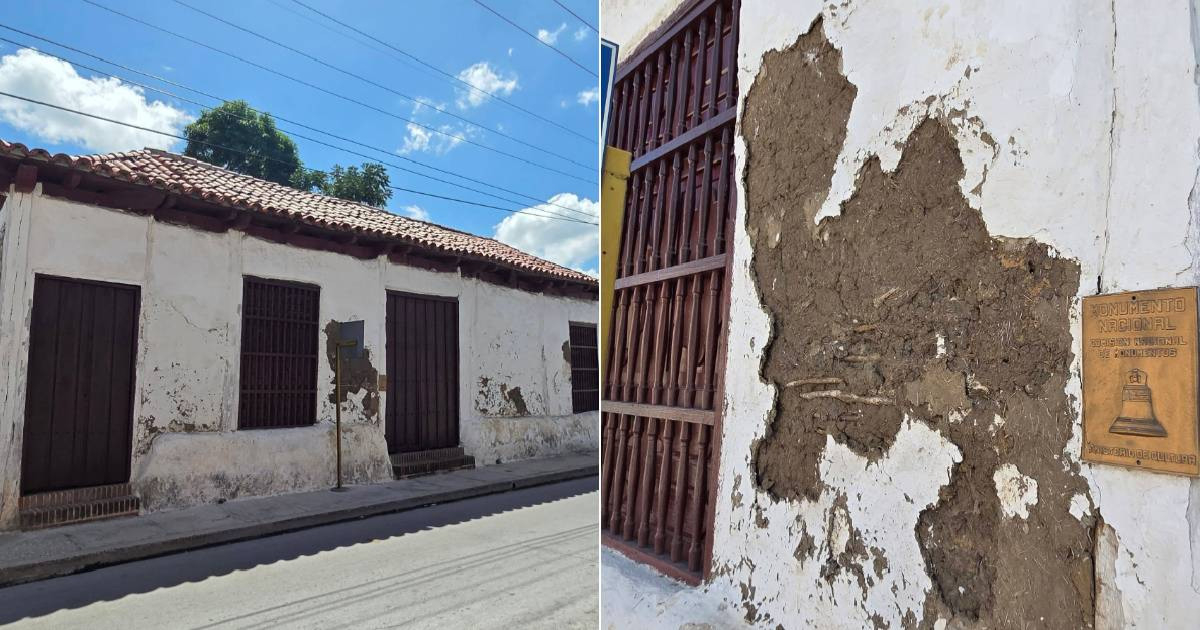
The Lieutenant Governor's House Museum in Holguín, the city's oldest surviving building and a designated National Monument, is already showing visible damage to its walls just four months post-renovation. This was documented on Sunday by the Facebook page Holguín en fotos, sharing current images of the building's state.
Locally known as the "Mud House" due to its unique construction technique involving mud, straw, twigs, and clay, this structure dates back to the early 18th century and was declared a National Monument in 2010.
Recent photos reveal peeling paint, exposed substrate, and cracks in areas that were reportedly part of the recent intervention. "It's been just four months, and this is how some of the walls look after the intervention. It's concerning that a newly renovated structure is showing such deterioration in such a short time," the source noted.
The post also posed an unanswered question: "We hope the work is still under warranty and that those responsible for the renovation can assess the situation and find a solution. This building is one of our city's most historically valuable properties and deserves to be preserved as such."
The public reaction in the comments section immediately pointed to poor execution. A technically knowledgeable commenter explained that the material used for these walls is called "mampuesto," a mix of clay and lime that requires up to 45 days of rest before use; without the proper consistency, issues like those shown in the photos occur.
Other locals agreed that the mud plastering technique requires expertise: "Not everyone knows how to treat it properly, and that's why these things happen," one person noted. Another was more direct: "From what we can see, what they did was a shoddy job."
Several comments also questioned the oversight of the work. "Why do we have so many specialists, technicians, and researchers in our province if, before undertaking such work, there's no analysis, no determination of what materials to use, and no supervision from Heritage?" one citizen asked.
Another voice called for transparency about the resources involved: "Find out the cost of the restoration and where the money went."
There was also a perception that the renovation might have been rushed to meet administrative goals, as suggested by one reader: "It seems like it was done just to meet a target or something similar. Heritage buildings should be renovated seriously, not just to fulfill a commitment or meet a deadline."
This case is not an isolated incident. Holguín has seen a series of heritage neglects this year without official response, including the partial collapse of the Ismaelillo theater's roof in May, the theft of a bronze star from General Calixto García's mausoleum in August, the neglected state of the José Martí IPVCE, and the transformation of the old Holguín-Gibara railway station into a dumping ground.
Three months after the collapse of the "Woman with Umbrella" sculpture on the pedestrian boulevard in the City of Parks, the empty pedestal still obstructs the path without any public explanation from the authorities, a silence now echoed in the face of the deterioration of the city's oldest building.
Concerns About Heritage Preservation in Holguín
What is the current state of the Lieutenant Governor's House Museum in Holguín?
The Lieutenant Governor's House Museum is showing visible damage, such as peeling paint and cracks, just four months after a renovation.
Why is the renovation of Holguín's oldest building controversial?
The renovation is controversial due to the quick appearance of damage and the perception that the work was poorly executed, possibly rushed to meet administrative goals.
What other heritage issues is Holguín facing?
Holguín is facing issues such as the partial collapse of the Ismaelillo theater's roof, theft from General Calixto García's mausoleum, neglect of the José Martí IPVCE, and the conversion of the old railway station into a dumping ground.