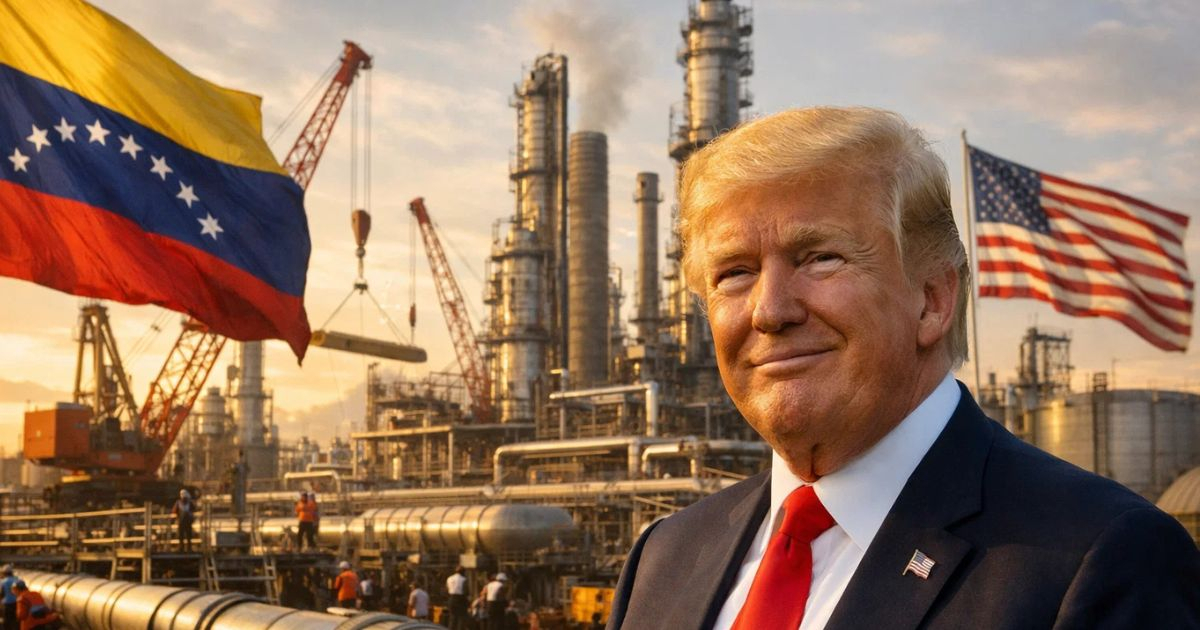
On Sunday, President Donald Trump revealed that a portion of the Venezuelan oil acquired through the latest agreement with Caracas will be used to replenish the United States' Strategic Petroleum Reserve, which is currently at its lowest level in over 40 years.
Trump shared this announcement on Truth Social, emphasizing that the process to refill the reserves will commence "very soon," framing the Venezuelan crude as a direct benefit to Americans.
"One of the things I'll do with the Venezuelan oil is refill the National Strategic Reserves, which have been left almost empty due to Sleepy Joe Biden," Trump wrote.
"The process to refill them will start very soon, and it’s a gift from Venezuela to the people of the United States. Thank you!" the former president added.
Despite Trump's reference to "National Strategic Reserves," the official name for the emergency federal oil storage is the Strategic Petroleum Reserve (SPR). This reserve consists of large underground salt caverns located in Texas and Louisiana, with an authorized capacity of 714 million barrels.
Historical Context and Recent Developments
Trump's statement follows a Reuters report indicating that oil stocks in the reserve dropped by 3.7 million barrels during the week ending August 21, falling to 289.7 million barrels, the lowest since November 1982. This quantity represents just over 40% of the reserve's authorized capacity, so Trump's assertion that Biden left it "practically empty" does not accurately reflect its current status.
Back in 2026, the Trump administration initiated an exchange of up to 172 million barrels from the Strategic Reserve as part of a coordinated action involving 400 million barrels among International Energy Agency member countries to address global supply disruptions.
The Significance of the Oil Agreement
This Sunday's announcement sheds light on the potential destination of the oil involved in the oil deal Trump introduced on Friday, labeling it as "the largest in world history." According to the details released by Washington, the United States secured majority control over more than 65 billion barrels of proven Venezuelan reserves through a scheme involving the development of 17 strategic fields. Trump assured that this operation would incur no cost to American taxpayers.
The details disclosed so far indicate that the United States would have access to 55% of the effective production through a combination of participation and purchasing rights. Some of this oil could be allocated specifically to strategic reserves and the U.S. Armed Forces.
Venezuelan Response and Future Prospects
Venezuela's interim President, Delcy Rodríguez, publicly supported the agreement over the weekend, asserting that Venezuela retains "ownership and sovereignty over its resources." Rodríguez stated that the project will have a 25-year duration, covering 17 oil fields, with a target production exceeding 1.5 million barrels per day.
This version contrasts with reports from U.S. sources that have mentioned rights over the fields lasting up to 100 years.
Key Questions About the U.S.-Venezuela Oil Deal
What is the Strategic Petroleum Reserve?
The Strategic Petroleum Reserve (SPR) is the United States' emergency stockpile of crude oil, stored in large underground salt caverns in Texas and Louisiana, with an authorized capacity of 714 million barrels.
How does the U.S. plan to use Venezuelan oil?
The U.S. intends to use a portion of the Venezuelan oil to refill its Strategic Petroleum Reserve and potentially supply the U.S. Armed Forces, as part of the recent agreement with Venezuela.
What are the potential benefits of the oil agreement for the U.S.?
The agreement could strengthen U.S. energy security by replenishing depleted reserves, and it may help stabilize oil prices by increasing supply through access to Venezuelan reserves.