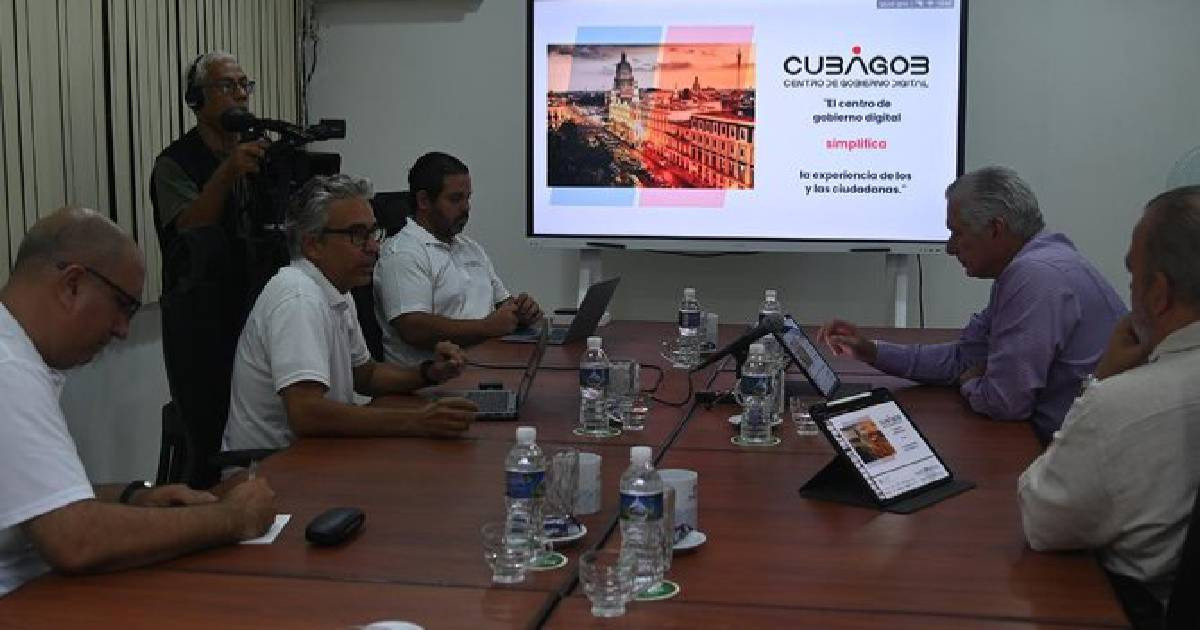
On Saturday, Cuban leader Miguel Díaz-Canel visited the Digital Government Center in the Playa district of Havana. He was there to mark the first anniversary of the Soberanía Platform, a governmental initiative aimed at digitizing public processes. This comes in a country plagued by power outages, the slowest internet in Latin America, and a telecommunications system in disarray, making this goal impractical for the majority of Cubans.
Accompanied by Prime Minister Manuel Marrero Cruz, Díaz-Canel received updates from Wilfredo González Vidal, the director of the Digital Government Center. González presented the platform's achievements since its inception under Decree 125 in July 2025, which include over 43,000 verified digital identities, nearly 24,000 passport applications for adults, and close to 40,000 civil status registrations, according to a report from the Presidential Office.
Despite these numbers, González Vidal admitted that they remain "insufficient" and emphasized the need for the population to gain more knowledge and trust in this tool.
Challenges of a Digital Transformation
The platform currently offers 12 services related to civil registration, five tied to citizen identity and electoral location changes, adult passport processing, and social services from the Ministry of Labor. Díaz-Canel expressed optimism, stating that as people experience quicker resolutions through this platform, their trust will grow.
In addition, the government unveiled two new projects: one for facilitating citizen engagement with the 176 economic and social reforms approved in June, and another for posting job opportunities in both the state and private sectors.
Reality vs. Rhetoric
The official narrative starkly contrasts with Cuba's current situation. In August, the state-owned Cuban Telecommunications Company (Etecsa) suffered three severe disruptions: a nationwide mobile network outage on the third of the month, a fiber optic cut affecting the Nauta payment system, and a false seismic alert sent to users in nine provinces on August 18.
Regarding the latter incident, the state monopoly took four days to attribute it to a "technical-human error" caused by their specialists testing the telecommunications network.
Public frustration with Etecsa is evident on social media with each service failure. Outrage intensified after the company raised internet tariffs in May 2025, increasing costs by 13 times with prices in dollars: 4 GB for $10, 8 GB for $20, and 16 GB for $35. Despite collecting $24.8 million in just 46 days, service quality remains poor.
Average internet speeds in Cuba linger at a mere 7.21 Mbps, the lowest in Latin America, with speeds dropping below 2 Mbps in several provinces during blackouts.
Infrastructure Struggles
Etecsa has admitted that its backup batteries cannot sustain the network for more than 24 hours without electricity, leaving 47.5% of mobile towers and 56.5% of cabinets offline during power cuts.
This is compounded by at least seven total electrical system failures this year, with numerous communities enduring over 20 hours of darkness daily due to the island's energy crisis.
Moreover, less than four percent of transactions in Cuba are digital. The Central Bank was compelled to remove the 5,000-peso cash transaction limit in July, implicitly acknowledging the failure of the forced banking policy enacted three years ago.
Comedian Ulises Toirac encapsulated the irony in July, directly questioning Etecsa: "With all the money you've collected after the price hike to fix those stealing from you, can't you equip your towers with batteries?"
Understanding Cuba's Digital Challenges
What is the Soberanía Platform?
The Soberanía Platform is a Cuban government initiative aimed at digitizing public services, launched to facilitate easier access to bureaucratic processes.
Why is digital transformation difficult in Cuba?
Digital transformation in Cuba faces major hurdles due to frequent power outages, slow internet speeds, high costs, and a fragile telecommunications infrastructure.
How has Etecsa's service affected Cubans?
Etecsa's service disruptions and high internet costs have caused public frustration, as the quality of service remains poor despite significant revenue from increased tariffs.