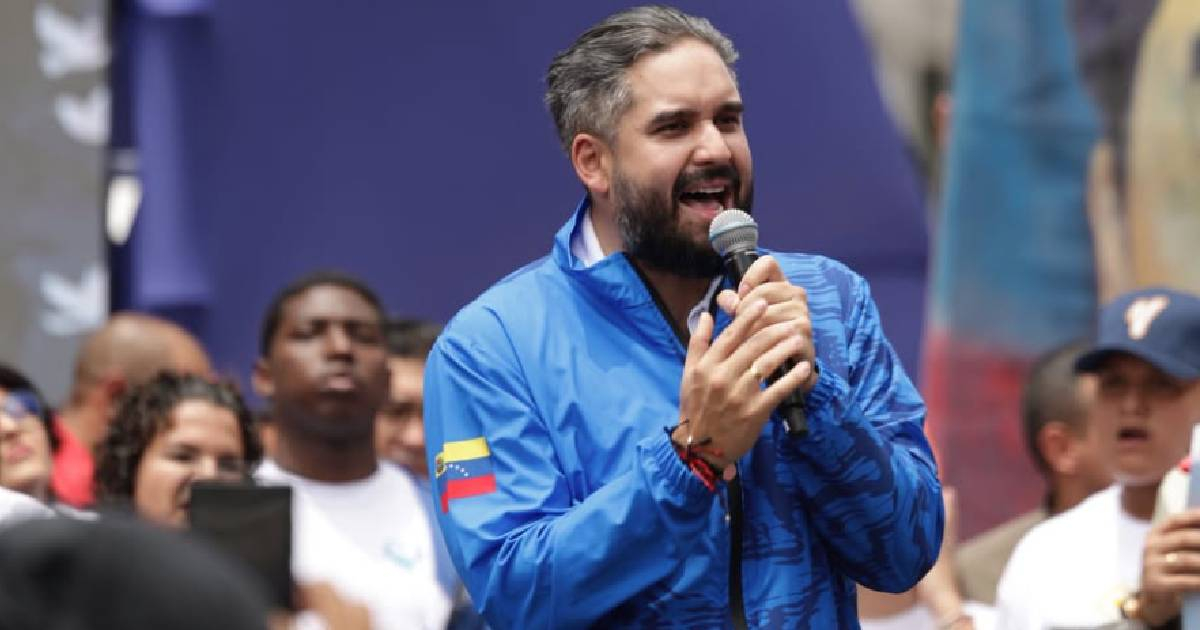
Nicolas Maduro Guerra, popularly referred to as "Nicolasito" and the son of the former Venezuelan president currently imprisoned in the United States, issued an official statement on X this Saturday. Using the design of Venezuelan institutional communications, he expressed his support for the newly announced historic oil agreement between Venezuela and the U.S., explicitly thanking President Donald Trump and Secretary of State Marco Rubio for their involvement in the deal.
The statement, made available in both Spanish and English, describes the agreement as "a landmark in the bilateral relations between Venezuela and the U.S." The document outlines the agreement's terms: the development of 17 strategic fields with a proven potential of 65 billion barrels of oil, an investment exceeding $100 billion, and more than $209 billion in taxes for the Venezuelan state, involving private operators.
"I extend my deepest gratitude to the President of the United States, Donald Trump, as well as Secretary of State, Marco Rubio, and the U.S. Government for their commitment to this agreement," reads the statement released by Maduro Guerra.
Maduro Guerra's declaration concludes with a statement of objectives: "Our goal is to move towards establishing a powerful energy-producing nation by putting our vast reserves at the service of national development, employment generation, increasing our workers' income, and enhancing the well-being of our people."
The agreement was initially announced by Trump over the weekend and confirmed by Venezuela's interim president, Delcy Rodriguez, who publicly endorsed the deal alongside the United Socialist Party of Venezuela.
Trump characterized it as the "largest oil deal in history," noting that the U.S. would gain majority control over the reserves at no cost to taxpayers.
The role of Maduro Guerra as a spokesperson for the agreement is intriguing for several reasons. The Southern District of New York's Attorney's Office included him in an indictment in January 2026 for alleged involvement in a drug trafficking network, and Washington called for his extradition to Caracas in February of that year.
Despite these allegations, the National Assembly deputy and president of the Venezuelan parliament's Interior Policy Commission now emerges as a public advocate for a pact with the very government pursuing legal action against his family.
The agreement is the culmination of efforts that began following the capture of Nicolas Maduro Moros on January 3, 2026, by U.S. forces.
Since then, Delcy Rodriguez's government has pursued pragmatic dialogue with Washington: Venezuela dispatched initial oil shipments to the U.S., and the Treasury Department issued licenses allowing American companies to operate in the country.
By August, several of these companies had already formalized agreements with Caracas, as reported by Reuters.
The deal has not escaped criticism. Congresswoman Maria Elvira Salazar initially questioned its terms before tempering her stance, while The New York Times noted it would be "highly unusual" for the U.S. federal government to acquire stakes in another country's oil fields, highlighting unclear legal mechanisms.
From Cuba, the official blogger known as "El Necio" accused the Venezuelan government of "handing over a century of oil extraction to the U.S." while refusing to sell fuel to the island.
Key Questions About the Venezuela-U.S. Oil Deal
What are the terms of the Venezuela-U.S. oil agreement?
The agreement involves developing 17 strategic oil fields with a proven capacity of 65 billion barrels, an investment of over $100 billion, and generating over $209 billion in taxes for Venezuela, with private operators participating.
How has Nicolas Maduro Guerra's involvement been perceived?
Maduro Guerra's involvement has attracted attention due to his past legal issues, as he was indicted for alleged drug trafficking. Despite this, he is now publicly supporting a deal with the U.S., which is pursuing charges against his family.
What criticisms have been raised about the oil deal?
Critics like Congresswoman Maria Elvira Salazar have questioned the agreement's terms, although she later softened her stance. The New York Times also highlighted the unusual nature of the U.S. acquiring foreign oil field stakes and the unclear legal framework.