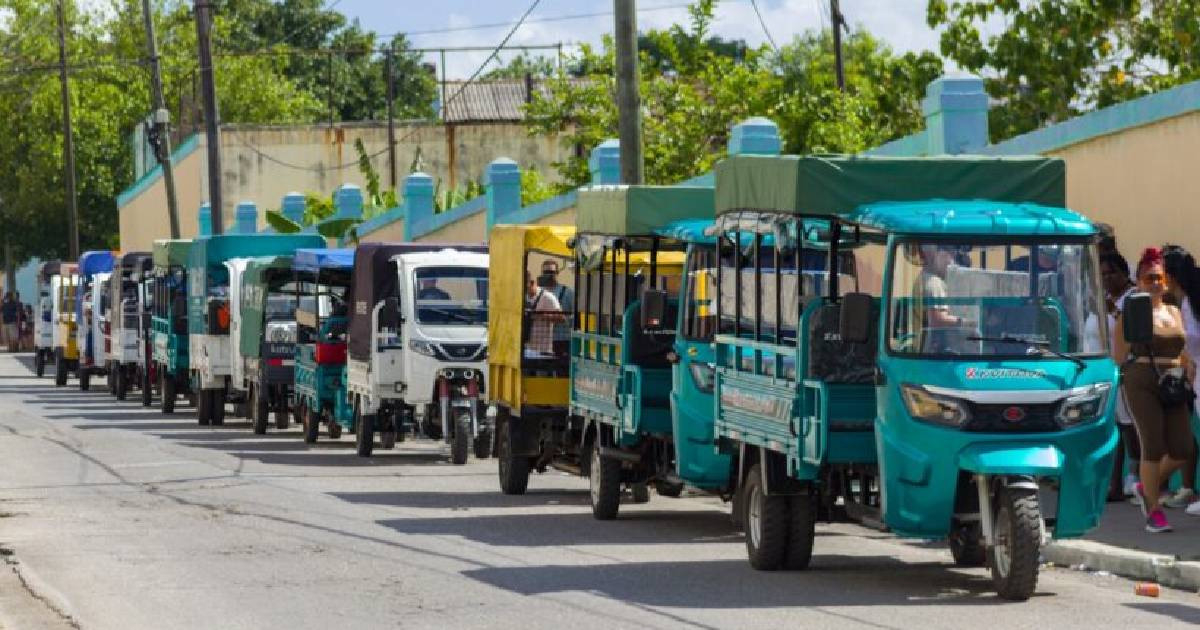
In Matanzas, a perplexing situation highlights the declining purchasing power of workers. Despite the availability of tricycles, they often sit half-empty because many potential riders cannot afford the fare. This issue was reported by the official newspaper, Girón, on Saturday.
According to Girón, each morning, a line of tricycles awaits passengers on America Street in Matanzas, near the high school. Meanwhile, dozens of people stand nearby, unable to pay for a ride.
The fare from the high school to Peñas Altas is 250 Cuban pesos, exceeding the average daily wage of a worker in Matanzas, which is approximately 236 pesos. This price gap leaves tricycles underutilized and limits the number of daily trips, as would-be passengers look for more affordable alternatives.
Economic Shifts and Stagnant Fares
The Communist Party's media outlet in the western province noted that economic conditions have shifted since June when the current fares were established. Gasoline prices have decreased by more than 50%, reducing operational costs for tricycle operators. Additionally, electric and hybrid vehicles, primarily powered by solar panels, have been introduced. Despite these changes, fares have remained unchanged.
Tricycle operators argue that they need to save money for new batteries and to cope with rising food prices and other household expenses.
However, the same official source suggests that lowering fares could attract more passengers and increase the number of daily trips.
Public Transport Challenges
This situation stands in stark contrast to the state of public transportation in the province. In February, public transport was virtually paralyzed, with no urban or intermunicipal routes operational.
In the absence of public transport, private tricycles emerged as a primary mobility option for locals.
In June, tricycle fares doubled overnight, sparking outrage among users. The municipal government, in collaboration with tricycle operators and the Communist Party, established regulated fares: 250 pesos for the high school to Peñas Altas route, 125 pesos to the high school-Terminal or Versalles, and 150 pesos to the Faustino Pérez Hospital. Despite these regulated fares, the population struggles to afford them.
Today, even with reduced gasoline prices and the addition of electric and hybrid vehicles, fares remain beyond the financial reach of many workers.
Exploring Affordable Solutions
Meanwhile, the provincial government is exploring alternatives to make transportation more affordable. Edilberto Casanova Armenteros, the Government's Program and Objectives Coordinator in Matanzas, mentioned that plans are underway for leased buses to charge 30% to 50% less than current private market rates.
This initiative aims to provide a more cost-effective and capacious option for those unable to afford the 250 pesos for a tricycle ride.
Despite demand for routes such as Pastorita, Canímar, Gelpis, and Guanábana, these remain unattended, as reported by Girón.
The sight of tricycles waiting for customers while potential passengers stand idly by captures a key contradiction in Matanzas' transportation landscape: private options are available, but their prices are out of reach for those who need them most.
This pattern of tolerance, proliferation, and delayed regulation of tricycles is mirrored in other provinces. In Sancti Spíritus, authorities announced plans to crack down on unlicensed tricycles beginning August 1st, following years of unregulated operation.
Understanding the Transportation Dilemma in Matanzas
Why can't many residents afford tricycle fares in Matanzas?
The fare for tricycles is set at 250 pesos, which is higher than the average daily wage for many workers in Matanzas, making it unaffordable for a significant portion of the population.
What changes have occurred in Matanzas' transportation sector since June?
Since June, gasoline prices have dropped significantly, and new electric and hybrid vehicles have been introduced, reducing operational costs. However, the fares have not been adjusted to reflect these changes.
What measures is the provincial government considering to make transportation more affordable?
The provincial government is evaluating the possibility of leased buses charging 30% to 50% less than current private market rates to offer a more affordable option for the population.