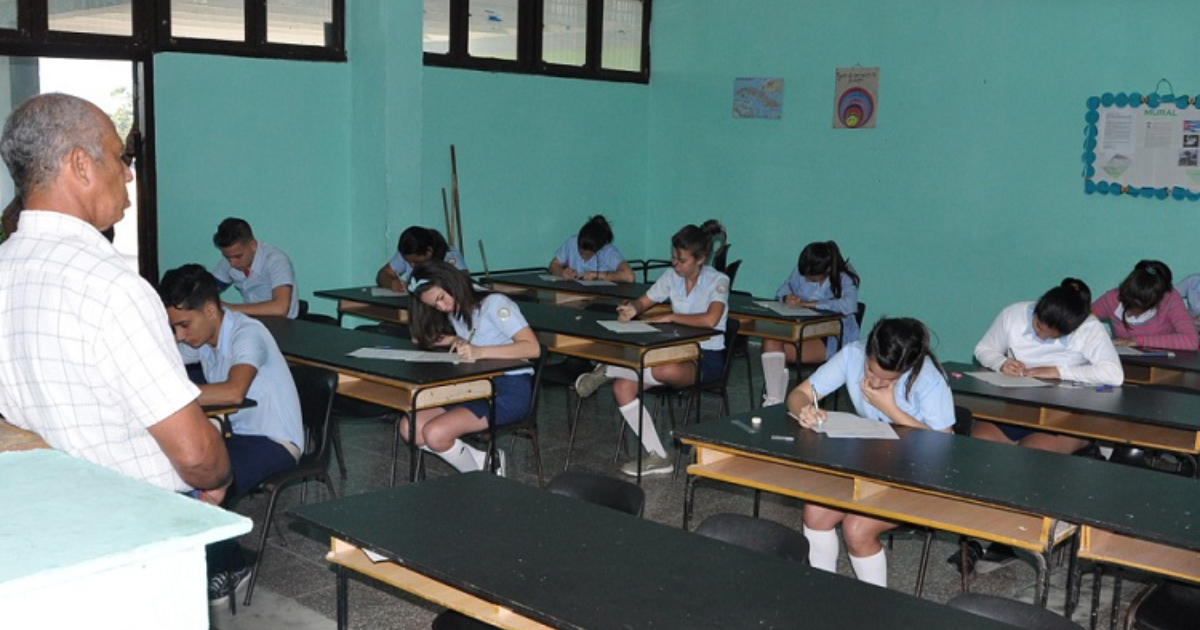
As the 2026-2027 school year approaches, slated to start on September 1, Cuban activist Thais Mailén Franco Benítez posed a poignant question that echoes the concerns of countless families on the island: "Do you really think that after more than 30 hours without electricity, teachers and students can function in a classroom?"
Through her Facebook post, Franco highlighted the glaring shortages that make a normal return to school nearly impossible: "There is no electricity, no water, no food, no healthcare." She emphasized that both educators and students "are forced to face an increasingly challenging reality, where studying, teaching, and even getting to school becomes a daily struggle."
Franco's inquiry did not go unnoticed. Many Cubans shared their personal stories in the comments, painting a grim picture of deprivation that the regime chooses to overlook.
Personal Testimonies Highlight the Struggles
Verónica C. Barrios revealed that her daughter only attends school because their area is linked to a hospital's electrical circuit. Yet, there are conditions: "When there's no electricity, she doesn't go. When there's no water, she doesn't go. If I have nothing for her breakfast, she doesn't go. If there's no snack or money for one, she doesn't go."
Yunia Avila, the mother of a high school student, was even more candid: "He's been sleeping on the floor for over a month with hardly any water, and he goes because he wants to, not because I make him."
Rina Gutiérrez succinctly captured the widespread sentiment: "In these circumstances, neither a child can learn nor a teacher can effectively conduct a class. Hunger, heat, and a lack of basic amenities make it impossible."
Educational System Faces Severe Challenges
The energy crisis is a dire backdrop. For instance, on August 27, the electrical crisis left 65% of the island without power, with outages in some areas extending beyond 30 consecutive hours this month.
This energy crisis is compounded by a severe teacher shortage. The regime has been unable to fill at least 24,000 teaching positions nationwide, representing 12.5% of the total. In Camagüey alone, the academic year will commence with nearly 3,000 teaching vacancies to serve over 95,000 students across 690 schools.
In response to the crisis, the Ministry of Education admitted to "exceptional" conditions and announced emergency measures: reduced class hours, relaxed uniform requirements—which would cover only 20% of students—and the possibility of one teacher covering multiple institutions. Universities, on the other hand, will begin with hybrid or semi-presential models depending on each territory's energy availability.
This isn't the first time the energy crisis has disrupted the education system. In May 2026, the government shortened the 2025-2026 school year due to a lack of fuel and canceled university entrance exams, opting instead for assignment based on pre-university academic indices.
Tony Cabrera, another Cuban who commented on Franco's post, pointed to a potential collective response: "The solution lies with the parents and teachers: unite and declare that under these conditions, learning and teaching are difficult."
Franco's question remains unanswered by officials: "How is a new school year supposed to start under these conditions?"
FAQs on Cuba's Educational and Energy Crisis
What are the main challenges facing Cuban schools?
Cuban schools are struggling with severe electricity outages, a lack of basic resources like water and food, and a significant shortage of teachers. These issues make it difficult to maintain a normal educational environment.
How is the Cuban government addressing the educational crisis?
The government has announced emergency measures such as reducing class hours and allowing flexibility with uniforms. They're also implementing hybrid or semi-presential university models depending on energy availability.
What impact does the energy crisis have on Cuban education?
The energy crisis severely affects the ability of schools to function, with power outages disrupting classes and making it hard for students to learn and teachers to teach effectively.