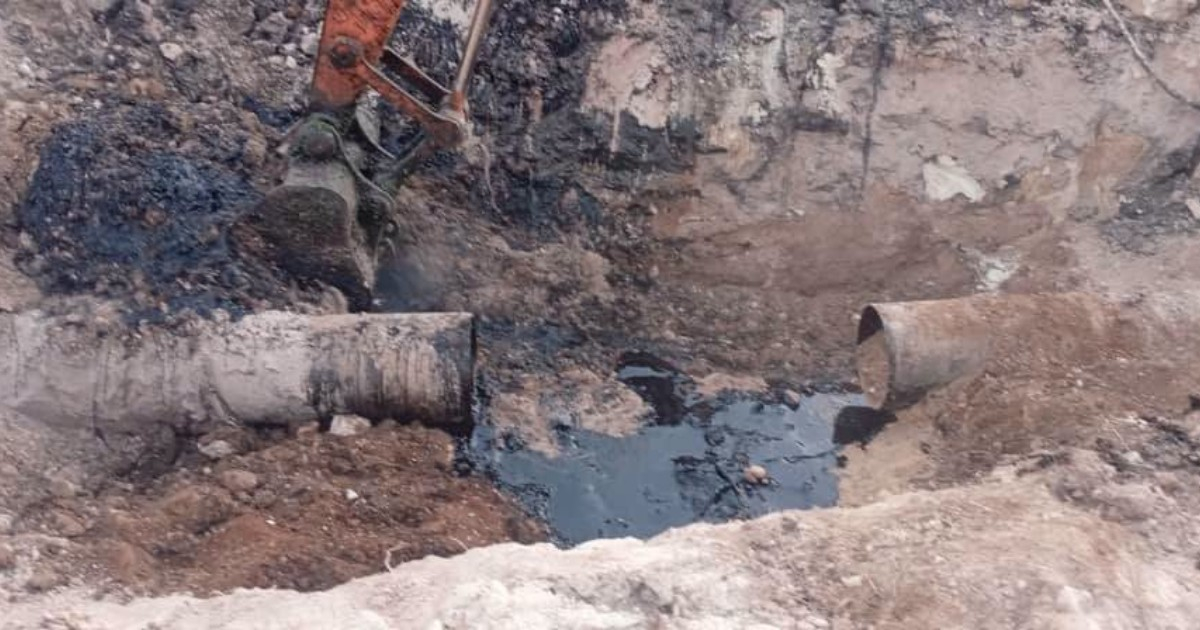
The company responsible for the Varadero-Matanzas pipeline has announced that a break at kilometer 6 on the Cidra road, in the Las Marías Council of Matanzas province, has been sealed. This crude oil spill had kept authorities and local residents on high alert, revealing the weaknesses in pipes that were constructed using standards from the now-defunct Soviet Union.
Emergency teams managed to extract and contain 45 cubic meters of spilled oil, according to "Con Todos La Victoria," an official account affiliated with the Matanzas provincial government.
The repair required 23 continuous hours of work, involving four companies from the CUPET group: the Hydrocarbons and Derivatives Transportation Company (EMCOR), the Oil and Gas Drilling and Extraction Company (EPEP), the Fuel Transportation Company (Transcupet), and the Petroleum Services Company (Emserpet).
As reported by CUPET, workers had to deal with outdated pipes that do not meet current international standards, and had to work in highly dangerous conditions due to the emission of gases from Cuban crude, which is highly flammable.
The damage posed a direct risk to the crude supply for the Antonio Guiteras thermoelectric plant, the largest in the country, located in Matanzas. This could have severely affected the National Electric System.
Operating since 2000, the Varadero-Matanzas pipeline stretches 75 kilometers and measures 20 inches in diameter, serving as the main oil supply route to the power plant.
The Guiteras plant experienced at least 17 outages from the national electrical system in 2026, with the last occurring in July due to a leak in the economizer of its boiler, before resuming generation with 190 MW in August.
Clean-up and drainage operations continue in the Las Marías Council, while environmental teams assess the extent of soil impact in the affected area.
This incident emerges amid a structural energy crisis: Cuba produces only about 40,000 barrels of oil per day, far short of the 90,000 to 110,000 needed to sustain its electrical system, making any pipeline disruption a direct threat to national power generation.
The Matanzas oil infrastructure has witnessed several serious incidents in recent years, including a crude spill at the former José Martí thermoelectric plant in May 2025 and the replacement of a deteriorated pipeline section in the provincial energy infrastructure in June 2026.
Understanding the Impact of the Varadero-Matanzas Pipeline Incident
What caused the oil spill in Matanzas?
The spill was caused by a break in the pipeline at kilometer 6 on the Cidra road, due to outdated pipes built under Soviet-era regulations.
How does this incident affect Cuba's energy supply?
The incident threatened the crude supply to the Antonio Guiteras thermoelectric plant, the largest in Cuba, potentially impacting the National Electric System significantly.
What measures were taken to address the spill?
Emergency teams worked for 23 hours to seal the break, involving four CUPET companies to manage and contain the spill.
What is the broader context of Cuba's energy crisis?
Cuba's energy crisis stems from producing only 40,000 barrels of oil per day, insufficient for the 90,000 to 110,000 barrels needed to maintain its electrical system.