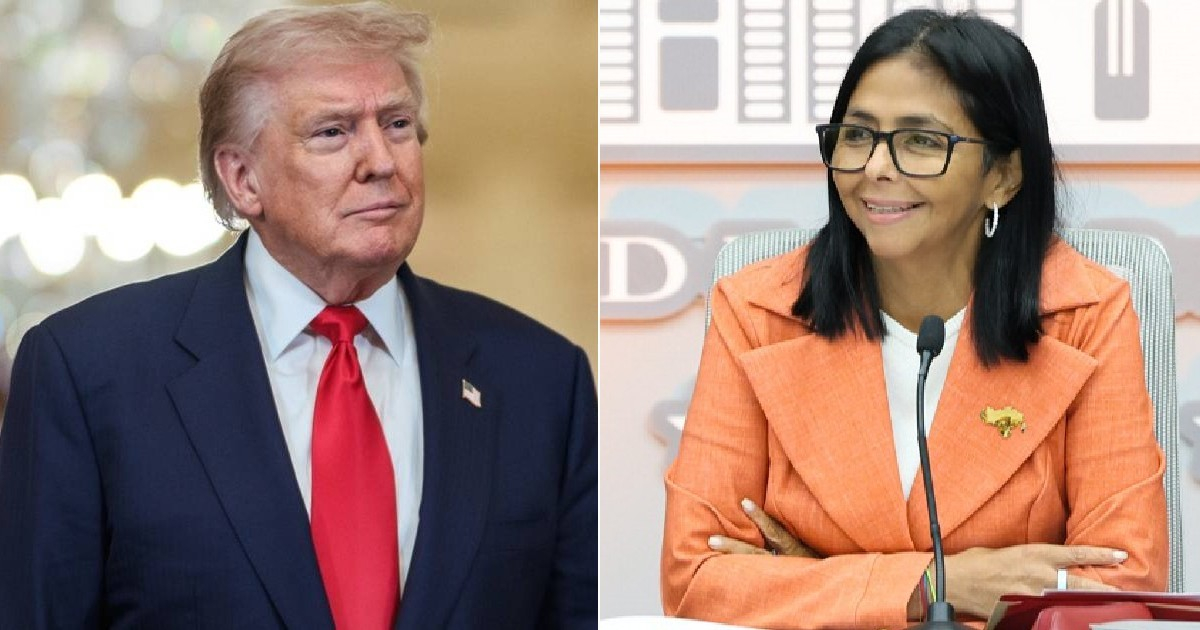
Interim Venezuelan President, Delcy Rodríguez, took to Instagram to announce a groundbreaking energy agreement with Washington. She described it as a "historic milestone in the bilateral relations between Venezuela and the United States."
The agreement outlines the development of 17 strategic oil fields, boasting a confirmed potential of 65 billion barrels of oil. The projected investment exceeds $100 billion, with expected revenues of over $209 billion for the Venezuelan state.
Delcy expressed that this deal will play a crucial role in the "rebirth of our nation," extending her gratitude to President Donald Trump, Secretary of State Marco Rubio, and the U.S. government for their commitment to this collaboration.
Strategic Partnership to Rebuild Venezuela's Oil Industry
Rodríguez highlighted that this initiative stems from stronger ties between Venezuela and the U.S., aimed at driving substantial investment flows for rebuilding the nation's strategic infrastructure and reviving its hydrocarbon industry.
Meanwhile, the United Socialist Party of Venezuela (PSUV) released an official statement showing "full support" for the interim president's agreements with Washington. This marks a turning point in the party's stance on oil sovereignty.
The statement, shared on X by PSUV's National Directorate in Caracas, followed Donald Trump's declaration on Truth Social, labeling it the "biggest oil deal in world history."
PSUV's Support Marks a Shift in Chavista Policy
The Venezuelan ruling party affirmed, "The United Socialist Party of Venezuela, committed to national sovereignty and the people's welfare, fully supports comrade Delcy Rodríguez, interim president of the Republic, regarding the agreements signed with the U.S. government on energy matters."
The PSUV justified its support, citing Venezuela's need for "real solutions for economic reactivation, public services recovery, earthquake relief, job creation, and income restoration for workers."
The party also framed the deal as a means to overcome "more than a decade of economic sanctions, unilateral coercive measures, and unjust blockades," urging the use of "all possible tools within the constitutional framework to leverage our vast hydrocarbon reserves for national development."
U.S. Agreement Transforms Venezuela's Oil Landscape
The 65 billion barrels represent about 21% of Venezuela's total proven reserves—approximately 303 billion barrels, the largest worldwide—primarily located in the Orinoco Oil Belt.
Trump, when announcing the deal on Truth Social, claimed the negotiations were spearheaded by Rubio and Secretary of War Pete Hegseth, stating that the pact "more than doubles" U.S. oil reserves at no cost to taxpayers.
The PSUV's endorsement of the agreement signifies a historic shift for Chavismo. In January 2026, Diosdado Cabello transitioned from opposing crude sales to Washington to publicly supporting them, stating, "If the United States is willing to buy our oil, we'll sell it."
Months earlier, Rodríguez's praise for Chevron had sparked criticism among Chavista supporters accusing her of contradicting the movement's long-standing oil sovereignty narrative.
This deal culminates a process initiated after Nicolás Maduro's capture by U.S. forces on January 3.
The Washington Post warned that the scheme is "vast and potentially costly," potentially facing legal and constitutional challenges in both Venezuela and the United States.
Frequently Asked Questions about the Venezuela-U.S. Oil Agreement
What is the projected investment for the oil agreement between Venezuela and the U.S.?
The projected investment for the oil agreement exceeds $100 billion.
How much oil is expected to be developed through the agreement?
The agreement involves developing 17 strategic oil fields with a proven potential of 65 billion barrels.
Why is the PSUV supporting the oil agreement?
The PSUV supports the agreement, seeing it as a solution for economic reactivation, public services recovery, job creation, and overcoming economic sanctions and blockades.