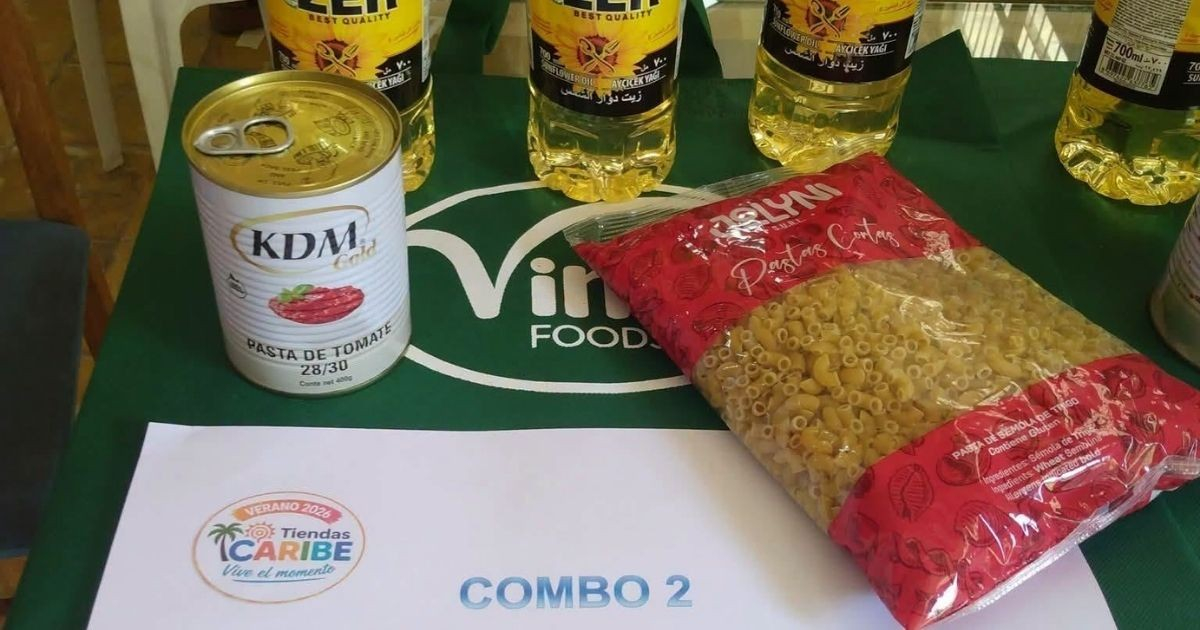
The state-run chain, Tiendas Caribe, has sparked a wave of anger on social media after advertising two food product combos on Facebook, featuring cooking oil priced around $12 and available only through Classic Card payment. This comes at a time when this essential commodity is scarce and its price is soaring in Cuba's informal market.
Tagged with the hashtag "#CaribeTeAyuda," the posts are directed at the store located on Autopista and 266 in Reparto San Agustín, Havana, and showcase two options. Combo 1 includes three ZER oils at $2.65 each, two Delizio tomato sauces, a jar of Vima pitted olives, and a Vima bag, totaling $12.10. Combo 2 replaces the sauces and olives with a KDM tomato paste and a pack of elbow pasta, priced at $11.85.
In response to criticism, the chain commented that these combos are part of their Electronic Commerce Division, which operates their virtual stores, emphasizing that cash payments are not viable: "The items shown in the Combos section belong to the Electronic Commerce Division, where our virtual stores are hosted. Therefore, payment is made exclusively through the Classic Card. [...] We apologize for the inconvenience caused by not allowing cash payment."
This explanation failed to calm the public. One user remarked that the card-only policy disadvantages most people: "It's really not smart of you since most people only have cash and not the complicated card, get it together because the State wants to collect the dollars."
Another user criticized the business strategy, accusing the chain of bundling slow-moving products with the oil to clear inventory: "They force slow-selling products on you with the oil to get rid of them." Another echoed this sentiment more bluntly: "Clearing out the warehouse, using oil as bait."
The most biting critique highlighted the regime's double standards regarding private businesses: "And how much is your profit margin, because it's more than 30 percent, so why aren't inspectors fining you?"
This 30% reference is significant. Since July 2024, the government launched a national inspection campaign, imposing massive fines for price violations as per Resolution 225/2024, which set maximum retail prices for six basic products and allowed a profit margin of up to 30% over costs and expenses.
Among the regulated prices was cooking oil—excluding olive oil—at 990 CUP per liter. By November of that year, the government reported nationwide fines exceeding 600 million pesos due to price checks.
Another user sarcastically compared the pricing to a different country: "Almost $12 for a few items?... where is this, Switzerland?" A user identifying as a doctor was more straightforward about the gap between prices and salaries: "What an offer for my doctor's salary. Imagine that!!"
The situation exacerbates the perception of exploitation. In August 2026, cooking oil prices ranged from 2,500 CUP in Havana to 7,000 CUP in some areas on the informal market, following the lifting of import caps through Resolution 150/2026, approved in June of that year.
Despite attempts by several provincial governments, including Guantánamo, Holguín, Matanzas, and Pinar del Río, to set reference prices, none managed to curb the rise. In this context, paying $2.65 for a bottle of oil—within a combo that compels the purchase of lesser-demand products—remains unaffordable for most Cubans, who earn wages in pesos and lack access to foreign currency.
Understanding the Controversy Over Tiendas Caribe's Oil Combos
Why are Cubans upset with Tiendas Caribe's product combos?
Cubans are frustrated because the combos include essential cooking oil at a time of scarcity, with prices around $12, payable only with a Classic Card, making it inaccessible for many who rely on cash.
What has the government done regarding price control in Cuba?
Since July 2024, the Cuban government has enforced price controls with Resolution 225/2024, setting maximum retail prices for basic items and allowing a 30% profit margin over costs, leading to significant fines for violations.
How are provincial governments responding to rising oil prices?
Provincial governments like Guantánamo, Holguín, Matanzas, and Pinar del Río have tried setting reference prices, but these measures have not effectively stopped the price increase in the informal market.