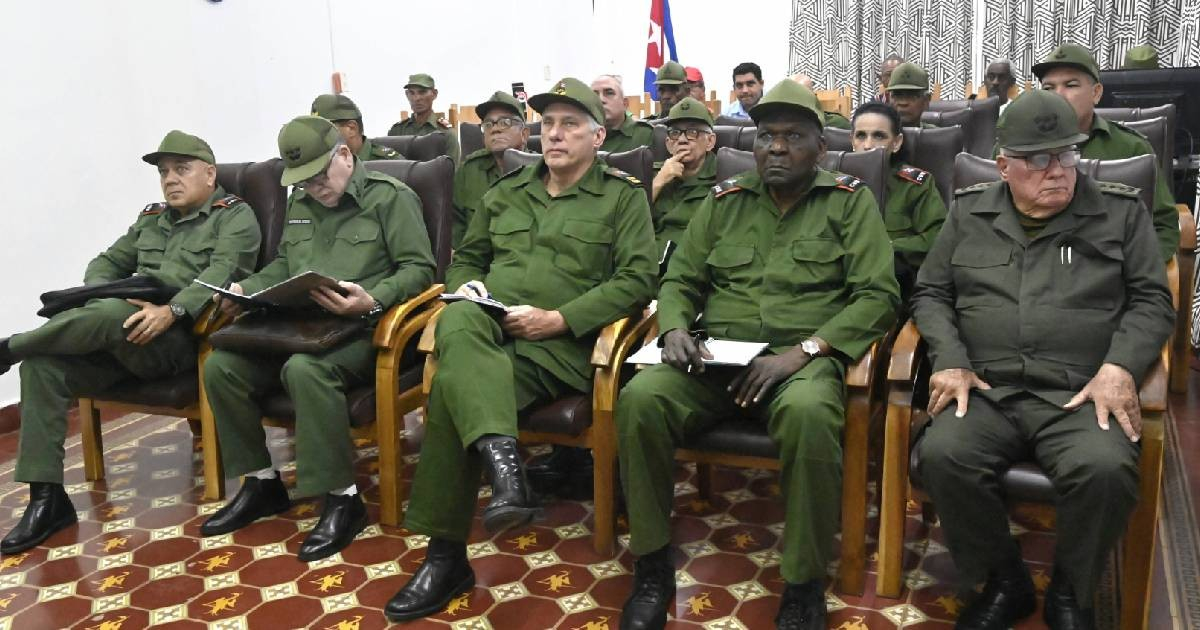
Facing mounting unpopularity and a severe economic and social crisis, Miguel Díaz-Canel once again emphasized the importance of "defense preparedness" on Friday. This concept has long been a cornerstone of the Cuban regime's narrative of an embattled nation.
The president led National Defense Day activities in several Defense Zones in Marianao, Havana, where he reiterated the need for ongoing training of both civilians and members of local defense councils, as reported by the official Cuban Presidency website.
The event brought together prominent figures from the regime's political-military apparatus, including Esteban Lazo Hernández, President of the National Assembly; Roberto Morales Ojeda, Secretary of Organization of the Communist Party's Central Committee; Army Corps Generals Álvaro López Miera, Minister of the Armed Forces, and Lázaro Alberto Álvarez Casas, Minister of the Interior; as well as Division General Amado Ricardo Guerra, Secretary of the Council of Ministers.
Alexis Pérez Batista, President of the Marianao Municipal Defense Council, explained that the activities aim to "enhance preparedness for armed struggle, maintain internal order, and strengthen economic readiness."
For decades, the government has strived to keep the population in a state of perpetual mobilization, with significant segments of civilian life subordinated to military and political structures.
Reinaldo Media Seja, President of the Pogolotti, Belén, Finlay Zone Defense Council, outlined actions planned during the "finalization of comprehensive combative readiness" and the training of council members "against systematic attrition and enemy invasion."
This region, home to over 26,000 residents, combines military preparations with efforts to address everyday issues such as power outages, water supply, food production, and waste management. According to official rhetoric, these measures are part of activating wartime structures.
This approach underscores the regime's strategy of leveraging territorial military structures as a tool for managing the economic crisis affecting the Cuban populace, a crisis stemming from decades of communist dictatorship.
Simultaneously, similar activities were reported in Cienfuegos on the same day, where defense structures were activated and reservists were trained in Aguada de Pasajeros within the Federal Defense Zone.
This Friday marked the eleventh such event personally led by Díaz-Canel in 2026, following similar activities in Arroyo Naranjo, Cerro, Havana del Este, and other regions. On August 1, Díaz-Canel urged young people to use the country's situation as an opportunity for defense training.
The militarization campaign intensified at the start of the year when the regime officially declared 2026 as the "Year of Defense Preparedness" and announced that Saturdays would be devoted to weekly military training for the population, under the doctrine of the "War of All the People."
The regime used the capture of Nicolás Maduro by U.S. forces on January 3, 2026, as a catalyst to reignite its war narrative and justify the accelerated mobilization of civilians, militias, and reservists nationwide.
Understanding Cuba's Defense Preparedness
What is the significance of National Defense Day in Cuba?
National Defense Day in Cuba serves as a platform for the government to emphasize the importance of defense preparedness among civilians and military personnel, highlighting the regime's narrative of an embattled nation.
How does the Cuban regime use military preparedness as a tool?
The Cuban regime utilizes military preparedness as a strategy to manage the ongoing economic crisis and maintain control over the population by integrating civilian life with military structures.
Why was 2026 declared the "Year of Defense Preparedness" in Cuba?
2026 was declared the "Year of Defense Preparedness" to intensify the regime's focus on military training and mobilization of the populace, justified by the geopolitical tensions following Nicolás Maduro's capture by U.S. forces.