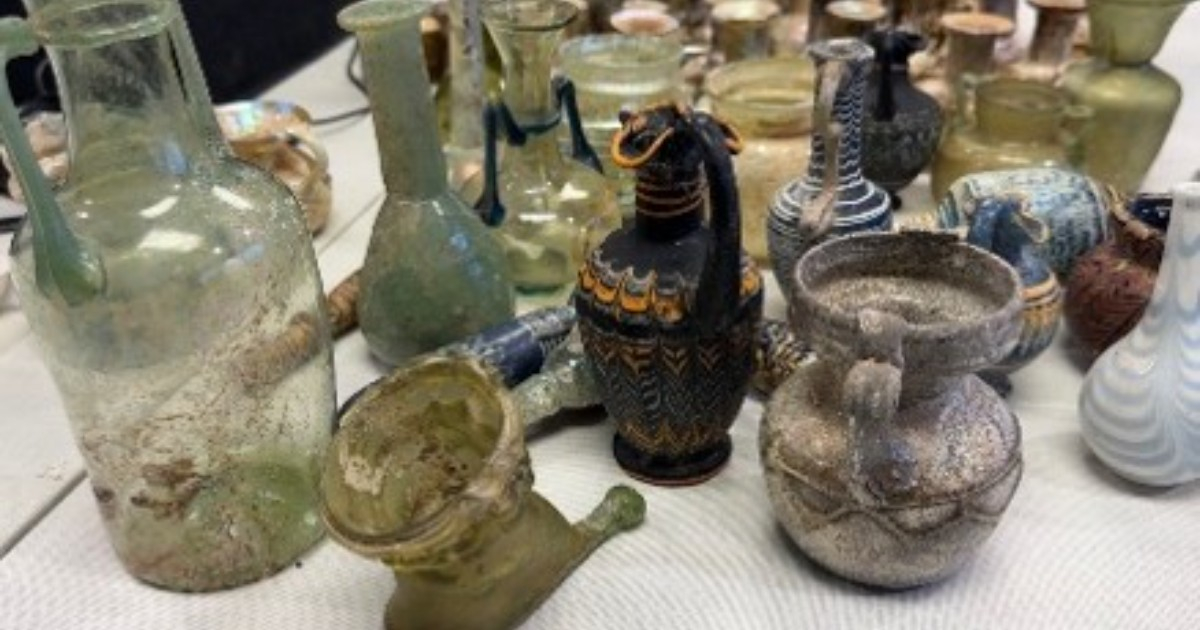
U.S. Immigration and Customs Enforcement (ICE) agents have confiscated over 22,000 ancient artifacts in Florida, marking one of the largest seizures of its kind in the agency's history.
Initial evaluations suggest that some of these items could date back 1,000 to 5,000 years and originate from civilizations in Europe, Africa, the Levant, and the Eastern Mediterranean. The collection includes coins, terracotta vessels, statues, weapons, jewelry, ornaments, and mosaic frames.
The identification and authentication process for such a vast number of pieces is expected to take a significant amount of time.
Throughout the processing week, HSI Tampa collaborated with over a dozen archaeological specialists, joining forces with the University of South Florida and the University of Pennsylvania. These institutions provide expertise in historical analysis and conservation techniques.
The operation was carried out by Tampa's Homeland Security Investigations (HSI) division in partnership with HSI's Cultural Property, Art, and Antiquities Program and the Customs and Border Protection Office.
This seizure is part of an ongoing investigation into global antiquities smuggling networks.
"Preserving cultural heritage is not only about enforcing the law but also about a commitment to history and humanity," stated Micah McCombs, acting special agent in charge of HSI Tampa. "Cultural property trafficking not only robs civilizations of their heritage but also funnels money into transnational criminal organizations, fuels international financial crimes, and in some cases, even funds terrorist activities."
This latest confiscation is not an isolated incident. Last June, HSI Tampa seized more than 12,000 artifacts in the same Tampa area as part of the same investigation. At the time, it was described as potentially the largest operation of its kind in the agency's history.
The new total of 22,000 pieces far surpasses that record, solidifying the case as one of the most significant in the program.
Special agent Leanna Richardson, the lead investigator on the case, eloquently described the experience: "I never imagined I would hold in my hands an object that may have been created over 4,000 years ago. It’s like walking through a museum with your personal archaeologist as a guide, and you can touch everything."
"The artifacts in this case that are authenticated will be one-of-a-kind," noted Mary Cook, senior advisor to the program, "and HSI is committed to taking every necessary step to ensure that the history of a civilization is preserved for future generations."
HSI warns that the black market for antiquities is a highly lucrative and low-risk business compared to drug trafficking, making it an attractive avenue for money laundering and funding criminal organizations.
Unlike narcotics, there is no field test to authenticate antiquities, so the agency relies on university experts to verify each piece.
Since 2007, HSI's Cultural Property, Art, and Antiquities Program has repatriated more than 20,000 objects to over 40 countries and institutions. Recent cases include returning cultural heritage items to Greece, the repatriation of over 135 artifacts in the second quarter of fiscal year 2023, and the recovery of a Picasso painting valued at $15 million.
Key Insights into the Antiquities Seizure in Florida
What makes this seizure significant?
This seizure is one of the largest in ICE’s history, involving over 22,000 artifacts potentially dating back thousands of years, highlighting the extensive global network involved in antiquities smuggling.
Why is the black market for antiquities considered lucrative?
The illicit trade in antiquities is seen as highly profitable and carries lower risks compared to drug trafficking, making it an appealing option for money laundering and supporting criminal enterprises.
How does HSI ensure the authenticity of seized artifacts?
HSI collaborates with university experts for the authentication of artifacts, as there are no field tests like those used for narcotics, relying on scholarly analysis for verification.